
A user enters an address during signup, clicks Create account, and waits. Your product needs to reject obvious typos and disposable addresses, protect sender reputation, keep the form responsive, and avoid sending personal data somewhere your privacy team hasn't approved. A production-ready email verification API has to balance all four.
This comparison focuses on the implementation decisions that matter after the demo: accuracy signals, synchronous latency, explainable outcomes, batch processing, webhooks, SDK availability, pricing mechanics, GDPR and EU residency, and enterprise support. It also separates two workflows that buyers often combine too quickly. Inline verification protects signup and authentication flows, while asynchronous or bulk verification cleans existing lists without holding a user request open.
Verification isn't a binary guarantee. SMTP behavior can be inconclusive, and catch-all domains can accept messages without proving that a specific mailbox exists. Treat verdicts, scores, and reason codes as inputs to a policy, not as permission to reject every uncertain address.
Table of Contents
- 1. Mailbeam
- 2. ZeroBounce
- 3. Bouncer
- 4. Verifalia
- 5. Kickbox
- 6. Mailgun Validate
- 7. Hunter
- Top 7 Email Verification APIs Comparison
- Choose by Workflow, Not Just Verification Score
1. Mailbeam
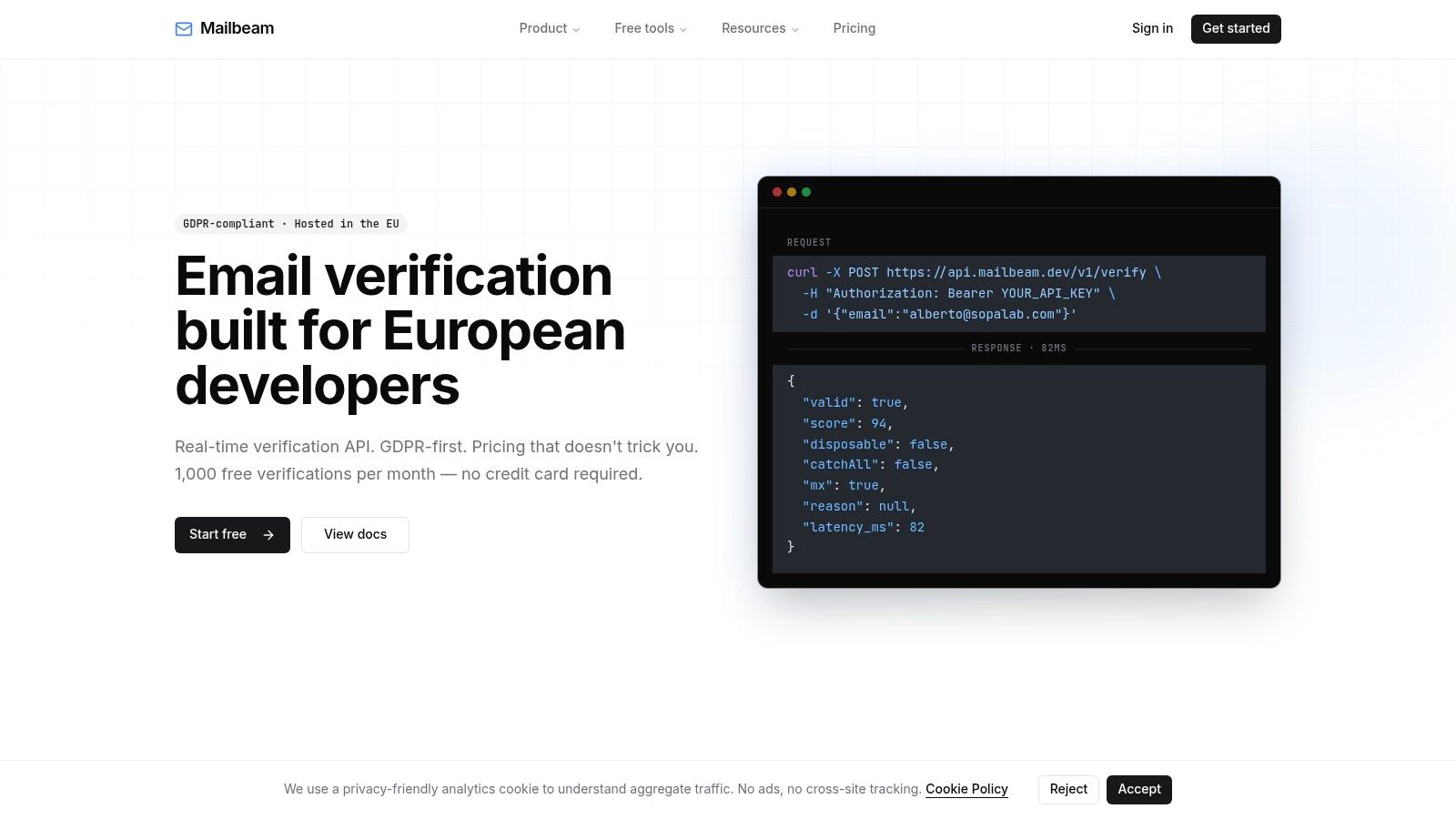
A signup form has little room for uncertainty. It must reject obvious typos without blocking legitimate users, while the product team still needs a reason for each decision and a clear answer about where address data is processed. Mailbeam fits this workflow when EU-only processing and explainable decisions are procurement requirements. Its HTTP API checks syntax, MX records, SMTP existence, disposable domains, role accounts, free providers, catch-all behavior, and related signals. The response includes a boolean validity result, a 0–100 quality score, and a machine-readable reason code, giving engineers more policy options than a single valid-or-invalid field.
The latency profile supports inline use. Cached or DNS-only checks take approximately 80 milliseconds, while full SMTP probes complete in under one second, according to the supplied product data. A synchronous request can therefore handle many form submissions, but uncertain SMTP outcomes should not automatically block the user. A timeout or inconclusive result can move the address into email confirmation, delayed review, or a cautious fail-open policy, depending on account risk.
Why the output matters in a signup flow
Reason codes let product teams define consistent actions. A syntax error can prompt correction immediately. A disposable-domain result can block registration. Catch-all and unknown outcomes can request confirmation instead of producing a false negative. Support teams also gain a usable explanation when a customer asks why an address was challenged.
Mailbeam supports CSV uploads, asynchronous bulk cleaning, and webhooks that send results to CRMs or internal event pipelines. Its documented compliance model places infrastructure in Frankfurt, keeps verification processing in the EU, deletes single-verification data after processing, and removes batch uploads after roughly 72 hours, based on the supplied product information.
Practical rule: Use the fast path for clear DNS and syntax decisions. Give inconclusive SMTP and catch-all results their own state rather than silently treating them as “invalid.”
Pricing and buyer fit
The supplied plan notes list 1,000 free verifications per month, a Growth plan at €49 per month for 50,000 verifications, and a Scale plan at €499 per month for 1,000,000 verifications. They also describe pay-as-you-go billing at €0.001 per verification, including an example of €10 for 10,000 verifications. This pricing structure avoids credit bundles, hidden multipliers, and expiring verification packs, though paid-plan usage does not roll over.
The main trade-off is integration readiness. Official Node.js, Python, PHP, Ruby, and Go SDKs are planned, so current implementations rely on the HTTP API and examples. Full SMTP checks can take longer than cached checks, and some mail servers leave mailbox existence inconclusive. EU SaaS, fintech, regulated products, agencies, and platforms can consider the service where transparent billing and explainable gating matter. Teams requiring released SDKs at launch should test the API, error handling, and internal wrapper effort during procurement.
2. ZeroBounce
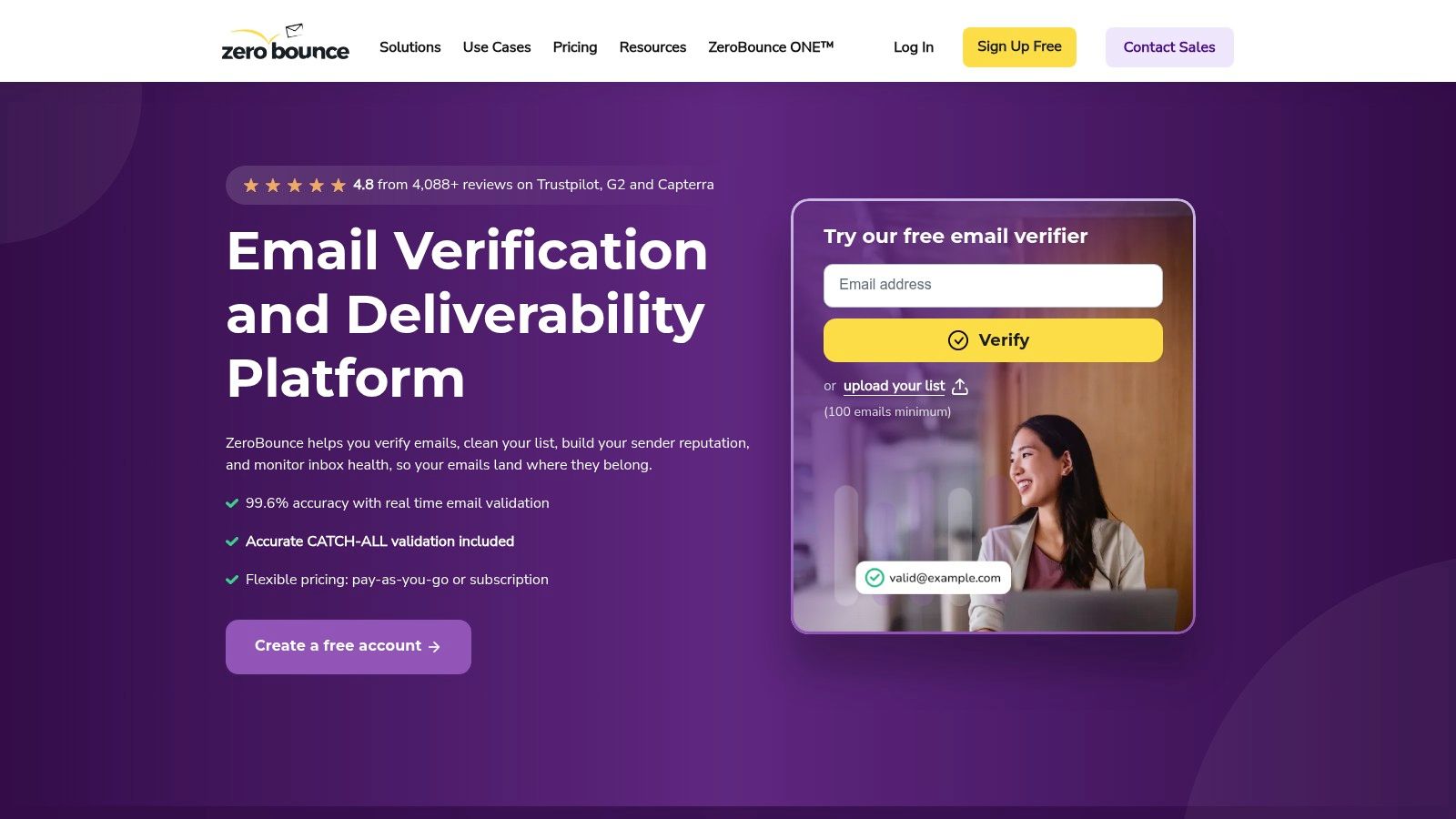
ZeroBounce suits teams that need address verification alongside deliverability operations. Its real-time and bulk APIs return detailed statuses and reason codes, while related tools cover Activity Data, inbox placement, and server testing. The result is a broader operating model than a signup-only endpoint, particularly for marketing operations and deliverability teams.
ZeroBounce also offers an EU endpoint and a data processing agreement. Those options do not, by themselves, establish EU-only processing for every workflow. Procurement teams should verify the selected endpoint, retention rules, subprocessors, and contractual coverage before approval.
Where it fits operationally
ZeroBounce supports both synchronous and asynchronous workflows. A product can call the real-time API during signup, while operations teams process larger lists separately. Detailed statuses and reason codes distinguish invalid, disposable, catch-all, and unknown outcomes. That separation gives product engineers more control over signup policy, especially when an SMTP server cannot confirm mailbox existence.
Integration coverage can reduce implementation work for teams connecting verification to marketing automation, CRM, or sending systems. The supplied product notes describe more than 50 native integrations and 24/7 support, both documented on ZeroBounce. Buyers should still test authentication, error handling, webhook or batch requirements, and ownership of custom mappings before committing.
Teams migrating from Mailbeam can use the Mailbeam migration guide for ZeroBounce to review field mappings before changing production logic.
Pricing mechanics
ZeroBounce uses credits. The supplied information says unknown results and duplicates do not consume credits, while free accounts include 100 free monthly validations, as described by ZeroBounce. That policy can limit waste in uncertain or repetitive lists. Optional AI Scoring and deliverability diagnostics may use additional credits, and volume discounts favor larger purchases. Irregular, low-volume demand may therefore require closer cost modeling.
ZeroBounce fits organizations that value broad integrations, explainable outcomes, support coverage, and adjacent deliverability testing. A simpler per-verification model, strict EU-only processing, or a minimal signup endpoint may point procurement teams elsewhere.
3. Bouncer
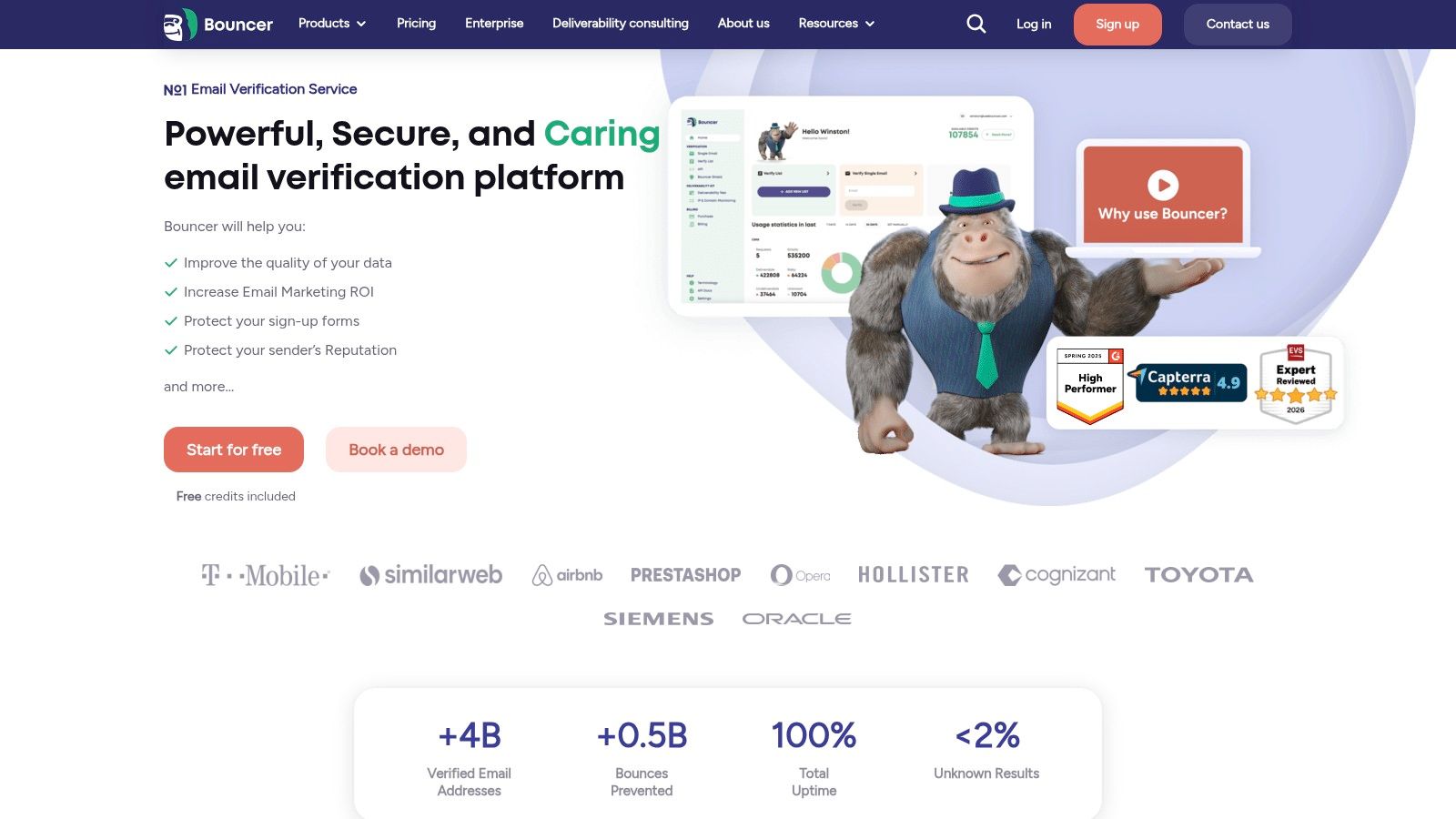
Bouncer combines EU-based hosting in Poland, live verification, bulk list cleaning, and the inline Bouncer Shield form product. This positions it between a developer API and an operations tool. A product can call the live verification endpoint during capture, while growth teams clean existing lists without creating a separate internal workflow.
Its credit policy changes the cost calculation for uneven demand. Credits do not expire, and the supplied product notes state that unknown results and duplicates are not charged, as documented by Bouncer. Unused capacity can therefore remain available for a later campaign instead of disappearing at the end of a billing period.
The useful trade-off
Bouncer's EU hosting and GDPR focus suit European buyers that need a regional processing posture. Its developer documentation and form widget can also reduce custom browser and backend work for inline validation. That matters to smaller product teams that need signup protection without operating a verification service themselves.
The product scope is narrower than a full deliverability platform. Features such as inbox testing sit outside the core verifier, so procurement teams should compare address quality and sender-placement diagnostics as separate requirements rather than treating them as one capability.
Teams replacing Mailbeam can consult the Mailbeam migration guide for Bouncer, especially when existing logic depends on reason fields or catch-all handling.
Best deployment pattern
Use the live API for high-intent actions such as signup, account recovery, or invitation acceptance. Use bulk cleaning for dormant contacts and imported data, and retain uncertain states instead of deleting them automatically. Bouncer fits buyers that value non-expiring credits, EU hosting, and a form-oriented workflow more than an extensive deliverability suite.
4. Verifalia
Verifalia is designed for buyers that must balance validation depth against response time. Its Standard, High, and Extreme levels let teams choose how much processing an address receives. Higher levels consume more credits per email, making the cost of deeper checks visible rather than burying it in a single verdict.
That structure fits asynchronous list hygiene better than every signup flow. A routine import can use Standard validation, while a high-value or compliance-sensitive list may justify additional processing. Product engineers should be cautious about applying the deepest tier directly to registration, where SMTP and anti-greylisting checks can add latency and create a poor user experience.
Asynchronous work is a first-class concern
Callbacks and webhooks support asynchronous jobs, with polling available as another option. Engineers can submit a file, store its job identifier, and process results after completion instead of holding a browser request open. This architecture is better suited to large files and deeper validation levels, particularly when the application needs durable retries and review of uncertain outcomes.
Verifalia's open-source SDKs cover .NET, Go, Java, JavaScript, PHP, and Ruby, according to the supplied product information. That breadth can reduce initial integration work for polyglot organizations. It does not remove the need to test provider-specific behavior, including failed requests, retries, timeouts, webhook authentication, and result persistence.
Who should choose it
Verifalia suits procurement teams seeking EU hosting, granular metadata, configurable validation quality, and pay-as-you-go credits. The trade-off is operational: deeper checks may be inappropriate for a low-latency signup gate. A split design is more defensible. Use a fast, conservative decision during registration, then reserve deeper validation for imported lists, campaign preparation, or manual review queues.
This separation also makes pricing easier to govern. Engineering can assign higher validation levels only where the expected reduction in uncertainty justifies additional credit use, while procurement can compare predictable list-cleaning costs with the latency requirements of synchronous product flows.
5. Kickbox
Kickbox is a familiar option for teams that prioritize a clear developer workflow. Its API supports single and batch verification, returns deliverable, undeliverable, risky, and unknown categories, and exposes reason codes and quality signals such as role, disposable, free-provider, and accept-all flags. That vocabulary gives product engineers enough structure to build more nuanced policies than a simple rejection rule.
Kickbox also supplies SDKs, Postman collections, sandbox and testing options, and support for high-volume batch jobs. Those details matter during implementation because the first production problem is rarely the happy-path request. Teams need to know how authentication failures, malformed input, throttling, retries, and unknown results behave before they place the API in front of users.
A balanced implementation profile
Kickbox sits comfortably between inline verification and list cleaning. Its stated focus on speed and developer usability suits signup checks, while batch processing and CRM or marketing-platform integrations support ongoing hygiene. The quality score can feed internal risk logic, but teams should define their own treatment of risky and unknown addresses instead of assuming the vendor's label maps directly to a business decision.
The pricing caveat is important. Public pricing references can vary by region, and the supplied notes describe a primarily credit-pack model. That means procurement should model expected volume, unused credits, rechecks, and batch retries rather than comparing only the headline pack price.
A score isn't a policy. Decide which outcomes are accepted, challenged, delayed, or blocked before connecting the verifier to account creation.
Kickbox is most suitable for organizations that value established API documentation, SDK support, test tooling, and a conventional verification workflow. It may be less attractive when a buyer requires transparent per-verification billing without credit planning or needs a clearly documented EU-only residency model.
6. Mailgun Validate
Mailgun Validate makes the most sense for teams already using Mailgun for sending. It provides real-time address validation, bulk CSV checks, EU API availability, and close integration with Mailgun's sending, analytics, and deliverability tooling. A single vendor can therefore cover validation and message delivery, which simplifies authentication, billing, operational ownership, and support escalation.
That convenience comes with coupling. Validation pricing is tied to the Mailgun plan and overage structure, so a team using the API without Mailgun sending may find the commercial model less straightforward than a standalone verifier. Procurement should separate the value of vendor consolidation from the actual cost of validation at expected signup and list-cleaning volumes.
Sending-stack alignment
The strongest argument for Mailgun Validate isn't necessarily a richer standalone verification experience. It's the reduced distance between the validation decision and the sending system. If the same team owns transactional email, campaign delivery, analytics, and address quality, shared tooling can simplify incident response and make it easier to connect invalid signups with later bounce behavior.
Teams should still verify whether the required deliverability features are included in Validate or belong to other Mailgun products, such as Optimize. That distinction affects both architecture and budget.
The buyer decision
Select Mailgun Validate when Mailgun is already central to the delivery stack and unified billing has operational value. Evaluate a dedicated provider instead when the product needs vendor-neutral verification, an API-only deployment, or a pricing model that doesn't depend on a sending plan. The EU endpoint is relevant for regional processing, but legal and security teams should confirm the exact data-handling terms for the chosen configuration.
7. Hunter
Hunter fits teams that combine email discovery with verification. Its Email Verifier API uses a GET endpoint for individual addresses and returns status, score, and metadata. The flow suits enrichment operations: find a professional address, check it, then pass the result to sales or CRM automation.
The implementation trade-off is batch handling. The supplied product notes describe an individual-email endpoint rather than a multi-email POST batch call. Teams processing large lists may therefore need their own queue, concurrency controls, and result aggregation. Hunter documents rate limits and credit usage, and provides examples plus a test key, giving engineers a way to test the integration before selecting a plan.
One vendor, two related jobs
Hunter's main advantage is consolidation. Sales development, recruiting, and enrichment teams can discover contacts and verify addresses in one platform instead of coordinating separate vendors. Fewer integrations can simplify ownership, while procurement still needs to model verification demand separately from Finder usage.
On standard plans, verification consumes 0.5 credits per email, according to the supplied plan notes. That unit cost matters when teams assess the combined platform rather than verification alone. Heavy Finder usage can also make total credit requirements less predictable than a standalone service priced per verification.
Teams migrating from Hunter can use the Mailbeam migration guide for Hunter to map endpoint responses and workflow assumptions.
Hunter is a practical choice when discovery and verification belong to one data operation. Product teams seeking batch-first processing, EU-residency-led signup verification, independent billing, or extensive asynchronous list-cleaning controls should compare it with providers designed around those requirements.
Top 7 Email Verification APIs Comparison
| Service | Implementation complexity 🔄 | Resource requirements ⚡ | Expected outcomes ⭐ | Ideal use cases 💡 | Key advantages 📊 |
|---|---|---|---|---|---|
| Mailbeam | Low 🔄, simple HTTP API for sync and async flows (SDKs planned) | Efficient ⚡, pay-as-you-go or plans; low latency (≈80 ms DNS; <1 s SMTP) | ⭐⭐⭐⭐, explainable 0–100 score + reason codes for deterministic gating | Product engineers embedding verification into signups, EU/GDPR-sensitive apps | EU-hosted DPA, explainable scoring, transparent per-verification pricing |
| ZeroBounce | Moderate 🔄, real-time & bulk APIs; many features add integration steps | Credit-based ⚡, credits model; 100 free/mo; extras may consume credits | ⭐⭐⭐⭐, mature validation + deliverability extras (inbox tests, activity data) | Teams needing deliverability diagnostics and broad integrations | Broad integrations, 24/7 support, EU endpoint & DPA available |
| Bouncer | Low 🔄, straightforward API and on-form widget for inline checks | Credit packs ⚡, non-expiring credits; small entry packs available | ⭐⭐⭐, reliable real-time checks with quick responses | SMBs and EU teams wanting simple, pay-per-use verification | Clear pricing, strong EU/GDPR posture, on-form widget |
| Verifalia | Moderate–High 🔄, multiple quality tiers and async/webhook flows | Variable ⚡, pay-as-you-go credits never expire; higher tiers cost more credits | ⭐⭐⭐⭐–⭐⭐⭐⭐⭐, configurable deep passes for higher accuracy | Bulk cleaning and workflows needing tunable accuracy vs speed | Multiple quality tiers, open-source SDKs, detailed metadata |
| Kickbox | Low 🔄, developer-friendly API and SDKs; sandbox/testing available | Credit packs ⚡, supports high-volume batch jobs; planning needed for credits | ⭐⭐⭐, balanced accuracy and speed suitable for inline checks | Teams needing stable in-flow validation and developer examples | Stable latency, clear docs, good for signup gating and hygiene |
| Mailgun Validate | Moderate 🔄, integrates with Mailgun stack; standalone use is possible | Tied to Mailgun plans ⚡, validation pricing linked to Mailgun overages | ⭐⭐⭐, convenient when centralizing send + validate with Mailgun | Teams already using Mailgun for sending and deliverability | Unified send+validate platform, predictable plan overages |
| Hunter (Verifier) | Low 🔄, simple GET endpoint; no multi-email POST on standard plans | Credit/subscription ⚡, credits per verification; integrated with Finder | ⭐⭐⭐, useful combined discovery+verification workflow | Workflows needing both email finding and verification under one vendor | One vendor for discovery + verification, clear docs and test key |
Choose by Workflow, Not Just Verification Score
The best email verification API depends on the decision your system must make, not on a single accuracy label. A signup product needs fast responses, stable timeouts, clear reasons, and an explicit policy for catch-all, unknown, greylisted, and temporarily unavailable results. A marketing operations team cleaning a dormant list cares more about asynchronous jobs, webhooks, export quality, retries, and predictable batch economics. Those are related requirements, but they aren't interchangeable.
Choose Mailbeam when EU-only processing, explainable signup decisions, low latency, and transparent per-verification billing are central. Its combination of parallel checks, reason codes, batch workflows, webhooks, and GDPR-first retention makes it particularly relevant to European SaaS, fintech, and regulated product teams. Choose ZeroBounce when you need a mature validation suite, broad integrations, and adjacent deliverability diagnostics. Bouncer is a strong alternative when EU hosting and non-expiring credits matter most.
For deeper quality tuning and SDK coverage, evaluate Verifalia. Its configurable validation levels suit teams willing to trade speed and credit consumption for additional processing depth. Kickbox fits established developer workflows that need single and batch APIs, SDKs, testing resources, and conventional risk categories. Mailgun Validate is the practical choice for organizations already committed to Mailgun sending, especially when unified vendor ownership reduces operational work. Hunter belongs on the shortlist when discovery and verification need to remain in one enrichment workflow.
Before procurement, run a controlled evaluation with representative addresses from your actual markets and user journeys. Measure synchronous latency, timeout behavior, reason-code stability, and the share of inconclusive results. Confirm data retention, processing location, subprocessors, DPA terms, and any distinction between an EU endpoint and guaranteed EU residency.
Then model the commercial reality. Include signup traffic, retries, re-verification, duplicate handling, batch cleaning, credit expiry, overages, and the cost of keeping uncertain addresses in a manual-review or confirmation path. Finally, test webhook delivery, SDK coverage, batch limits, support response, SLA language, API-key controls, and failure behavior. The provider that produces the strongest demo verdict isn't necessarily the one that creates the safest production system.
Mailbeam offers a GDPR-first, EU-hosted email verification API with low-latency checks, explainable scores, reason codes, batch processing, and webhooks for signup and list-hygiene workflows. Visit Mailbeam to evaluate a transparent per-verification model and see whether its EU-only processing fits your product and procurement requirements.