
“Free” is one of the least useful words in email verification API free searches. A permanent quota may support a prototype, while trial credits may be better for cleaning one list, and neither necessarily belongs in a live registration flow. The relevant question is whether the service gives you enough allowance, predictable credit rules, synchronous latency, useful reason codes, appropriate verification depth, clear API behavior, and acceptable GDPR and data-residency terms.
This comparison separates those workloads. The ten tools cover developer prototypes, growth operations, bulk list hygiene, and production signup protection. A market report values the global email validation API market at $1.4 billion in 2025 and projects $3.8 billion by 2034, with a projected 11.7% compound annual growth rate from 2026 to 2034 (market forecast for email validation APIs). That scale makes implementation details more important than a “free” badge.
Use the reviews to narrow the field first. Then test representative addresses in your own form flow, especially disposable, role-based, catch-all, and temporarily unavailable cases. For broader B2B context, see this guide to email verification for B2B teams.
Table of Contents
- 1. Mailbeam
- 2. ZeroBounce
- 3. Hunter
- 4. Emailable
- 5. Bouncer
- 6. Verifalia
- 7. AbstractAPI Email Validation API
- 8. mailboxlayer
- 9. Kickbox
- 10. MillionVerifier
- Top 10 Free Email Verification APIs, Quick Comparison
- Choose by Workflow, Not Free Credits
1. Mailbeam
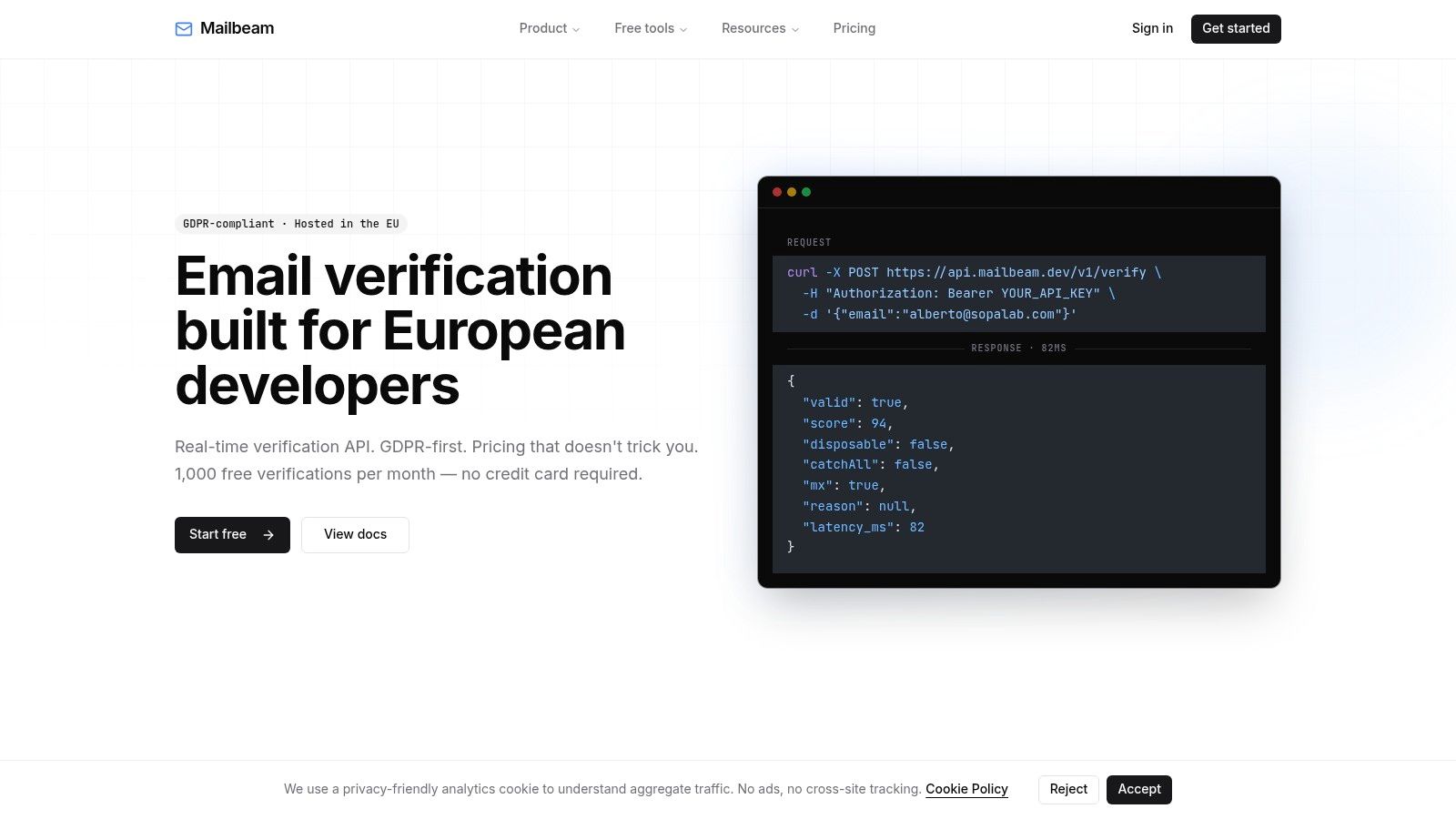
Mailbeam is the strongest fit here when real-time signup validation, explainability, and EU handling matter more than a large ecosystem. Its HTTP API returns a validity boolean, a 0–100 quality score, and machine-readable reason codes, giving product teams something more useful than a bare valid or invalid response. Those reasons can drive deterministic rules, such as blocking disposable addresses, warning about role accounts, or deferring uncertain catch-all results.
The service runs parallel checks for syntax, MX records, SMTP existence, disposable domains, role-based addresses, free providers, and catch-all behavior. Cached or DNS-only lookups are approximately 80 ms, while full SMTP probes take under one second, according to Mailbeam's supplied product information. That makes it suitable for synchronous form validation, although teams should still measure p95 behavior in their own geography and network path.
Why the free allowance matters
Mailbeam provides 1,000 free verifications per month without requiring a credit card. That's an ongoing allowance, not merely an evaluation balance, so it's more useful for prototypes, internal tools, and light signup traffic. It won't cover a high-volume consumer registration flow, and paid quotas don't roll over.
Pricing is stated per verification, without credits, multipliers, or expiring bundles. The Growth plan is €49 per month for 50,000 verifications, while Scale is €499 per month for 1,000,000 verifications, with higher service levels and support on the upper tier. These plan details may change, so confirm them on the Mailbeam website before procurement.
Where it reduces implementation risk
Mailbeam's infrastructure is hosted in Frankfurt within the European Union, with a default Data Processing Addendum. Single verifications aren't retained after completion, and batch uploads are automatically deleted after roughly 72 hours, according to the supplied product information. That combination is particularly relevant for EU SaaS, fintech, and regulated teams that need to document processing and retention rather than infer them from a vendor's location.
The trade-off is developer maturity. HTTP examples and reference documentation are available, while official SDKs for Node.js, Python, PHP, Ruby, and Go are planned rather than generally available. For teams comfortable with REST, that's a manageable limitation. For teams requiring a mature SDK ecosystem, it deserves a place in the evaluation criteria.
2. ZeroBounce
ZeroBounce is a mature choice for teams that need both bulk cleaning and real-time verification. Its API and bulk endpoints return multiple statuses and sub-statuses, including catch-all and disposable outcomes, so operations teams can create more nuanced rules than a simple binary filter.
The ongoing free allowance is useful for development and low-volume testing. That distinction matters because a recurring allowance lets engineers observe behavior over time, while one-time credits only answer whether an integration works on a selected sample. ZeroBounce also offers documentation, integrations, SDK support, and EU API endpoint options, which can reduce integration work for an established marketing stack.
Its weakness is proportional complexity. A broad martech ecosystem helps a team that already uses adjacent email tools, but it can make a simple signup check harder to reason about. Volume-tiered pricing may also be less attractive for small or medium workloads than a narrowly focused API with straightforward per-verification billing.
For migration planning, compare response fields and status mapping rather than assuming the two services use identical semantics. Mailbeam provides a dedicated ZeroBounce migration guide, which can help teams identify the integration differences before changing providers. Treat EU processing, retention, and endpoint configuration as procurement questions to verify in current documentation.
3. Hunter
Hunter makes sense when verification sits beside email discovery and prospecting. Its Email Verifier API and bulk verification features share a credit system with Finder and Domain Search, allowing growth teams to find an address and validate it within one platform.
The model is easy to start but less easy to forecast. A verification consumes 0.5 credit, while failed or unknown verifications don't consume credits under the supplied plan notes. That rule can protect a small evaluation budget, but the shared balance means product teams must distinguish verification usage from discovery usage when estimating capacity.
Hunter's documentation and help center are strengths. An engineering team can usually get a basic request working quickly, and sales users may prefer one account rather than separate discovery and verification products. The platform is less compelling when verification is the only requirement, because its broader workflow introduces features and metering that a signup service doesn't need.
For a registration form, pay attention to the returned reason detail and the handling of uncertain results. A user who mistypes an address needs a corrective message, while a catch-all or temporarily unavailable response may deserve a retry rather than rejection. Hunter can be a practical fit for growth teams already invested in its ecosystem, but teams choosing a pure verification API should compare the total credit model, not just the entry-level allowance.
4. Emailable
Emailable is oriented toward teams that want a developer-friendly API with bulk cleaning, widgets, and workflow integrations. Its most useful commercial behavior is that unknown results and duplicates are refunded, which prevents ambiguous or repeated records from consuming the same budget as actionable checks.
That approach is valuable during a trial. A test list often contains duplicates and addresses that mail servers won't classify confidently. If those outcomes are refunded, a team can learn more from its allowance before paying for additional processing. Emailable also states that credits never expire, which makes unused capacity more practical for intermittent projects.
The platform is suitable for signup forms, but its strongest differentiation is operational convenience rather than EU-first processing. The supplied notes describe it as primarily US-based and don't identify an explicit EU-only processing option. EU organizations should therefore confirm processing locations, subprocessors, retention, deletion, and transfer mechanisms before sending identifiable production addresses.
A useful implementation test is to send the same representative sample through the API and widget, then compare their status and error behavior. Product teams should also check whether unknown outcomes can be routed to a retry queue instead of presented as a hard failure. Emailable is a sensible option for small projects that value fair charging rules and integrations, but data handling needs more scrutiny for EU-sensitive workloads.
5. Bouncer
Bouncer targets teams that prioritize verification quality and fair credit accounting. Its real-time API and bulk endpoints support both signup protection and offline list cleaning, while unknown results and duplicates aren't charged under the supplied plan notes.
That charging policy changes the economics of testing. A verifier that bills only actionable outcomes gives teams a clearer view of useful consumption, especially when mail servers return uncertain responses. Bouncer also offers 100 free credits to start, transparent pay-as-you-go credits that don't expire, and developer documentation.
The free allocation is best treated as an integration and sample-testing budget, not a permanent production capacity plan. For a live form, the key question is whether the allowance and rate limits match actual registration volume. For list cleaning, pay-as-you-go credits can be more appropriate because the workload arrives in periodic batches rather than one address at a time.
Bouncer's feature set remains centered on verification. Teams seeking broader deliverability monitoring or campaign controls may need adjacent products. It also shouldn't be selected for EU processing solely because the company is associated with Europe. Confirm the current DPA, subprocessors, processing regions, transfer mechanisms, retention, and deletion terms directly before procurement.
6. Verifalia
Verifalia stands out for letting users choose validation depth. Its Standard, High, and Extreme quality levels provide an explicit way to trade verification thoroughness against processing cost and speed, especially for mail hosts that are difficult to classify.
That control is useful for mixed workloads. A signup form usually needs a responsive decision and a clear fallback for uncertain responses. A quarterly list-cleaning job can afford deeper checks where the value of reducing undeliverable records justifies additional processing. Verifalia's SDKs and webhook callbacks also support asynchronous batch workflows instead of forcing every operation into a synchronous request.
The free plan offers daily credits, up to 25 per day, with best-effort speed according to the supplied notes. Higher quality levels consume multiple credits per address, so the headline allowance can overstate practical capacity if every address requires the deepest check. This is a good example of why buyers should read credit rules alongside the free quota.
Verifalia is strongest for technical teams that want to control depth and understand the processing model. It's less suitable when a product team needs a consistently fast free tier for live signup gating. Before integrating it into a form, measure timeout behavior, decide how to handle pending results, and ensure the API's quality-level semantics map cleanly to your user-facing policy.
7. AbstractAPI Email Validation API
AbstractAPI Email Validation API is a clean option for developers who want a pure API experience and permanent free access. The Email Validation API provides risk and deliverability signals, domain and sender information, and the full API response on the free plan.
The allowance is 100 requests per month, so it's appropriate for documentation examples, prototypes, and low-frequency internal validation rather than a busy production registration flow. AbstractAPI meters its email, phone, IP, and other APIs separately, which is easier to understand than a shared credit pool. The trade-off is that rate limits and monthly quotas become relevant quickly once a product moves beyond testing.
A product engineer should inspect the response schema before designing account rules. A risk signal can support a decision, but it may not explain the decision as directly as a dedicated reason-code system. If the API distinguishes disposable, catch-all, and uncertain outcomes, those fields should be mapped to separate policies. If it doesn't, the application may need a conservative fallback that protects deliverability without rejecting legitimate users.
For teams comparing developer APIs, the email verification API comparison offers another implementation-oriented reference point. AbstractAPI's advantage is simplicity and a self-serve onboarding path. Its limitation is scope. It's primarily a validation and risk API, not a complete deliverability operations suite, so bulk hygiene, retention, and residency requirements require careful review.
8. mailboxlayer
mailboxlayer suits lightweight integrations that need JSON signals for syntax, typo, MX, SMTP, disposable, and free-provider checks. Its quality score adds a decision layer beyond a simple pass or fail, allowing an application to accept, warn, or queue an address.
The permanent free plan provides 100 requests per month, useful for testing and hobby projects. A free email validation service overview can help compare that ongoing allowance with trial-credit models. The supplied plan notes describe limits on volume and features, plus non-commercial use, so teams should review current terms before treating it as a production dependency. HTTPS is available on paid tiers, which matters when a live form sends addresses to the API.
The implementation is relatively small. A backend can authenticate, call the endpoint, inspect usage, and map the response into signup rules without adopting a broader marketing platform. Synchronous latency, timeout behavior, and retry handling still need testing in the actual registration flow. Offline list cleaning has different requirements, especially around throughput and quota consumption.
The narrow scope is also the main limitation. The supplied notes do not position mailboxlayer around enterprise SLAs or extensive deliverability operations. A quality score may offer less explanation than explicit reason codes when support or compliance teams review a decision. Commercial users should confirm usage rights, transport security, processing location, retention, and quota behavior, including whether EU residency is available. For signup protection, it is a practical starting point. For bulk hygiene, verify capacity and response detail first.
9. Kickbox
Kickbox is a recognized option for teams that want an established verifier with real-time and bulk workflows. Its API returns deliverable, undeliverable, risky, and unknown statuses alongside a quality score, giving marketing and product teams a familiar set of routing choices.
The free access is trial-based rather than an ongoing allowance. The supplied notes describe about 100 verification credits at signup, which is enough to test latency, schema handling, and accuracy on a representative sample, but not to support continuing production traffic. That makes Kickbox better for vendor evaluation than for a small application that needs free validation month after month.
SDKs for major languages and broad ecosystem presence can reduce implementation friction. The main question is whether the returned statuses are actionable enough for your flow. “Unknown” may combine several causes, including catch-all behavior or a temporary mail-server response, so don't automatically reject every address in that category.
Kickbox fits teams that value brand familiarity, stable integrations, and a straightforward trial. It's less attractive when EU-only processing is mandatory or when the business needs a recurring free quota. Measure the API in the actual signup path, including timeouts and retries, rather than assuming bulk-tool behavior will translate directly to synchronous registration.
10. MillionVerifier
MillionVerifier is built around API access, bulk processing, and low-cost volume evaluation. It offers trial-credit options, including 500 credits with a business email under the supplied plan notes, plus pay-as-you-go credit packs with volume discounts.
That structure favors a one-time list-cleaning project or a team that wants to test a sizeable sample before committing. It's less useful for a product that needs a recurring allowance because the free access is trial-based rather than a monthly freemium quota. Once the trial ends, the buyer needs to model ongoing consumption and whether credits expire or apply differently to uncertain outcomes.
The API is described as straightforward, with endpoints for verification and usage checks. That can be enough for an internal pipeline, particularly when the main workload is asynchronous CSV processing. For signup protection, engineers should test response consistency and timeout behavior under real form conditions, then define what the application does when the service can't reach a recipient mail server.
MillionVerifier's advantage is evaluation flexibility and aggressive volume pricing. Its disadvantage is a smaller set of developer and deliverability extras than larger suites. It's a practical candidate for bulk hygiene and price-sensitive operations, but regulated teams should separately verify data handling, residency, retention, and contractual terms before uploading contact data.
Top 10 Free Email Verification APIs, Quick Comparison
| Provider | Key features | Quality & UX ★ | Pricing / Value 💰 | Target audience 👥 | Unique selling points ✨ |
|---|---|---|---|---|---|
| 🏆 Mailbeam | Real-time HTTP API + web tools; 8 parallel checks (syntax, MX, SMTP, disposable, role, free, catch-all); webhooks; batch CSV | ★★★★★, low latency (~80ms DNS; <1s SMTP); explainable 0–100 score & reason codes | 💰 1,000 free/mo; Growth €49 (50k); Scale €499 (1M); transparent per-verification | 👥 Product engineers, GDPR-sensitive SaaS/fintech, growth ops, agencies | ✨ EU-hosted (Frankfurt) & DPA by default; GDPR-native deletion; deterministic reason codes |
| ZeroBounce | Real-time API + bulk; status/sub-statuses; SDKs | ★★★★☆, mature, stable; good accuracy | 💰 Freemium credits; volume-tiered pricing (not cheapest at mid-scale) | 👥 Marketers, large martech stacks, teams needing broad integrations | ✨ Established ecosystem; broad integrations and docs |
| Hunter | Finder + Verifier integrated; bulk & API (0.5 credit/verif.) | ★★★★☆, easy UX for outreach workflows | 💰 Free limited credits; unified credit model across features | 👥 Sales/growth teams running discovery + outreach | ✨ Combined discovery + verification in one platform |
| Emailable | Real-time API, bulk, widgets; refunds for unknowns/duplicates | ★★★★☆, developer-friendly; predictable results | 💰 250 free start credits; credits never expire; refunds reduce waste | 👥 Devs, small teams testing verification | ✨ Refunds for unknowns/duplicates; predictable billing |
| Bouncer | Real-time API + bulk; clear charging rules | ★★★★☆, lightweight integration; accurate | 💰 100 free credits start; pay-as-you-go credits never expire; competitive at volume | 👥 Developers and volume-focused teams | ✨ Doesn't charge for "unknowns"; fair unit pricing |
| Verifalia | Real-time + bulk; quality-level controls (Std/High/Extreme); SDKs | ★★★★☆, granular depth control; documented | 💰 Daily free credits (up to ~25/day); deeper checks consume more credits | 👥 Teams needing custom validation depth; QA-heavy use | ✨ Multi-tier quality levels for hard hosts; webhooks & SDKs |
| AbstractAPI – Email Validation | Risk/deliverability signals; full response on free tier | ★★★★☆, pure API focus; clear docs | 💰 Permanent free tier (100/mo); simple metering | 👥 Developers who want a straightforward API | ✨ Permanent free tier; part of multi-API suite (IP/phone/etc.) |
| mailboxlayer (APILayer) | Syntax, typo, MX, SMTP, disposable checks; score | ★★★★☆, simple, fast; good for prototyping | 💰 Permanent free (100/mo) for testing; paid tiers for SSL/rate | 👥 Hobbyists, small projects, quick prototypes | ✨ Lightweight JSON API; easy integration; free tier for devs |
| Kickbox | Real-time API + bulk; quality score & statuses | ★★★★☆, proven accuracy & stability | 💰 Free trial credits (~100); paid per-credit (trial-only free) | 👥 Email marketers and ESP integrations | ✨ Recognized brand; reliable deliverability performance |
| MillionVerifier | Real-time API + bulk; trial credits and volume packs | ★★★★☆, budget-friendly accuracy at scale | 💰 Trial credits (e.g., 500); aggressive discounts on large packs | 👥 Budget-conscious teams needing high-volume checks | ✨ Strong volume discounts; multiple trial options |
Choose by Workflow, Not Free Credits
The right free email verification API depends on the work your system must perform. A prototype can benefit from a permanent monthly quota and simple JSON responses. A one-time list-cleaning project may get more value from trial credits or pay-as-you-go packs. A signup form needs a responsive synchronous endpoint, predictable timeout behavior, and reason codes that let the product distinguish a typo from a disposable address or an uncertain mail server.
That distinction matters because verification operates at infrastructure scale. One market report estimates approximately 180 billion verification calls per year in 2025, up 22% year over year from 2024 (email validation API market data). The operational lesson is straightforward. A small per-request delay or an unclear failure policy becomes material when verification runs across every registration, CRM import, and list-cleaning job.
Deliverability data explains why teams use these APIs at all. A 2026 industry benchmark puts the average cross-industry bounce rate for well-maintained lists at about 1.2%, while B2B lists are around 2.33%, and anything above 2% is commonly treated as weak list hygiene (email deliverability benchmarks). Another benchmark reports average deliverability of 83.1% across 15 email service providers in 2024, so verification is one control within a broader sending system, not a guarantee of inbox placement.
Use this decision sequence:
- Choose a recurring free allowance for prototypes, internal tools, and light validation. Mailbeam, ZeroBounce, AbstractAPI, and mailboxlayer fit different versions of that need, but their quotas and terms aren't interchangeable.
- Choose trial credits when you're evaluating a provider or cleaning a discrete list. Kickbox and MillionVerifier are better viewed through that lens than as permanently free production services.
- Choose bulk-oriented processing when the workload is CSV-based and asynchronous. Verifalia, Bouncer, Emailable, ZeroBounce, and MillionVerifier can support that pattern, subject to current limits and retention terms.
- Choose low latency and explainability for synchronous signup gating. Mailbeam is the clearest fit in this supplied set because it combines low-latency paths, a score, and machine-readable reasons with EU hosting and a recurring free quota.
Before selecting a provider, test at least 500 mixed addresses for a signup-flow evaluation, because one comparative benchmark describes 100-address samples as statistically weak and recommends measuring p95 latency rather than average response time (email check API comparison methodology). Include known valid addresses, typos, role accounts, disposable domains, catch-all domains, and addresses that may produce uncertain responses. Don't let the application treat every unknown result as invalid.
The policy decision is as important as the API. Disposable addresses can be blocked when account quality is central, but privacy-oriented aliases may be legitimate. Catch-all results should generally be reviewed through a risk policy rather than rejected automatically. Unknown or temporarily unavailable results may deserve a retry queue, while syntax failures can produce an immediate correction message.
Finally, confirm processing region, retention, deletion, DPA coverage, subprocessor terms, and transport security before sending production data. Mailbeam is the strongest fit here for EU-sensitive teams that need real-time checks, explainable reason codes, and a recurring free quota. Its free plan is still limited, official SDKs are planned, and advanced SLA or dedicated features require higher tiers, so validate those constraints against your roadmap rather than treating the free plan as a permanent production guarantee.
Mailbeam provides an EU-hosted Email Verification API with low-latency checks, machine-readable reasons, GDPR-first handling, and 1,000 free verifications per month without a credit card. If you're protecting signups or cleaning lists under EU data requirements, visit Mailbeam to test the API and review the current plans.