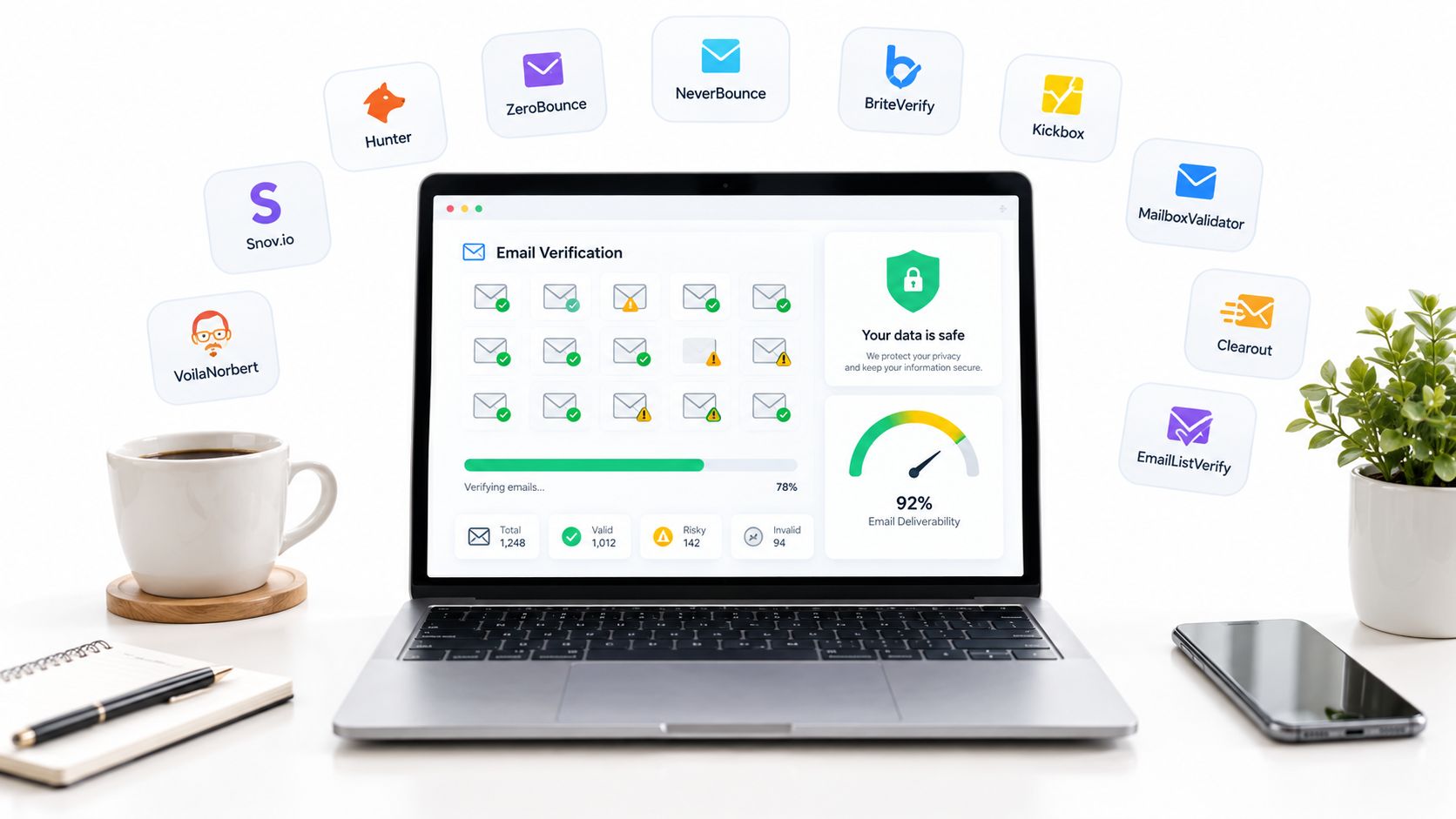
Free verification runs out faster than expected. A signup form starts accepting throwaway addresses, a launch list needs cleaning before send day, and the free tier you picked turns out to be enough for spot checks but not for real gating. Email verification free online tools solve different parts of that problem, so the useful comparison is not “which one is best,” it's which free allowance fits your workflow.
I've seen the same pattern on real forms and real exports, if the tool only checks syntax, it's fine for catching obvious mistakes, but it won't protect a signup funnel from disposable or risky addresses. If it only gives a one-off trial bucket, it may be better for a list cleanup than for ongoing validation. And if it processes data outside the EU without clear controls, that can become the actual cost.
This guide keeps the focus on what each free tier can cover, how it surfaces risk, catch-all, and unknown results, and where the data is processed. It separates single-check signup gating from bulk list cleaning, because those are different jobs with different tolerance for latency, uncertainty, and privacy risk. It also closes with when a GDPR-first paid API such as Mailbeam makes more sense than stretching a free checker past its limit.
Table of Contents
- 1. Free Email Verifier by Mailbeam
- 2. Hunter Email Verifier
- 3. ZeroBounce
- 4. Kickbox
- 5. Verifalia
- 6. Bouncer
- 7. Clearout
- 8. Emailable
- 9. MillionVerifier
- 10. Snov.io Email Verifier
- Top 10 Free Online Email Verifiers, Comparison
- Match the Free Tier to How You Actually Verify
1. Free Email Verifier by Mailbeam
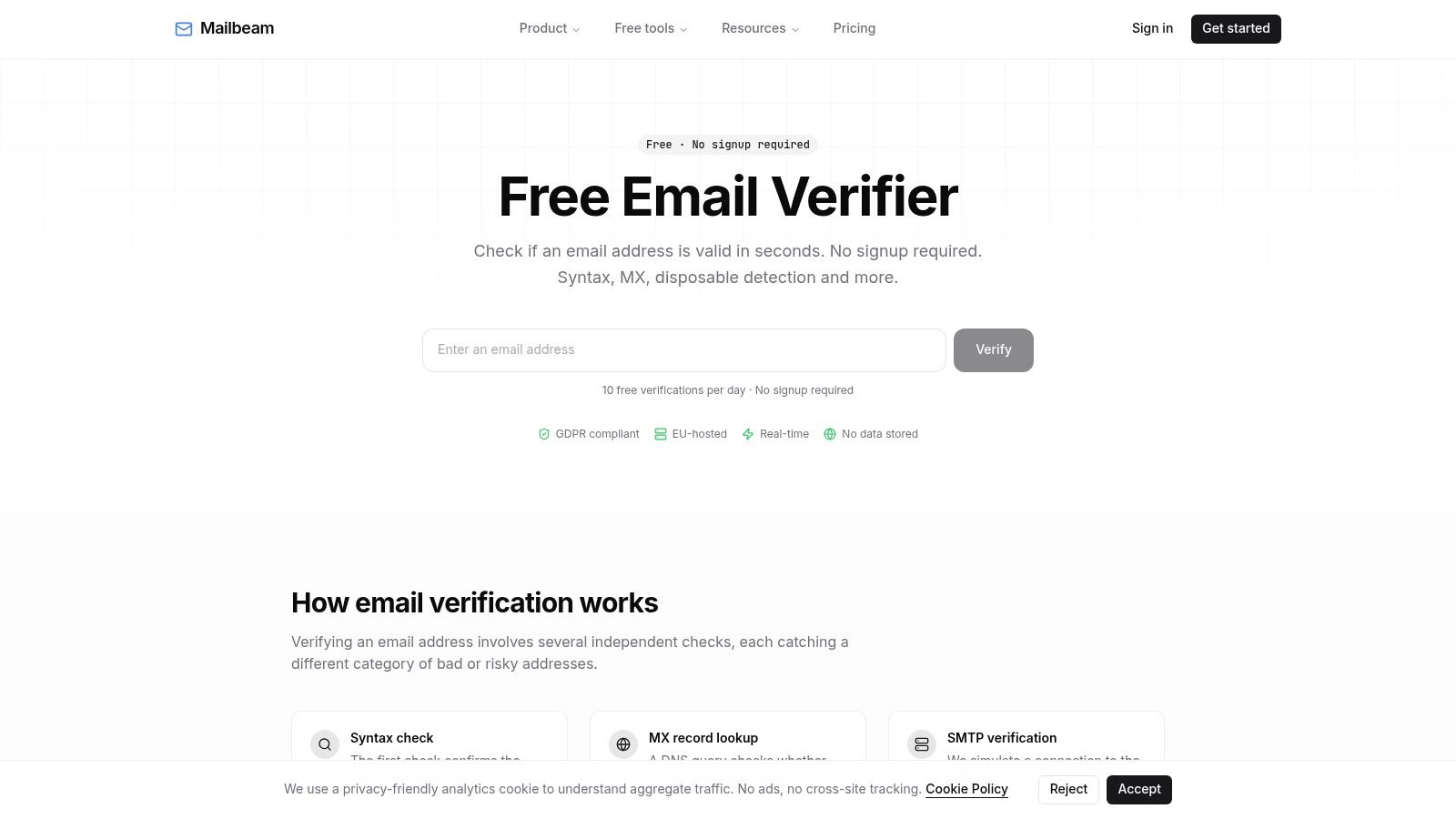
Mailbeam is the most practical first stop if you need signup gating rather than occasional cleanup. Its free web verifier runs in the browser with no signup and checks syntax, MX records, SMTP mailbox confirmation, disposable-domain, role-account, and catch-all behavior, then returns a verdict of Deliverable, Risky, Undeliverable, or Unknown with a 0 to 100 confidence score. That matters because a Boolean pass or fail is too blunt for a live form.
Where the free tier fits, and where it doesn't
The trade-off is simple. You get 10 verifications per day on the free web tool, which is enough for ad hoc testing, QA, or a very small signup flow, but not for heavy list work. That limit makes it a good fit for product teams who want to validate the user experience on a form, not for marketers who need to scrub thousands of records.
Practical rule: use this free tier to decide whether to block, confirm, or flag an address at the point of capture, not to build a long-term audit trail.
The bigger advantage is the output. Mailbeam gives reason codes instead of a vague pass/fail, so a product team can show a better inline error, route uncertain results through confirmation, or let borderline cases through with rate limits. That's stronger than a free checker that only exposes syntax or domain status.
For compliance-sensitive teams, the other trade-off is location and retention. Mailbeam is EU-hosted and GDPR-first, and its single lookups aren't retained, while batch uploads auto-delete. That lowers the operational friction compared with tools that keep results around by default.
For a deeper walkthrough of how to use it in a signup flow, see the companion guide on choosing the best free email verifier for your form. Website: Mailbeam Free Email Verifier
2. Hunter Email Verifier
Hunter fits best inside a prospecting workflow. The free plan gives 50 credits per month, and those credits are shared across Hunter's finder and verifier, so the trade-off is convenience versus separation. If you already use Hunter for prospecting, that shared pool is easy to live with. If you only need verification, the quota can shrink fast.
Hunter also covers the practical basics. It supports single and bulk verification, includes API access on the free plan, and connects with Chrome, Sheets, and CRMs. That makes it useful for sales teams that want one system for finding, checking, and sending. It also means verification competes with every other action drawing from the same credits.
What the shared credit pool means in practice
The main limit is allocation, not function. A team doing active prospecting can burn through free credits before list cleaning gets a fair run, especially because the allowance renews monthly rather than daily. That works for occasional checks. It is a poor match for signup gating that needs steady daily validation.
Hunter is stronger for low-friction verification inside outreach than for treating validation as a separate control. That trade-off matters because a verifier should sit in front of bad data, not trail behind another tool's quota.
For teams comparing it with a form-gating setup, the question is simple: does the monthly free pool cover your real cadence? If it does not, verification turns into occasional housekeeping, and stale addresses will still make it into your list. For syntax and MX checks you can run before bulk verification, see how to check if an email address is valid. Website: Hunter
3. ZeroBounce
ZeroBounce is the familiar choice when the job is list hygiene and deliverability support. The free account includes 100 monthly verification credits, which is enough for trialing workflows or validating a small dataset, but it's still a bounded monthly bucket. The trade-off is straightforward, you get a mature ecosystem, but you don't get much breathing room for ongoing free use.
Its main value is classification. ZeroBounce detects catch-all, disposable, and role-based addresses, which makes it useful when you want to separate clearly bad records from addresses that are merely uncertain. That matters because not every risky result deserves the same action. A role account may be valid in a business context, while a disposable domain usually is not.
The credit trade-off you need to watch
Extra features can consume additional credits. That makes ZeroBounce more appropriate for teams that know exactly what they're measuring, and less attractive for people who want to run broad exploratory checks without watching every action. The platform is mature, but maturity doesn't remove cost pressure.
For signup gating, the benefit is that the categories are familiar and operationally useful. For bulk cleaning, the downside is that a modest free allowance can vanish quickly once you start rechecking lists or testing multiple segments. In other words, it's easy to run a pilot and hard to keep relying on the free plan.
If you need a verifier that feels established and still gives you a small monthly runway, ZeroBounce is credible. If you need a free tool to support constant form validation, the allowance is too thin. Website: ZeroBounce
4. Kickbox
Kickbox is the practical choice for bursty use, not steady free use. It leans on a pay-as-you-go credit model, and one useful detail is that Unknown results aren't charged, which softens the cost of ambiguous lookups. That makes sense for teams that verify in spikes, then go quiet for a while.
The trade-off is that the free offer is not the center of the product. You may find starter credits through signup or integrations, but the official posture is still a credit-pack model. That's fine if you're validating a launch list, less good if you want a renewable free tier for a signup form.
Unknown is not the same as safe. A free verifier that returns uncertainty is being honest, but your policy still has to decide whether that uncertainty gets blocked, confirmed, or deferred.
Where Kickbox helps, and where it slows you down
Kickbox is attractive because it handles bulk verification and real-time verification without forcing a long commitment. It also integrates with platforms like HubSpot, which helps teams that already live in a CRM. The drawback is that the free allowance is patchy across channels, so you can't always count on a stable ongoing quota.
That makes Kickbox better for planned cleanups than for always-on signup checks. If your need is occasional, the model works. If your need is repeated gating on a product signup form, a small, free, renewable allowance is usually easier to manage than scavenging credits from marketplace offers. Website: Kickbox
5. Verifalia
Verifalia is the most obviously EU-minded option in this list after Mailbeam. Its Free plan gives 25 verifications per day, so the trade-off is predictable, modest renewable capacity in exchange for a narrower ceiling. That's useful if you want a small but steady allowance rather than a one-time trial bundle.
The platform supports real-time and batch verification, plus an embeddable widget and REST API. That mix is useful because it lets a team test both the form use case and the list-cleaning use case without changing tools. The daily cap, however, means large one-off cleanups will hit a wall quickly.
Why the daily cap is good and bad at the same time
Daily quotas are easier to plan around than hidden shared pools. You know what you get, and you can spread checks across days. The downside is obvious, if you need to clean a large export right now, a daily allowance isn't a cleanup plan, it's a delay.
Verifalia also supports free deduplication in results, which is useful when a list contains repeated addresses. That helps reduce noise before you decide what to suppress or revalidate. For teams doing incremental hygiene, that's a real advantage.
The trade-off is operational cadence. If your workflow is “a few checks every day,” Verifalia is comfortable. If your workflow is “upload the whole CRM dump before launch,” you'll outgrow the free tier fast. Website: Verifalia
6. Bouncer
Bouncer is a solid starter choice if you want a small free bucket without handing over a card. It gives 100 free credits to start, and the trade-off is flexibility versus scale. That's enough to prove the workflow, but not enough to maintain a long-running free validation habit.
It supports bulk list cleaning and a real-time API, and it flags risky, role-based, disposable, and catch-all addresses. That makes it useful when you want a verifier that separates obvious failures from edge cases instead of pretending every address falls neatly into valid or invalid. The approach is practical, especially for signup gating where a risky result should trigger a different path, not an automatic block.
The useful part is the policy flexibility
Bouncer works best when your team already knows how it wants to treat uncertain results. If a catch-all domain is allowed but a disposable address is not, the categories help. If your policy is still undecided, the tool won't solve that for you.
The free credits are a good starting point, but they're not a stable operating model. Once the starter pool is gone, you're in paid territory. That's fine for a one-off list test or a pilot form integration, but not ideal if you want to keep checking every signup forever on the free plan. Website: Bouncer
7. Clearout
Clearout is strongest when you care about preventing bad addresses at capture time. Its free trial gives 100 credits, which is enough to test both list cleaning and form protection, but not enough to run a full production validation program. The trade-off is that you get a useful protective layer, yet only a modest trial window.
The product's Form Guard is the practical hook. It helps block bad emails during signup, which is the right place to stop junk from entering the system in the first place. The platform also categorizes addresses as valid, invalid, catch-all, or risky, so the output is usable for routing decisions instead of just reporting status.
For teams that like reading product documentation before committing, Clearout's pricing and FAQs make the usage model easier to estimate than many competitors. That matters because credit tools often look cheap until you run them across a real list.
If you want a walkthrough for cleaning in batches rather than gating on the form, the companion guide on bulk email verifier workflows is the better reference point. Website: Clearout
8. Emailable
Emailable gives the most comfortable trial allowance in this group for many teams. The free account includes 250 verifications, which is enough to do more than a token test without immediately worrying about the next quota reset. The trade-off is that the richer deliverability features sit higher in the stack, so the free tier proves the experience more than the full system.
It supports bulk verification, a real-time API, integrations, and live support. That combination makes it approachable for teams that want both usability and technical depth. It's especially useful when a product manager and a developer both need to evaluate the same tool from different angles.
Why the larger trial matters
A larger trial is valuable because it lets you test more than the happy path. You can feed in obviously valid, obviously invalid, risky, and catch-all examples, then see whether the reporting matches your policy. That's much more useful than spending a handful of credits and getting only a shallow read.
The limitation is credit discipline. Once you start using multiple features, you need to watch consumption carefully. The free allowance can disappear faster than expected if several people are testing at once.
Emailable is best when you want a trial that feels like a real pilot rather than a demo. It's not a forever-free utility, but it is one of the more generous entry points if you need meaningful hands-on testing before deciding. Website: Emailable
9. MillionVerifier
MillionVerifier is aimed at teams that care about volume and price discipline. The free paths are unusually generous for eligible users, with 500 free credits with a business email and up to 10,000 via eligible integrations. The trade-off is that the larger trials often depend on connecting something else, so the cheapest route isn't always the simplest.
It supports bulk verification, a real-time API, and flags for disposable, role, and catch-all addresses. That makes it a credible option for cold-email teams that need a lot of batch validation without paying premium rates too early. The utility is obvious if your lists are large and your standards are pragmatic.
The catch with large trials
Bigger trial offers sound great, but they can tie you to a specific workflow or integration. That's fine if you already use the connected platform. It's less fine if you just want to paste an email and move on.
The interface and documentation are more utilitarian than some rivals, which won't bother operators who care more about throughput than polish. If you're comparing free tools for a larger cleanup project, MillionVerifier can be a good value. If your priority is a slick signup experience, it may feel less refined than the tools built around product gating first. Website: MillionVerifier
10. Snov.io Email Verifier
Snov.io makes sense when your verification work already lives inside a broader sales stack. The free plan gives 50 test credits, and the credits are shared across Snov tools, so the trade-off is convenience versus separation. If you're already using Snov for prospecting and outreach, that shared model is efficient. If you only need verification, it's restrictive.
The verifier supports single and bulk verification and exposes an API. That's enough to use it in different parts of the workflow, but the free allowance is small enough that heavy use becomes a paid decision quickly. The verifier feels best as one piece of a wider system, not as a standalone forever-free utility.
Shared credits change how teams behave
Unified credit pools are efficient on paper and annoying in practice if multiple people are touching the stack. A sales rep can spend the same pool that operations expected to use for cleanup, and that makes planning harder. For small teams, the simplicity can still be worth it.
The upside is that Snov's knowledge base and credit rules are clear, so you're not guessing how the free plan works. The downside is that 50 credits won't sustain much ongoing verification. For a signup flow, it's too small to be the default guardrail. For occasional checks inside an existing Snov workflow, it's perfectly serviceable. Website: Snov.io
Top 10 Free Online Email Verifiers, Comparison
| Product | Core features | UX & Pricing | Target audience | Notable USPs |
|---|---|---|---|---|
| 🏆 Free Email Verifier, Check if Any Email is Valid, Mailbeam | Realtime API + web tool; syntax, MX, SMTP, disposable, role, catch-all; score (0–100) & reason codes; webhooks & bulk | ★★★★★ low-latency (≈80ms cached, <1s SMTP); 💰 Free 10/day web trials; transparent per-verification plans | 👥 EU product teams, developers needing in-flow signup validation | ✨ EU-only hosting & DPA; explainable scores/reasons; API + bulk + GDPR-first |
| Hunter Email Verifier (hunter.io) | Single & bulk checks; API; Chrome/Sheets & CRM integrations | ★★★☆☆; 💰50 credits/month free (shared across Hunter tools) | 👥 Sales/prospecting teams using Hunter stack | ✨ Built-in prospecting + verifier; strong integrations |
| ZeroBounce (zerobounce.net) | Real-time & bulk; catch-all/disposable/role detection; scoring/activity data | ★★★★☆; 💰100 free/month; add-on scoring consumes credits | 👥 Marketers/ops focused on deliverability & list hygiene | ✨ Deliverability/activity insights; mature API/ecosystem |
| Kickbox (kickbox.com) | Real-time & bulk API; integrations; Unknown-result refunds | ★★★☆☆; 💰Credit packs (pay-as-you-go); refunds for Unknown | 👥 Teams with bursty verification needs | ✨ Credit refunds for 'Unknown' results; HubSpot integration |
| Verifalia (verifalia.com) | Real-time & batch; embeddable widget; graded result quality | ★★★☆☆; 💰25/day free credits; EU/GDPR posture | 👥 EU teams wanting renewable daily allowance | ✨ Daily free credits; result quality tiers & widget |
| Bouncer (usebouncer.com) | Bulk list cleaning & realtime API; risk/role/disposable detection | ★★★☆☆; 💰100 starter credits; pay-as-you-go credits | 👥 SMBs / one-off cleaners needing simple pricing | ✨ Easy, transparent credit pricing; accurate core checks |
| Clearout (clearout.io) | Bulk, API, and Form Guard (real-time) | ★★★☆☆; 💰100 free trial credits | 👥 Marketers needing form-time protection | ✨ Form Guard to block bad emails at capture |
| Emailable (emailable.com) | Bulk & realtime API; integrations and live support; deliverability add-ons | ★★★★☆; 💰250 free trial verifications | 👥 Teams wanting larger trial & hands-on support | ✨ Large trial bundle; add-ons for deeper deliverability |
| MillionVerifier (millionverifier.com) | Bulk verifier & realtime API; disposable/role/catch-all flags | ★★★☆☆; 💰500 free w/ business email (up to 10k via integrations); competitive per-credit pricing | 👥 Cost-conscious / cold-email teams | ✨ Generous trial routes; low per-credit cost at scale |
| Snov.io Email Verifier (snov.io) | Single & bulk verification; API; unified credits across Snov tools | ★★★☆☆; 💰50 test credits free (shared with Snov suite) | 👥 Users of Snov sales/outreach stack | ✨ Seamless integration with Snov finder/outreach tools |
Match the Free Tier to How You Actually Verify
Use a free checker for occasional one-off checks, and move to a paid API when addresses must be verified in real time at signup, when personal data must stay in the EU under a default DPA, or when you need webhooks and transparent per-verification pricing. The right decision starts with volume, not brand recognition, because a tool that looks generous on paper can still collapse under daily usage. For list hygiene, a bigger trial bucket can be enough. For product gating, you need predictable latency and clear reason codes.
The benchmarks around email volume and data quality explain why this matters. Email use is huge, with 4.55 billion people using email worldwide in 2025, about 56% of the global population and 82% of internet users, while approximately 376.4 billion email messages were sent daily in 2025 and are projected to reach 392.5 billion in 2026 and 408.2 billion in 2027 (Hostinger benchmark summary). At that scale, even small address-quality mistakes add up quickly, so free verification should be treated as a control, not a nice-to-have.
The most useful operating rule is to count how many checks you run per day and per month, then compare that against the free allowance without assuming you'll always stay under it. If your need is mostly manual review, a small daily or monthly bucket is fine. If your signup flow depends on fast, EU-hosted verification with a DPA in place, compare Mailbeam at mailbeam.dev against your current free setup.
Mailbeam gives you a free online verifier that fits real signup flows, not just casual lookups. It checks syntax, MX, SMTP, disposable domains, role accounts, and catch-all behavior, then returns clear verdicts and reason codes from EU-hosted infrastructure. If you want to test a GDPR-first option against your current process, visit Mailbeam and see how it handles the same addresses your free tool is struggling with.