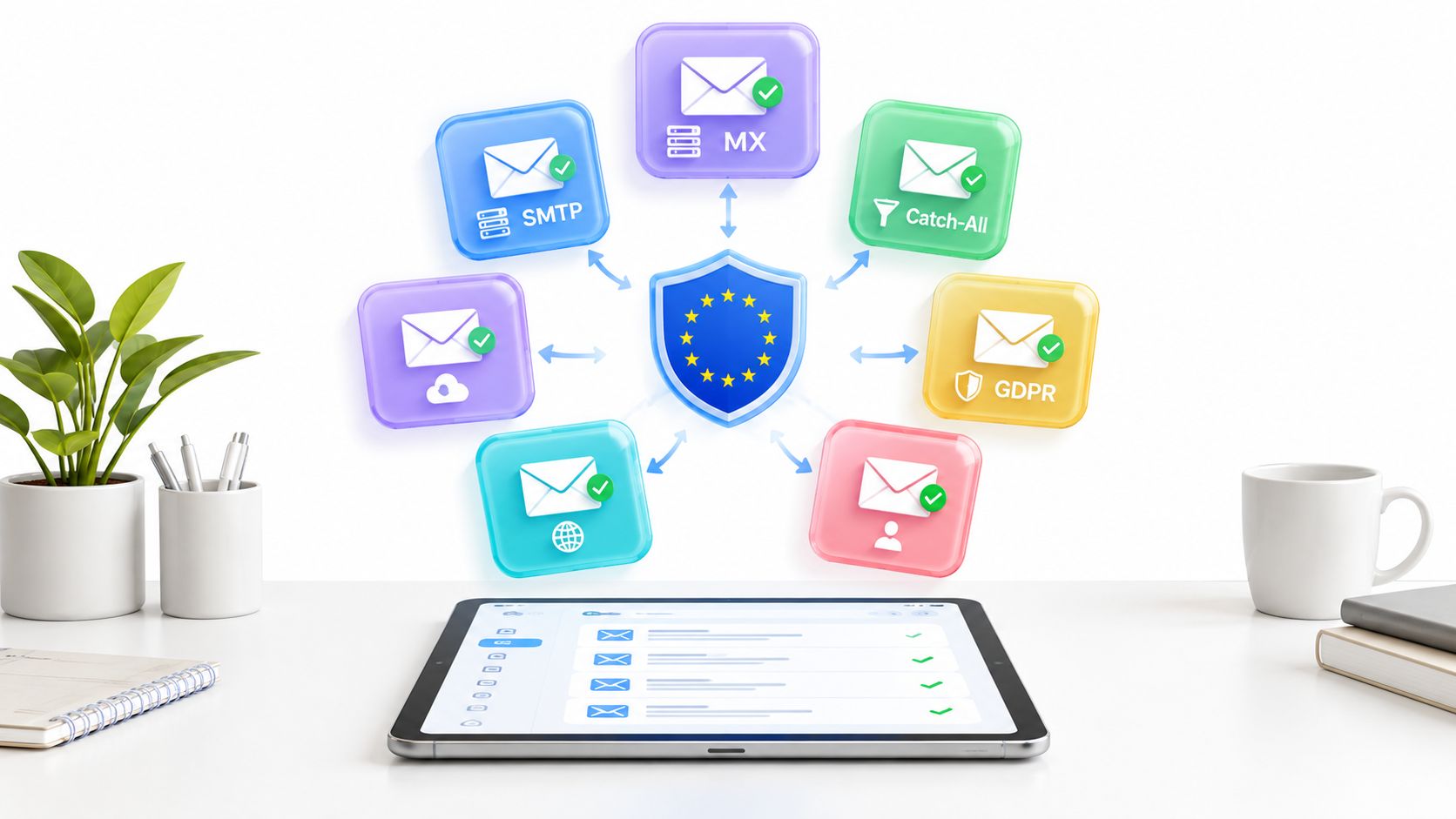
The biggest free quota doesn't automatically make a verifier the best choice. A one-time credit grant helps with a single list cleanup, but it's less useful than a smaller allowance that renews for every signup flow or campaign. You also need to ask what happens to unknown results, whether the service performs SMTP checks or only DNS checks, how it treats catch-all domains, and whether your developers can receive useful reason codes through an API.
That distinction matters because syntax alone catches only about 60–70% of invalid addresses, while layered syntax, MX, and SMTP checks can reach roughly 97–99% accuracy, subject to server behavior and connectivity (Mailvalid's comparison of verification layers). The seven tools below are ranked by the job they perform best, not by headline credits alone. If you're also comparing adjacent tools, this guide to free email notification add-ons covers a different part of the email workflow.
Table of Contents
- 1. Free Email Verifier, Check if Any Email is Valid, Mailbeam
- 2. ZeroBounce
- 3. Hunter Email Verifier
- 4. Verifalia
- 5. Emailable
- 6. Bouncer
- 7. Abstract Email Validation API
- Top 7 Free Email Verifiers Comparison
- Choose by Workflow, Not by Credit Count
1. Free Email Verifier, Check if Any Email is Valid, Mailbeam
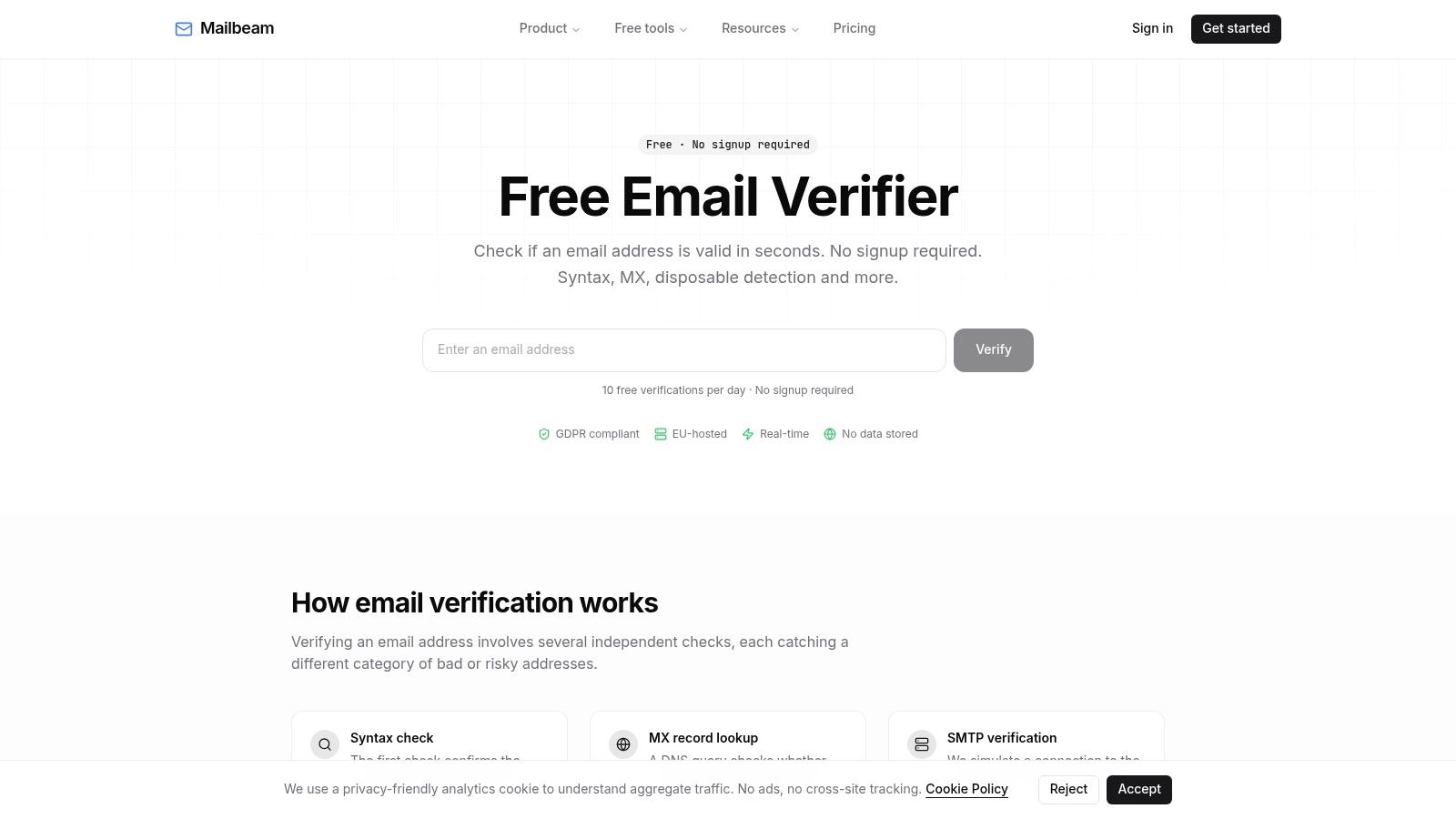
Mailbeam is the strongest fit for real-time signup protection, especially for EU-focused product teams. Its free web verifier lets you check 10 addresses per day without signing up, while a free account provides 1,000 verifications per month, according to the product information supplied for this comparison. Those are different quota mechanics, and that difference matters. The first supports occasional manual checks, while the account tier is designed for recurring product or marketing workflows.
The service combines syntax validation, MX lookups, SMTP mailbox probing, disposable-domain detection, role-address identification, free-provider detection, and catch-all analysis. It returns a 0–100 deliverability score with labels such as Deliverable, Risky, Undeliverable, and Unknown. That makes the result more useful than a binary answer when your application needs to decide whether to accept an address, ask for correction, or route it for review.
Why the result format matters
Mailbeam exposes machine-readable reason codes, so developers can distinguish a malformed address from a missing MX record, disposable domain, role account, catch-all response, or inconclusive SMTP result. That supports deterministic signup rules and clearer user-facing messages.
Its stated latency is also suited to synchronous validation, with cached or DNS-only paths around 80 milliseconds and full SMTP probes under a second, based on the supplied product information. SMTP results can still become Unknown when a remote server times out, uses graylisting, or limits probing. That's a limitation of mailbox-level verification generally, not a reason to treat Unknown as Deliverable.
Practical rule: Use DNS-only checks to keep a form responsive, then apply deeper SMTP review to ambiguous addresses or higher-risk workflows.
Mailbeam's EU-hosted infrastructure in Frankfurt, default Data Processing Addendum, short retention approach, and EU-only verification processing give it a clear position for regulated teams. Single verifications aren't retained after completion, while batch uploads are automatically deleted after roughly 72 hours, according to the supplied publisher information. Its API, webhooks, CSV uploads, and bulk verifier also connect signup protection with ongoing list hygiene. Teams wanting implementation detail can review the free email validation service documentation. Visit the Mailbeam verifier when recurring free usage, explainable outputs, and EU processing matter more than a large one-time allowance.
2. ZeroBounce
ZeroBounce is best for one-off list cleaning when you also want a broader deliverability ecosystem. It supports bulk uploads, a real-time validation API, and additional features such as activity data and AI scoring. A WordPress plugin and other integrations can reduce the work required to connect verification with existing marketing systems.
Its most practical policy is that Unknown results and duplicate entries don't consume credits, according to the supplied plan notes. That changes the effective value of a free allowance. A tool that charges for every ambiguous or repeated row can make a nominally larger quota less useful than it appears, particularly when a list contains imported duplicates or mail servers that resist SMTP probing.
Where ZeroBounce earns its place
The service is a sensible choice for marketers who want verification inside a wider operational stack. You can upload a list for hygiene work, call the API during collection, and use supporting deliverability features when verification alone isn't enough. That breadth is useful for established teams, though it may feel excessive if you only need to check a few addresses or protect a small signup form.
The free allowance is described as modest and connected to account or business-domain status, so check the current eligibility rules before planning a campaign around it. Free access should be treated as an evaluation path rather than an assumed recurring production quota unless the account explicitly shows renewal terms.
Unknown should remain a review category. It indicates that the verifier couldn't establish mailbox status confidently, not that the address is safe to send.
ZeroBounce's mature ecosystem can outweigh a less generous free entry point for teams already using its integrations. For comparison, the independent benchmark supplied in the brief reported 70.00% overall accuracy for Hunter and 60.70% for ZeroBounce under default settings on the same dataset, which reinforces the need to test the actual workflow rather than rely on brand familiarity (the Prospeo verification comparison). Review the ZeroBounce platform, then test duplicate, Unknown, catch-all, and API behavior with representative addresses. Teams migrating from another provider can also consult Mailbeam's ZeroBounce migration notes.
3. Hunter Email Verifier
Hunter is the best choice when verification belongs inside an outreach and email-discovery stack. Its product combines email finding, verification, and sequences, so a small sales or growth team can manage prospect discovery and address validation under one account. That consolidation is more important than it may first appear. If a team already pays attention to Hunter workflows, adding a separate verifier creates another export, import, credential, and result-mapping problem.
Hunter supports single checks, bulk verification, and API access. Its standard credit model typically charges 0.5 credit per verified email, according to the supplied plan notes, while duplicate requests within a billing period don't consume credits again. The apparent free quota therefore depends on what else is drawing from the same pool. Discovery and verification share credits, so a free allowance can disappear quickly when prospecting and cleaning happen together.
The trade-off for developers
The main operational risk is not verification depth. It's quota contention. A marketing user finding contacts can consume the same resource that an engineer expects to use for validation. Define separate usage rules before connecting Hunter to an automated flow, and monitor credit consumption at the account level.
Hunter's results can also include ambiguous outcomes such as accept-all or Unknown. That's appropriate for responsible list hygiene, but it means your sending workflow needs a policy for addresses that accept mail at the domain level without proving that a specific mailbox exists.
The supplied independent comparison ranked Hunter at 70.00% overall accuracy under its default settings, the highest result in that cited comparison (the Prospeo benchmark). That figure shouldn't be generalized to every dataset or configuration, but it does support testing Hunter on your own sources and domain mix.
Choose Hunter if your team values a unified outbound workspace, simple account management, and API access. Choose a dedicated verifier instead if signup protection, EU-only processing, or independently controlled verification quotas is the primary requirement. Explore the Hunter email verifier before committing free credits to production automation.
4. Verifalia
Verifalia is best for ongoing light usage with a predictable daily allowance. Its permanent free plan provides daily credits rather than a single introductory grant. That makes it structurally different from tools that look generous on signup but don't replenish. For a small form, recurring manual checks, or periodic hygiene tasks, a daily trickle can be easier to plan around than a one-time balance.
The platform also offers a real-time form widget and official SDKs for .NET, Go, Java, JavaScript, PHP, and Ruby, based on the supplied product information. That language coverage gives developers a practical route to integration without building every HTTP wrapper and response parser themselves.
Best use and limitation
Verifalia's deduplication options and distinct handling of Unknown results help teams avoid treating every response as equally reliable. The service is therefore better suited to a workflow that retains a review state than one that deletes everything not marked deliverable.
The daily cap is the central limitation. It works well for continuing, low-volume use, but it isn't an efficient fit for a large one-time cleanup unless you purchase additional credits. The free plan also has restrictions such as no SLA and account limits, so it should be evaluated as a lightweight operational tier, not an enterprise commitment.
A practical implementation would use the widget or API at collection time, store the returned classification, and send only clearly deliverable records into downstream campaigns. Catch-all and Unknown results should remain visible to an operator or receive a separate policy.
Verifalia's EU-friendly positioning makes it worth considering for European teams, but compliance decisions should still be based on the current DPA, retention terms, subprocessors, and residency documentation. Review the Verifalia verification service and test its SDK path with your actual form stack. It ranks here because recurring daily access can be more valuable than a larger initial balance for teams that need steady, modest usage.
5. Emailable
Emailable is the strongest fit for evaluation and one-off list cleaning when credits can be preserved for later. It provides bulk validation, in-app checks, an API, and an embeddable widget. The supplied plan notes describe a larger initial free credit allowance at signup, no card requirement, and a policy that refunds credits for Unknown results and duplicates.
That refund policy affects list economics in a useful way. A list often contains repeated records or addresses that a mail server won't classify confidently. If those rows return to the balance, you can rerun a corrected file or test another workflow without paying for uncertainty twice.
A flexible credit model
Emailable uses one credit per check, while credits don't expire and subscriptions are optional, according to the supplied product information. That suits agencies, campaign teams, and developers who don't verify addresses every month. A recurring quota is better for continuous signup traffic, but non-expiring credits are better when demand arrives in bursts.
The service supports both offline and real-time work. Bulk validation helps before a campaign, while the widget can intercept poor-quality addresses during collection. Keep those workflows separate in your reporting. A clean imported list and a real-time signup stream have different error patterns, and one shouldn't be used as a proxy for the other.
Emailable's caveat is commercial rather than technical. The minimum pay-as-you-go purchase may feel high for a very small buyer, and deliverability add-ons such as inbox placement reports use separate credits. Confirm which operation consumes which balance before comparing it with a verifier that uses a single per-check price.
Credit advice: A non-expiring balance is valuable only if your team can see which checks, retries, duplicates, and add-ons consume it.
Consider Emailable when you need bulk and API access but don't want a monthly subscription. Visit the Emailable validation platform and test duplicate and Unknown handling before importing a production list.
6. Bouncer
Bouncer is best for a controlled evaluation followed by occasional list cleaning. Its free access includes single-email checks and 100 free signup credits, while its pay-as-you-go credits don't expire, according to the supplied plan notes. That is a one-time starter allowance, not a recurring monthly quota, so it shouldn't be compared directly with Verifalia's daily model or Mailbeam's monthly account allowance.
The platform supports bulk verification and real-time API validation, with an emphasis on GDPR compliance and EU data storage. Those features make it relevant to agencies and European teams that need to assess a provider before committing a list or connecting an acquisition form.
Clear categories, careful decisions
Bouncer separates results into Deliverable, Risky, Undeliverable, and Unknown. That classification is operationally useful because it gives marketers more choices than keep or delete. A Risky address might need suppression, manual review, or a controlled test depending on consent, engagement history, and sender policy. Unknown should not be automatically promoted to deliverable.
The service also doesn't charge for Unknown results or duplicates, according to the supplied product information. That helps control the cost of exploratory cleaning, where the first pass may reveal many ambiguous records. Still, the starter allowance is limited, and the entry pack can be less attractive for very small purchases than a provider with a lower minimum.
Independent benchmark data supplied in the brief placed Bouncer at 65.43% overall accuracy under default settings on the cited 3,000-address comparison, while the same source reported materially different results among providers (the Prospeo email verification benchmark). Treat that as a comparison point, not a universal score. Test your own corporate domains, catch-all behavior, and regional address mix.
Bouncer is a sensible shortlist option when EU positioning, non-expiring credits, and straightforward risk categories matter. Review the Bouncer email verification service before choosing it for recurring signup traffic. Migration planning is easier with Mailbeam's Bouncer migration documentation.
7. Abstract Email Validation API
Abstract is the best choice for focused API testing and small development environments. Its Email Validation API performs syntax, MX, SMTP, disposable, and catch-all checks in a single request, returning validity and risk or quality fields in JSON. That makes it straightforward to place behind a signup endpoint, internal admin tool, or test application.
The free tier provides 100 requests per month, according to the supplied product information. That's enough to validate an integration, test response handling, and exercise error states. It's modest for a production signup flow, particularly when retries, QA, staging, and real users share the same allowance.
Where the API fits
Abstract's strength is consistency. Developers can build around one response shape instead of combining a syntax library, DNS resolver, disposable-domain list, and SMTP service. The API-first approach also makes it easier to keep verification logic out of the browser and centralize logging, rate limits, and privacy controls.
The limitation is scale. Bulk list operations and higher requests-per-second requirements belong to paid tiers, so a team shouldn't mistake the development allowance for a durable production plan. You'll also need to inspect how the API represents Unknown, catch-all, timeout, and SMTP-protected domains before deciding whether the application should block, warn, or accept.
The broader deliverability context supports that caution. A 2026 dataset covering 14 million form submissions found that 12% of signups used disposable addresses, while only 62% of submitted emails were valid after accounting for typos, defunct domains, role-based addresses, and full inboxes (Fidro's 2026 signup dataset). A simple API call is useful only when your product acts on those distinctions.
Choose Abstract for a clean developer entry point and testing allowance. Visit the Abstract Email Validation API and verify its current free-tier limits, response fields, and data-processing terms before using it in a live registration flow.
Top 7 Free Email Verifiers Comparison
| Service | Implementation complexity 🔄 | Resource requirements ⚡ | Expected outcomes ⭐ | Ideal use cases 📊 | Key advantages & tips 💡 |
|---|---|---|---|---|---|
| Free Email Verifier, Mailbeam | Low 🔄, simple HTTP API, web UI, webhooks, CSV/bulk | Low ⚡, free tier (10/day no signup; 1,000/mo free account); pay-per-verification | High ⭐⭐⭐⭐, explainable scores, low-latency (<1s SMTP) for signup validation | Gate signups, real-time form checks, EU-data workflows | 💡 EU/GDPR-first, numeric reason codes; SMTP probes can yield “Unknown” for some servers |
| ZeroBounce | Medium 🔄, bulk + real-time API, many integrations | Medium ⚡, modest free credits; unknowns/duplicates don't consume credits | High ⭐⭐⭐⭐, mature platform with activity & AI scoring | One-off list hygiene, in-flow checks, integrated platforms (e.g., WordPress) | 💡 Strong ecosystem; cost-effective for de-duplicated/unknown results, pricing higher at small volumes |
| Hunter Email Verifier | Low 🔄, part of outreach suite; API & bulk tools | Low-Medium ⚡, free monthly credits; unified credit pool shared with finder | Good ⭐⭐⭐, convenient for combined discovery+verification | Small teams doing outreach and automated sequences | 💡 Easy start within an outreach stack; shared credits can be depleted by other features |
| Verifalia | Low-Medium 🔄, official SDKs (.NET, Go, Java, JS, PHP, Ruby) and form widget | Low ⚡, permanent daily free credits; paid credits for larger jobs | Good ⭐⭐⭐, dependable for periodic hygiene and lightweight real-time use | Ongoing light hygiene, form widgets, developer-friendly integrations | 💡 Predictable daily free allotment and broad SDKs; daily caps limit large one-off cleans |
| Emailable | Low 🔄, bulk, API and embeddable widget | Medium ⚡, large initial free credits; refunds for unknowns/duplicates; min purchase sizes apply | Good-High ⭐⭐⭐⭐, claims fast bulk throughput for time-sensitive campaigns | Fast bulk validation, campaign prep, embeddable checks | 💡 Generous signup credits and refundable policies; some deliverability add-ons cost extra |
| Bouncer | Low-Medium 🔄, API, bulk, GDPR-focused tooling | Low-Medium ⚡, 100 free starter credits; pay-as-you-go credits never expire | High ⭐⭐⭐⭐, emphasis on accuracy and fewer “unknown” results | EU-compliant workflows, accuracy-sensitive hygiene, trial evaluations | 💡 Clear pricing and EU data storage; starter credits are one-time (not recurring) |
| Abstract Email Validation API | Low 🔄, developer-first JSON API, single-call multi-checks | Low ⚡, consistent free tier (100/month); paid tiers for bulk/RPS | Good ⭐⭐⭐, concise risk/quality scoring suitable for forms | Engineering teams embedding real-time validation and dev testing | 💡 Simple docs and integration; free tier useful for testing but modest for production |
Choose by Workflow, Not by Credit Count
The best free email verifier depends on what you're protecting. Choose Mailbeam when EU-only processing, explainable reason codes, low-latency signup validation, and a recurring free allowance matter. Its layered checks are suited to product flows that need to distinguish disposable, role-based, catch-all, and mailbox-level outcomes instead of accepting every syntactically correct address.
Choose Verifalia for ongoing light usage where daily free credits and SDK coverage are more useful than a large one-time grant. Its model fits a small form or routine maintenance process, but the daily cap and free-plan restrictions make it less convenient for a large cleanup.
Choose Emailable or Bouncer for evaluation and list-cleaning workflows. Emailable's non-expiring credits and refunds for duplicates and Unknown results suit bursty usage. Bouncer combines a one-time starter balance with non-expiring pay-as-you-go credits, clear risk categories, and EU-oriented compliance positioning.
Choose Hunter when verification belongs inside an outreach stack that already includes email discovery and sequences. Watch the shared credit pool, because finding and verifying contacts can compete for the same allowance. Choose ZeroBounce when a mature ecosystem, bulk workflows, integrations, and broader validation extras justify a more modest free entry point. Choose Abstract when the primary goal is testing a focused API with a small development allowance.
The technical choice should follow the address states you need to handle. Syntax and MX checks are fast, but SMTP probing provides deeper mailbox evidence and can introduce latency or Unknown responses. Catch-all domains are especially important because a healthy domain doesn't prove that an individual mailbox exists. One benchmark supplied in the brief found that 33.1% of checks reached catch-all domains, while 12.3% of verified addresses were flat-out invalid, showing why MX-only decisions can be misleading (BounceZero's 2026 deliverability benchmark).
Before importing a list or connecting a form, confirm four things:
- Quota type: Is the allowance recurring, daily, monthly, or a one-time credit grant?
- Ambiguous results: Are Unknown and catch-all outcomes free, refunded, charged, or grouped with valid addresses without clear indication?
- Integration path: Do you need an HTTP API, webhook, SDK, widget, CSV upload, or bulk endpoint?
- Privacy controls: Review retention, subprocessors, DPA terms, and data residency, especially for EU or regulated workflows.
A free verifier is a testing and hygiene tool, not a guarantee of inbox placement. List quality still matters because one industry summary reports annual list value loss of 22.5%, an average bounce rate of 10.4%, and average deliverability of 83.1% (ContactInfo's email verification guidance). Use verification before addresses enter your database, repeat it before important sends, and keep uncertain outcomes out of automatic deliverable segments.
Mailbeam offers a free web verifier, recurring account usage, layered syntax, DNS, SMTP, disposable, role, and catch-all checks, plus explainable scores and reason codes for product workflows. Visit Mailbeam to test the free tools, review the API approach, and assess whether EU-hosted processing fits your signup protection or list-cleaning requirements.