
Most buyers start with a headline accuracy percentage and end up choosing on price. That shortcut misses where verifiers differ: whether a check runs inside a live signup form or as a batch job, where data is processed and how long it's kept, how credits are billed, and what an API response gives your product team to act on. A binary “valid” result may be inadequate when your workflow needs to distinguish a typo, disposable address, catch-all domain, role account, or uncertain SMTP response.
The ten providers below are ranked by buying fit rather than by an unsupported accuracy leaderboard. They cover real-time signup gating, bulk list cleaning, EU-oriented data handling, and credit-based versus flat billing. Each entry identifies the limitation to test before committing, because a verifier's value depends on how its decisions behave in your own traffic and list.
Table of Contents
- 1. Mailbeam
- 2. ZeroBounce
- 3. Kickbox
- 4. Bouncer
- 5. Verifalia
- 6. Emailable
- 7. Hunter Email Verifier
- 8. Sinch Mailgun Optimize
- 9. MillionVerifier
- 10. Clearout
- Top 10 Email Verifier Comparison
- Pick the Right Verifier for Your Workflow
1. Mailbeam
Mailbeam fits products that need verification inside a signup flow, rather than only in a marketing dashboard. Its API checks syntax, MX, SMTP, disposable domains, role accounts, free providers, and catch-all domains, then returns a 0–100 quality score with machine-readable reason codes. That output supports more precise policies than a valid or invalid flag. A form can block a confirmed invalid address, suggest a correction for a likely typo, and route an indeterminate catch-all result to a secondary review path.
The service targets EU-focused processing. Its documented setup includes Frankfurt-hosted infrastructure, EU-only verification processing, a default DPA, and short-lived data handling. Single lookups are not retained after completion, while batch uploads are automatically deleted after roughly 72 hours. Procurement teams should verify those details against the current DPA, subprocessors, and their own retention requirements.
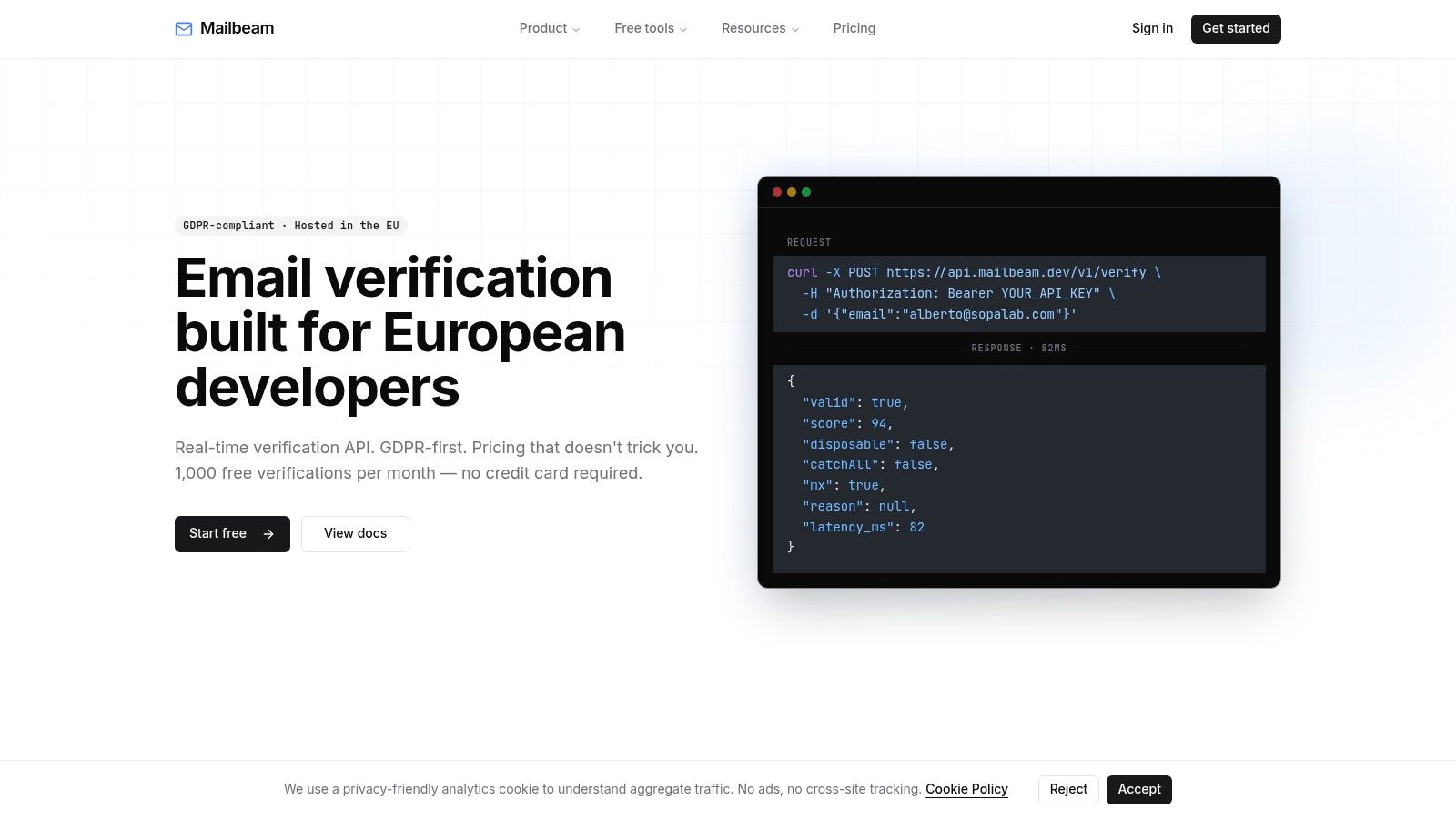
Best fit for synchronous product decisions
Mailbeam reports cached or DNS-only paths at approximately 80 ms and full SMTP probes under one second. That makes it a candidate for synchronous validation, provided the application handles timeouts and uncertain responses explicitly. It also supports CSV batch jobs, asynchronous endpoints, webhooks, and HTTP integrations. Official SDKs are planned, so current integrations rely on HTTP requests and the available Node.js, Python, PHP, Ruby, and Go examples.
Billing uses per-verification quotas and pay-as-you-go options rather than multipliers or expiring credit bundles. The free tier includes 1,000 verifications per month. Growth is listed at €49 per month for 50,000 verifications, and Scale at €499 per month for 1,000,000 verifications. These product details should be rechecked before purchase. Unused verifications do not roll over.
Practical rule: Block confirmed invalid and disposable addresses, flag catch-all and indeterminate results, and retain the original reason code for auditability.
Test before committing: measure p95 latency, timeout behavior, SMTP uncertainty, false positives on legitimate EU domains, and API behavior when a form cannot wait for a full probe. Dedicated IP pools, custom SLAs, and on-premise deployment require higher-tier discussions.
2. ZeroBounce
ZeroBounce suits teams that want bulk verification alongside a wider deliverability toolkit. Its offering combines real-time API checks and list cleaning with add-ons such as inbox-placement testing, blacklist monitoring, and DMARC monitoring. The provider also advertises broad integrations and SDK examples, which can reduce engineering work when verification must connect to an existing CRM, ESP, or campaign process.
The product's published materials include a 99.6% accuracy guarantee, but that figure should be treated as a vendor claim rather than a universal benchmark. Independent evaluation is more useful when it tests inbox placement, delivery, and bounce behavior on your own mailbox mix. A verifier can return “valid” while a campaign still encounters reputation, throttling, authentication, or content problems.
Where the credit model matters
ZeroBounce uses credits across its API and dashboard, with free monthly credits on its free tier. That arrangement can be convenient for a team that alternates between one-off list uploads and ongoing API calls. It can also make forecasting harder if different features consume credits differently or if unused capacity doesn't match your signup traffic.
The main limitation to test is whether the broader suite adds operational value or expands the bill. Run a representative sample through the API and bulk interface, then compare reason-code detail, catch-all handling, webhook behavior, and the effective cost of addresses you retain. Teams should also verify current processing regions and retention terms directly, particularly if EU-only residency is mandatory.
3. Kickbox
Kickbox is a sensible candidate for teams that verify in bursts. Its core offer combines bulk list cleaning with a real-time API, and its pay-as-you-go structure avoids forcing occasional users into a recurring subscription. Free starter credits make a small proof of concept straightforward.
The developer experience is the attraction. Documentation, API examples, and integration guidance are aimed at teams that want to embed verification into applications or connect it to sending platforms. Kickbox also provides a quality-oriented result rather than limiting the workflow to a bare syntax check. That matters when the application needs to separate a confirmed failure from an address that requires caution.
Better for periodic jobs than automatic scale
Pay-as-you-go pricing is easy to understand for a quarterly list clean, but high-volume teams should ask for enterprise terms instead of assuming the public ladder will remain competitive. Deep volume discounts and custom arrangements require a sales conversation. The service's compliance posture includes GDPR and CCPA positioning, but regulated teams should still inspect the DPA, subprocessors, retention schedule, and processing locations.
Test before committing: focus on catch-all outputs, SMTP timeouts, and whether “unknown” is actionable enough for your signup policy. A tool that groups several uncertain conditions into one status may be acceptable for bulk suppression, yet frustrating when a product team needs to show a user a precise correction message. Also compare pay-as-you-go costs with a monthly plan from a provider that bills directly per verification.
4. Bouncer
Bouncer is a strong option for buyers who want an EU-friendly provider with both API and batch workflows. It detects role and disposable addresses, offers developer documentation, and exposes practical implementation material, including MCP server documentation. Its credit-based pricing can be attractive for teams that want established verification without committing to a flat monthly volume.
The catch is that credits shape the economics. Bouncer doesn't offer an unlimited monthly tier, so continuous signup traffic and periodic list cleaning draw from the same basic purchasing logic. A team with predictable, high-volume API traffic should model actual monthly usage, retries, duplicate handling, and uncertain results rather than comparing only the displayed price per credit.
EU posture still needs due diligence
An EU-oriented provider can simplify a privacy review, but location alone doesn't establish that every relevant processing condition meets your requirements. Confirm the current DPA, subprocessors, processing regions, transfer mechanisms, retention rules, deletion process, and batch-upload controls. Then test whether reason codes distinguish invalid, disposable, role, catch-all, and SMTP-uncertain results well enough for your policies.
Bouncer is likely to fit teams that need a practical API and EU-aware procurement path. It may be a poorer fit for a product that wants flat monthly billing, highly predictable recurring quotas, or a single endpoint with especially detailed explanations. The decision should turn on how many borderline addresses your workflow receives and what your system does with them.
5. Verifalia
Verifalia is built for teams that need more control over verification depth than a basic one-pass list cleaner provides. Its Italy-based, EU-hosted positioning, detailed result statuses, deduplication options, throttling controls, and multiple verification levels make it suitable for privacy-sensitive operations and difficult domains.
The multi-pass approach is useful when a mail server is slow, restrictive, or inconclusive. Instead of treating every uncertain response as an immediate rejection, teams can tune speed and depth according to list quality and campaign risk. That distinction is important because SMTP checks can return temporary or ambiguous results that don't prove an address is nonexistent.
Granularity has a cost
Verifalia's freemium offering includes daily credits, which supports controlled testing. Advanced verification levels, however, can cost more than a basic single-pass workflow. A buyer should compare the incremental value of deeper passes against the number of addresses that move from uncertain to usable, not assume that more checking automatically means better deliverability.
Test before committing: upload the same sample at different verification levels and inspect status transitions, retry behavior, deduplication, throttling, and export fields. Confirm how long uploaded addresses remain available and how deletion works. For EU organizations, request the current legal documentation and verify that the selected plan, rather than only the company's headquarters, provides the required processing arrangement.
6. Emailable
Emailable is a practical middle ground for teams that want a friendly dashboard, bulk CSV processing, API access, and routine list-hygiene reporting. Its interface is approachable for marketing and operations users, while the API supports product and engineering workflows. Role and disposable detection are included in the verification feature set.
The platform is particularly reasonable for small and mid-market teams that don't want to build an entire cleaning workflow around raw API responses. A dashboard can help nontechnical users upload a list, inspect categories, and export results. That convenience matters when list maintenance is owned by marketing rather than engineering.
Check the effective rate, not the displayed tier
Emailable offers pay-as-you-go access, but pricing and bundles vary by usage. The effective per-verification rate should be checked against your actual volume, treatment of unknown or duplicate records, and any custom tier requirements. Teams with irregular jobs may find the flexibility useful, while larger continuous senders should compare the cost with flat monthly plans and bulk-focused providers.
A deeper evaluation should test whether its result categories expose enough detail for signup gating. A marketing team may be comfortable suppressing risky addresses, but a product team may need to distinguish a disposable domain from a temporary SMTP response. For additional context on free verification approaches, see this comparison of free email verifier options, while treating any changing product details as subject to confirmation.
Test before committing: run a CSV and an API sample, compare duplicate treatment, inspect webhook and retry behavior, and measure false positives on legitimate company domains. Don't assume a smooth dashboard means the synchronous API has the latency profile your registration flow needs.
7. Hunter Email Verifier
Hunter makes the most sense when verification is part of a prospecting workflow. Teams can find contacts, verify individual or bulk addresses, and manage outreach-related data under one account. Paid plans can automatically re-verify saved leads monthly, which is useful for organizations that already maintain prospect records in Hunter.
Its credit model is the main buying consideration. Verification, discovery, and outreach activities can share a broader usage system, while API behavior depends on the selected plan. Some verification statuses aren't charged, and outreach plans can apply 0.5 credit per verification, according to the product rules supplied for this comparison. Those details can be valuable, but they also make standalone price comparisons less obvious.
Choose the workflow, not the verifier alone
Hunter is efficient when the team already uses its company-domain search and prospecting features. If verification is the only requirement, the combined credit system may be less economical than a dedicated provider with direct per-verification billing. That trade-off becomes more important when a CRM or signup application generates verification requests continuously rather than in prospecting bursts.
For a deeper evaluation of the category, consult this guide to email verification tools, then test Hunter's current plan rules against your own usage. Pay attention to duplicate handling, saved-lead rechecks, API rate limits, and what happens to contacts that return catch-all or uncertain statuses. A unified workflow is valuable only if the billing and decision logic remain understandable to the team operating it.
8. Sinch Mailgun Optimize
Sinch Mailgun Optimize is best suited to teams already using Mailgun for sending, analytics, and deliverability operations. Its validation capabilities include real-time form checks, bulk uploads, and API access inside the wider Mailgun environment. Keeping sending and validation with one provider can reduce integration points and simplify operational ownership.
That convenience comes with a procurement question. Validation quotas may be included in some subscriptions, while overages and exact pricing depend on the selected Mailgun plan. The standalone economics are therefore harder to compare with a verifier that publishes one direct per-check rate. Teams should inspect the current billing page, quota rules, API limits, and treatment of failed or repeated checks before assuming consolidation is cheaper.
Validation doesn't replace authentication
Mailgun's broader deliverability context is useful because verification sits alongside authentication and monitoring rather than replacing them. A valid address can still receive poorly authenticated or poorly timed mail, and a clean list can't compensate for weak sender practices. A 2025 deliverability report found that 53.8% of surveyed senders used DMARC, while 25.7% planned to move from monitoring-only to stronger enforcement, according to Mailgun's deliverability report. Those figures show why verification should be evaluated as one control in a wider program.
Test before committing: compare validation cost after subscription fees, confirm whether form checks and bulk jobs draw from the same quota, and verify the data-retention terms for addresses submitted through each interface. Mailgun is a logical fit for an existing sending customer, but it may add unnecessary platform overhead for a team that only needs an independent signup verifier.
9. MillionVerifier
MillionVerifier targets buyers who prioritize cost-conscious bulk cleaning and recurring hygiene. It offers bulk verification, API access, disposable and catch-all handling, integrations, and an EverClean option for ongoing list maintenance. Agencies and startups that process large lists periodically may prefer its simple packaging over a broader deliverability suite.
The provider markets a 99%+ accuracy claim and a money-back guarantee. Those are vendor positions, not substitutes for a controlled test on your own data. The right comparison is whether the service correctly separates confirmed invalid addresses from catch-all, disposable, and uncertain outcomes, and whether the remaining valid segment produces fewer hard bounces in your sending environment.
Low cost can shift the burden to operations
The interface and reporting are more utilitarian than premium platforms, which may be perfectly acceptable for a technically comfortable team. It can be less suitable when marketing users need polished audit trails, detailed decision explanations, or built-in deliverability diagnostics. Recurring hygiene also needs careful scheduling, because verification at one point in time doesn't stop addresses from becoming stale later.
Test before committing: upload a representative list, inspect every result category, and verify how the API exposes reason codes. Check catch-all treatment, disposable-domain updates, webhook reliability, rate limits, and the exact conditions of the guarantee. If the tool returns a binary “safe” outcome without enough explanation, build a separate review path for uncertain records rather than blocking or sending automatically.
10. Clearout
Clearout offers bulk and API verification, role and disposable detection, list-enrichment capabilities, subscriptions, pay-as-you-go top-ups, and automatic credit replenishment. Its flexible payment menu makes it suitable for teams whose volume changes between campaigns. Free starter credits also make a limited proof of value easy to run.
The product includes a “Safe-to-Send” category that can be refundable if the message is sent within 24 hours, subject to the provider's conditions. That can connect verification with a defined sending window, but it isn't a universal guarantee. The operational process must ensure that the team sends within the permitted period and understands which result categories qualify.
Match the guarantee to your process
Clearout may suit a marketing operation that wants a blend of bulk cleaning, API checks, and flexible purchasing. The refundable category becomes less useful for teams that verify a list, wait for an approval cycle, and send much later. In that case, the team should value the underlying result quality and billing terms rather than the refund mechanism.
This overview of bulk email verification tools can help frame the comparison, but Clearout's current conditions should be checked directly. Test the API and CSV workflows separately, measure how credits are consumed by retries and uncertain addresses, and confirm whether auto-top-up can be disabled or capped. Also inspect the retention and deletion terms if the list contains identifiable EU contacts.
Top 10 Email Verifier Comparison
| Provider | Core features & performance | Compliance & data residency | 💰 Pricing / value | 👥 Best for | ✨ USP & ★ Rating |
|---|---|---|---|---|---|
| 🏆 Mailbeam | Real-time API, 8 parallel checks (syntax/MX/SMTP/disposable/role/catch‑all), explainable 0–100 score, low latency (≈80ms–<1s) | EU‑hosted (Frankfurt), DPA included, no US transfers, short retention (single lookups not retained; batches ~72h) | 💰 Free 1k/mo; Growth €49 (50k); Scale €499 (1M); example €0.001/verify | 👥 Dev teams needing signup gating + EU compliance | ✨ Explainable reason codes, webhook + batch support, predictable per‑verify billing, ★★★★★ |
| ZeroBounce | Real‑time + bulk, deliverability add‑ons (inbox tests, blacklist/DMARC), SDKs | Global provider (not EU‑first); many integrations | 💰 Transparent volume pricing; free credits on trial; mid‑market per‑1k | 👥 Teams wanting deliverability suite + large hygiene jobs | ✨ Deliverability tooling & many integrations, ★★★★☆ |
| Kickbox | Bulk + real‑time API, predictable PAYG credit ladder, free starter credits | GDPR/CCPA posture; standard compliance controls | 💰 Pay‑as‑you‑go credits; good for burst usage | 👥 Teams that verify in bursts or periodic batch cleaning | ✨ Simple pricing and good support, ★★★★ |
| Bouncer | Bulk & API, role & disposable detection, developer docs (MCP) | EU‑friendly options; developer‑centric | 💰 Competitive per‑credit pricing (credits model) | 👥 Dev teams wanting EU posture and solid API depth | ✨ MCP server docs, pragmatic dev resources, ★★★★ |
| Verifalia | Multi‑pass verification levels, dedupe & detailed statuses, throttling controls | EU‑hosted (Italy), GDPR‑friendly legal docs | 💰 Free daily credits; advanced passes costlier | 👥 GDPR‑sensitive teams needing hard‑to‑validate domains | ✨ Multi‑pass tuning for tricky domains, ★★★★ |
| Emailable | Bulk CSV + API, dashboard & reporting, role/disposable detection | Standard compliance (dashboard focused) | 💰 PAYG + support; approachable cost for routine cleaning | 👥 SMBs & mid‑market teams wanting UI + API | ✨ Easy onboarding + reporting UX, ★★★ |
| Hunter Email Verifier | Single & bulk verification, monthly re‑verify of saved leads, API | Part of Hunter stack (global) | 💰 Credits tied to Hunter plans (plan‑dependent) | 👥 Sales/prospecting teams already using Hunter | ✨ Integrated with prospect discovery workflows, ★★★ |
| Sinch Mailgun Optimize | Real‑time form validation + bulk, integrated with sending & analytics | Operated within Mailgun platform (enterprise posture) | 💰 Quotas/pricing tied to Mailgun plans (less transparent) | 👥 Teams wanting validation + sending in one vendor | ✨ One‑vendor send + validation integration, ★★★★ |
| MillionVerifier | Bulk, API, EverClean recurring hygiene, catch‑all/disposable checks | Standard compliance; cost‑focused | 💰 Aggressive pricing for large lists; money‑back guarantee | 👥 Agencies/startups needing low‑cost large cleans | ✨ Low‑cost scale + EverClean option, ★★★ |
| Clearout | Bulk & API, role/disposable detection, dashboard, auto top‑ups | Standard compliance; free starter credits | 💰 Flexible pricing (subs + PAYG + auto top‑up); free 100 credits | 👥 Teams wanting flexible billing & quick trials | ✨ “Safe‑to‑Send” refundable category (conditions apply), ★★★★ |
Pick the Right Verifier for Your Workflow
Start with the constraint that can't move: real-time signup gating, periodic list cleaning, or EU-only processing with a default DPA. Shortlist two or three providers that meet it, then run the same sample file through each, comparing results, latency under your own traffic, and the true per-verification cost after plan limits and overages. Treat accuracy claims as hypotheses to test on your data before you trust them.
The evidence for recurring hygiene is stronger than the usual one-time-cleanup advice. A peer-reviewed study of contact addresses in the MEDLINE biomedical database tested 265 randomly selected authors and received 52 bounce notices, an observed bounce rate of 20%. Its time-dependent model estimated that approximately 2.1% of contact email addresses become invalid each year, and applied to MEDLINE's 3,283,151 unique contact addresses, that implied roughly 69,000 addresses becoming stale within one year. The study also estimated that 18% of addresses were already invalid at analysis time. These findings support both real-time checks during collection and recurring bulk verification, because a clean database doesn't remain clean indefinitely. Read the peer-reviewed study on email-address decay for the underlying methodology.
Benchmarks also explain why hard-bounce prevention matters. A synthesis of Mailchimp-delivered messages reports an average hard-bounce rate of approximately 0.21% and a soft-bounce rate of about 0.70%, while another industry summary places total bounce rates near 2.48%. These figures come from benchmark summaries, not a promise about your program, and they don't mean a verifier can remove every soft bounce. Syntax, DNS, MX, SMTP, disposable, catch-all, and role checks can reduce the preventable portion, while authentication, engagement, complaint control, and sending behavior remain separate responsibilities. See the email bounce-rate benchmark summary for the cited benchmark context.
Your acceptance test should therefore include more than a vendor's score. Measure hard-bounce rate, complaint rate, activation rate, false-positive rate, p95 verification latency, timeout and retry behavior, webhook delivery, and the percentage of results that are actionable. Compare signup cohorts or cleaned-list segments, retain reason codes, and create different policies for confirmed invalid, disposable, catch-all, role, and indeterminate addresses.
Disposable detection deserves particular caution. Independent benchmark evidence cited in recent coverage found that 17 detection services identified only 59% of known disposable providers across 272 tests, which means a large domain list isn't proof of reliable coverage. Newly created or short-lived disposable domains can evade static lists, so test confidence, update frequency, and graduated responses. Blocking every uncertain address may damage conversion, while allowing every risky address can pollute activation and engagement data. The disposable email detection review provides the relevant benchmark context.
For EU and regulated teams, procurement should include data flow and explainability. Ask where single checks and batch files are processed, how long inputs and results remain available, whether deletion is automatic, what subprocessors are used, and whether the DPA covers the exact plan under consideration. A verifier can support compliance, but it doesn't replace a legal basis, internal retention policy, access controls, or documented decision logic.
The best email verifier tool is therefore the one that fits your most consequential workflow. Choose Mailbeam when EU-first processing, explainable API outcomes, and low-latency signup validation are central. Consider ZeroBounce for a broader deliverability suite, Kickbox for burst-based developer work, Bouncer or Verifalia for EU-oriented evaluation, Hunter when prospecting and verification belong together, Mailgun when sending already runs there, and cost-focused providers when list cleaning is the primary job. Let your own sample, traffic pattern, retention obligations, and total cost decide the final ranking.
Mailbeam provides an EU-hosted email verification API with parallel syntax, MX, SMTP, disposable, role, free-provider, and catch-all checks, plus scores and machine-readable reason codes for signup and bulk workflows. Visit Mailbeam to test a GDPR-first verifier against your own integration requirements and list-cleaning process.