
A dirty list can reach only 76% inbox placement, while a clean list can reach 97%, according to a 2026 comparison of email deliverability benchmarks (2026 deliverability benchmark comparison). That gap changes how an engineering or compliance team should evaluate an email list cleaning service. The question isn't whether a vendor removes invalid addresses. It's whether the service produces a defensible, machine-readable risk decision before an address enters a signup funnel, CRM, or campaign audience.
The benchmark evidence is also less tidy than vendor landing pages suggest. Independent comparisons report accuracy from 93.2% to 96.8%, while another benchmark reports SMTP-level results from 92% to 99.5%, with one top result at 99.9% (verification guide benchmark, SMTP accuracy benchmark). Those spreads reflect different datasets, default settings, probing methods, and definitions of “valid.” A regulated team should therefore benchmark not only accuracy, but also latency, catch-all treatment, reason codes, retention, and EU processing.
Table of Contents
- Why Email List Cleaning Is Now a Deliverability Control
- How List Cleaning Tools Actually Verify an Address
- Comparing Mailbeam, ZeroBounce, Hunter, and Bouncer
- Accuracy and Latency Benchmarks Worth Believing
- Catch-All and Role-Based Addresses as a Decision Problem
- GDPR, Data Residency, and Retention Under the New Rules
- API, Webhooks, and Batch Workflows in Practice
- Which Service to Pick for Your Use Case
Why Email List Cleaning Is Now a Deliverability Control
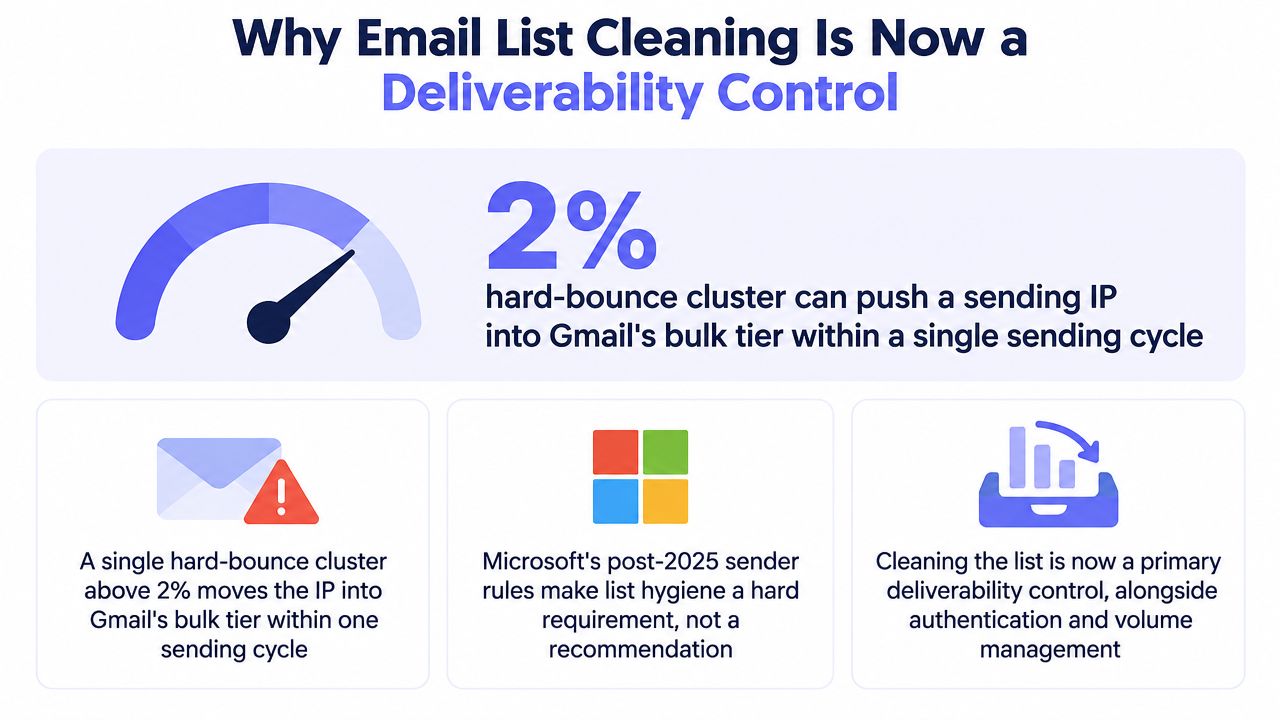
List hygiene is a control-plane function, not a periodic file-cleaning task. An email list cleaning service should convert address signals into a machine-readable decision before a contact reaches an active audience. The relevant output is not merely “valid” or “invalid.” It should identify whether the record is safe to send, requires review, or belongs in suppression, with a reason code and timestamp that downstream systems can use.
Mailbox providers evaluate sending behavior across campaigns and time. Hard bounces, complaint events, and repeated attempts to reach suppressed recipients therefore affect more than the message that triggered them. The sending platform needs a feedback loop that turns those events into durable suppression rules, rather than relying on an operator to export failures and update a list later.
A deliverability survey found that nearly 40% of senders rarely or never perform list hygiene, while more than a quarter clean lists monthly or more often (Mailgun's State of Deliverability takeaways). Among respondents who prioritize hygiene, 47.5% identified sender reputation protection as its largest benefit. The operational implication is clear: verification belongs alongside consent, suppression, and ESP event processing, not in a standalone marketing workflow.
Reactive cleanup versus continuous verification
Reactive cleanup begins after an address has already entered the sending path. The team receives a bounce, exports the failure, and removes the record after the event. That reduces recurrence only if every downstream copy is updated and the address does not re-enter through another import or signup.
Continuous verification attaches a policy decision to each event:
- Signup: assess the address before creating a marketable contact.
- CRM import: verify records before synchronization with an audience.
- Re-engagement: recheck dormant or previously uncertain addresses.
- Batch campaign: validate the final audience before a high-volume send.
Verification latency is operational risk. A response that arrives after account creation cannot reliably gate the signup. A response that arrives after launch supports remediation, not prevention. Vendor testing should therefore record response time under the same conditions as accuracy, including real-time API behavior and queue handling.
Practical rule: Store the reason code, risk score, timestamp, source event, and action taken. That record lets a regulated team reproduce why an address was accepted, reviewed, or suppressed.
A service earns consideration when its result can be consumed by signup controls, CRM rules, and ESP suppression logic. Teams should also test EU data residency, retention settings, webhook delivery, and failure behavior. For a concise definition of the operating discipline, see this guide to email list hygiene. A dashboard label is useful only when it produces an auditable decision that the rest of the sending system can enforce.
How List Cleaning Tools Actually Verify an Address
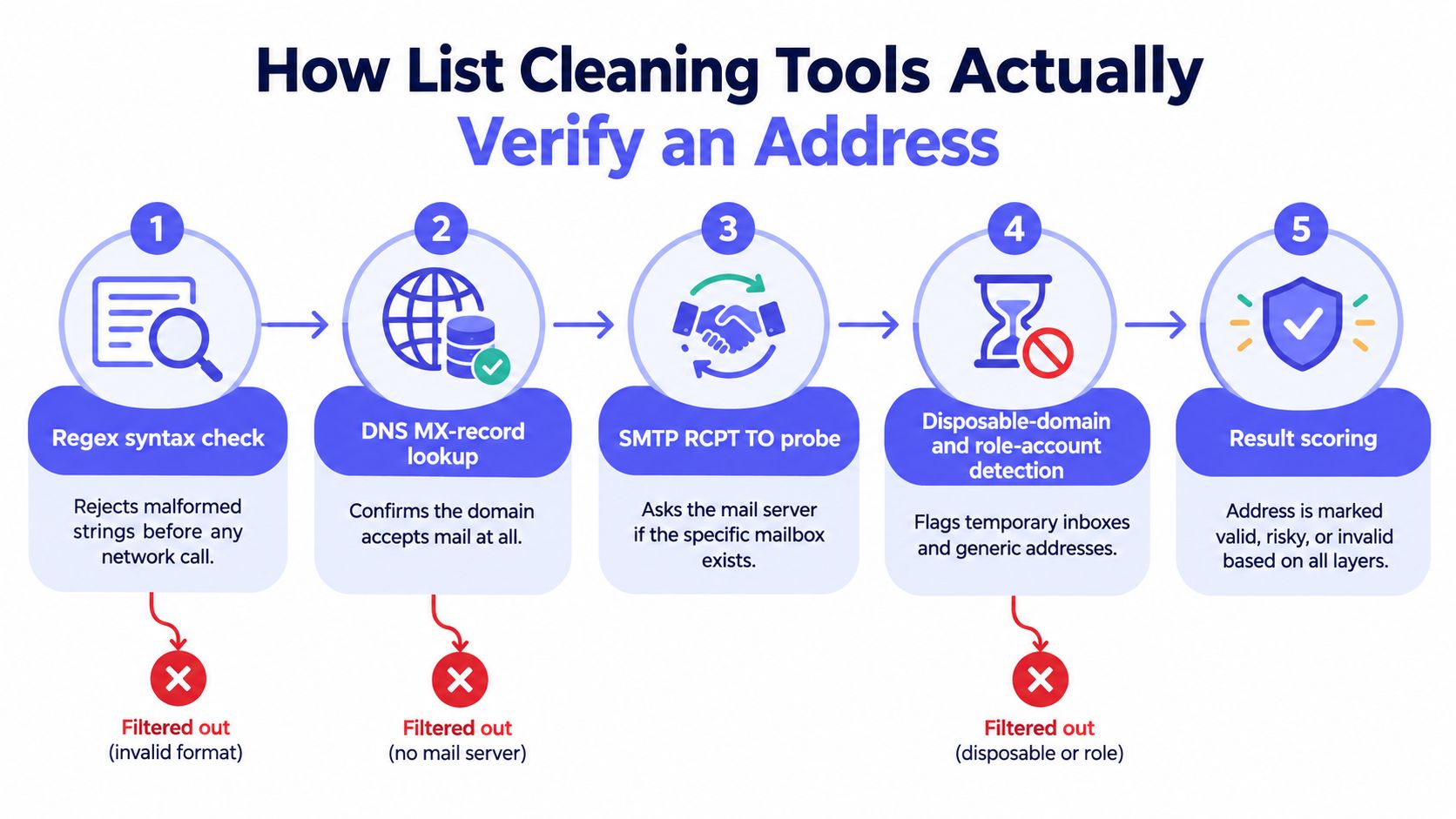
Seven verification layers turn an email address into a machine-readable risk profile. Each layer removes a different uncertainty, but none proves deliverability alone. A domain may accept mail while a mailbox is absent, and an SMTP server may accept a probe before rejecting the eventual message. A syntactically valid address can also be disposable, role-based, catch-all, or unsuitable for a campaign.
The verification layers
Syntax validation examines the address string before a network request. It catches malformed structures, missing domains, illegal characters, and common transcription errors. The result is fast and safe, but it cannot establish mailbox existence.
DNS and MX inspection checks whether the domain publishes mail-handling infrastructure. A positive result indicates that the domain appears able to receive email. It does not confirm that a recipient mailbox exists, is monitored, or should receive marketing messages.
SMTP probing conducts a controlled exchange with the receiving server. This is the most direct technical test, yet greylisting, throttling, privacy controls, and catch-all behavior can produce ambiguous responses. Acceptance during probing does not guarantee final delivery.
Disposable-domain detection compares the domain with known temporary-email patterns and reputation data. It identifies addresses likely to create short-lived accounts or weak campaign value. The policy remains context-dependent, since some legitimate users may need temporary addresses.
Role-account detection identifies addresses such as
info@,sales@, andsupport@. These mailboxes may be active, but they represent a group rather than an individual subscriber. A valid role account may therefore be unsuitable for a personal lifecycle sequence.Catch-all assessment tests whether a domain accepts arbitrary recipients. If it does, mailbox existence becomes difficult to establish. The defensible result is often
unknown, notvalid.Free-provider classification identifies consumer mailbox domains. That classification is not negative by itself. It becomes useful when combined with product policy, fraud controls, or a requirement for a business address.
Read the reason code, not only the verdict
A result limited to valid or invalid leaves product and marketing teams guessing. Prefer structured outputs such as syntax_error, mx_missing, smtp_unknown, disposable, role_account, and catch_all. A policy engine can map each code to allow, suppress, or re-verify, while retaining a deterministic record for audit and later review.
The same address can receive different outcomes under different vendor settings. Probe depth, timeout handling, retry logic, and the treatment of catch-all domains all affect the final classification. A regulated team should therefore compare reason-code coverage and decision consistency, not only the headline pass rate.
Catch-all and unknown results usually require a separate queue. Re-verification, manual review, or a lower-risk communication path can be appropriate until engagement evidence supports promotion into an active send segment. This approach treats list cleaning as an ongoing control: every address carries a status, reason, timestamp, and policy action rather than disappearing into a one-time purge.
Comparing Mailbeam, ZeroBounce, Hunter, and Bouncer
A fair comparison needs a shared decision matrix, not four sales-page summaries. The available independent evidence supports a broad market comparison, but it doesn't provide a controlled, labeled ground-truth scorecard for every named vendor across identical EU endpoints. The table therefore distinguishes independent benchmark evidence from vendor capability claims and marks unavailable fields rather than filling them with assumptions.
| Vendor | Independent Accuracy | Avg SMTP Latency | EU Residency | Batch vs Real-Time | API / Webhook / CRM |
|---|---|---|---|---|---|
| Mailbeam | No comparable independent figure provided in the verified data | Vendor documentation describes low-latency paths and full probes under one second | EU-hosted, EU-only processing stated by the publisher | Real-time API plus CSV and asynchronous batch workflows | HTTP API, webhooks, companion tools, CRM and internal pipeline use |
| ZeroBounce | Independent comparisons show material variation by test design; no vendor-specific figure is established here | Not established in the verified data | EU availability requires contractual and endpoint confirmation | Real-time API and bulk verification | API, integrations, and workflow support described in market coverage |
| Hunter | Independent comparisons show material variation by test design; no vendor-specific figure is established here | Not established in the verified data | EU processing posture requires procurement confirmation | Real-time verification and batch workflows | API and integrations; webhook and CRM scope requires confirmation |
| Bouncer | Independent comparisons show material variation by test design; no vendor-specific figure is established here | Not established in the verified data | EU availability requires contractual and endpoint confirmation | Real-time API and bulk verification | API, integrations, and reporting support; webhook scope requires confirmation |
What the matrix reveals
Accuracy is not interchangeable with deliverability. One benchmark may classify a catch-all address as valid, while another may label it risky or unknown. Unless the procurement team receives the underlying definitions, an accuracy percentage can't tell you how the service behaves on your actual list.
Residency is a contract question. A marketing page may mention GDPR support, but a regulated buyer needs the processing region, sub-processors, deletion behavior, and DPA terms before sending personal data. Mailbeam's publisher materials state EU-hosted infrastructure, EU-only processing, a default DPA, and automatic deletion of batch uploads after roughly 72 hours. Those are specific claims to validate in the contract and technical documentation, not substitutes for validation.
Integration depth determines enforcement. A bulk CSV report helps an operator clean a file. An API with reason codes can block a disposable address at signup. A webhook can propagate a later status change into a CRM or customer-data pipeline. Teams evaluating the email verification API comparison should ask which of those surfaces are available in their required region and plan.
The practical choice is less about finding a universal winner and more about matching a vendor's classification model to the system that consumes it.
Accuracy and Latency Benchmarks Worth Believing
Accuracy and latency should be evaluated as one control, not as separate vendor scores. A result that arrives too slowly can block a real-time signup flow, while a fast verdict without a stable reason code cannot support deterministic routing. For a regulated team, the useful output is machine-readable: a status, risk reason, timestamp, and request identifier that the application can apply consistently.
Published benchmarks show why headline accuracy requires normalization. The independent verification comparison reports materially different accuracy and latency outcomes across vendors, while the SMTP benchmark shows that classification results also shift with the test design. Instead of ranking vendors by the highest percentage, procurement should adjust for catch-all treatment, dataset composition, retry behavior, and whether the measurement used the intended EU endpoint. A result from a clean B2B list does not predict performance on a typo-heavy signup stream.
| Vendor | Verified-Deliverable Rate | False-Positive Rate | Median Latency | p95 Latency, EU Endpoint |
|---|---|---|---|---|
| Mailbeam | No comparable independent figure provided | Not established in the verified data | Not established independently | Not established independently |
| ZeroBounce | Not established under one shared test | Not established under one shared test | Not established in the verified data | Not established in the verified data |
| Hunter | Not established under one shared test | Not established under one shared test | Not established in the verified data | Not established in the verified data |
| Bouncer | Not established under one shared test | Not established under one shared test | Not established in the verified data | Not established in the verified data |
Build a reproducible procurement test
Require every vendor to answer the same questions:
- Ground truth definition: Explain how “deliverable,” “risky,” “unknown,” and “invalid” are assigned.
- Catch-all policy: State whether catch-all addresses are scored, flagged separately, or included in deliverable totals.
- Latency distribution: Provide p50, p95, timeout, and retry behavior for the production endpoint, including its EU availability.
- Dataset controls: Support a blind test containing syntax errors, disposable domains, role accounts, catch-all domains, and known operational addresses.
- Decision export: Return stable reason codes, scores, timestamps, and request identifiers in a machine-readable format.
The denominator determines the meaning of an accuracy claim. A vendor testing a clean business list can appear stronger than one processing mixed consumer domains, malformed input, and uncertain recipients. Ask vendors to disclose exclusions, rechecks, and status changes rather than accepting a single aggregate score.
The procurement decision should therefore measure two two risks: incorrect classification and unacceptable decision time. A lower headline accuracy may be preferable if the vendor exposes transparent uncertainty, consistent codes, and an EU endpoint that meets signup latency requirements. A higher score is less useful when its definitions cannot be reproduced on the list the application will process in practice.
Catch-All and Role-Based Addresses as a Decision Problem
Catch-all and role-based addresses should produce a risk score, not a binary deliverable decision. A catch-all server may accept almost any recipient, so an SMTP response does not prove that the named mailbox exists. A role address may accept mail while reaching a shared function rather than an individual, which changes its value for engagement and consent workflows.
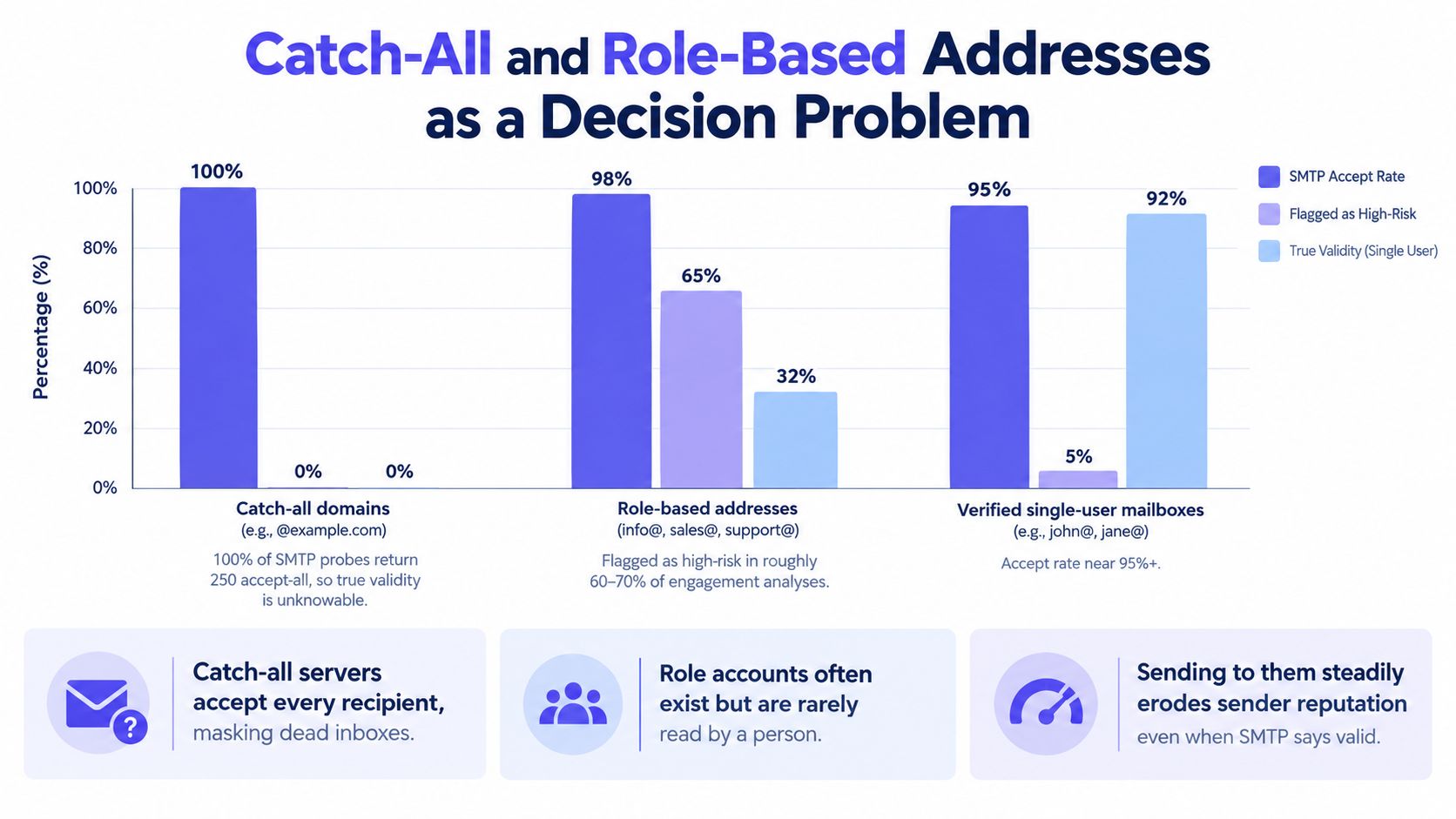
Convert reason codes into policy
A machine-readable result should map to a repeatable action:
| Reason code | Meaning | Default action |
|---|---|---|
catch_all_accept |
The domain accepts arbitrary recipients, so mailbox existence remains uncertain | Quarantine or require an engagement signal |
role_account |
The address represents a function or group | Suppress from personal lifecycle sends, or route to a separate segment |
disposable |
The domain is associated with temporary inboxes | Block in account creation where policy permits |
unknown |
The verifier could not establish a reliable result | Re-verify before a major send |
Provider labels differ, but the application should preserve the distinction instead of collapsing every accepted response into valid. Store the reason code, confidence state, timestamp, and resulting action so later audits can reproduce the decision.
Consider a B2B SaaS signup from a catch-all domain with no prior engagement. Quarantine it for 7 days and promote it only after a click or another approved ownership signal. The same address can be allowed for a transactional password reset when the user has already authenticated and the message is required to complete an account action. The address has not changed. The surrounding risk and purpose have.
Role-based addresses also require context. support@ may be suitable for a service notification, while the same address may be unsuitable for a newsletter or product education sequence. Suppression from personal lifecycle campaigns does not require deletion from every operational workflow.
A deterministic implementation can assign separate scores for address classification, engagement evidence, sending purpose, and account state. Signup, transactional delivery, and batch marketing then apply different thresholds to the same verification result. This approach makes uncertainty visible, supports controlled quarantine, and lets regulated teams explain why an address was accepted, held, segmented, or blocked.
GDPR, Data Residency, and Retention Under the New Rules
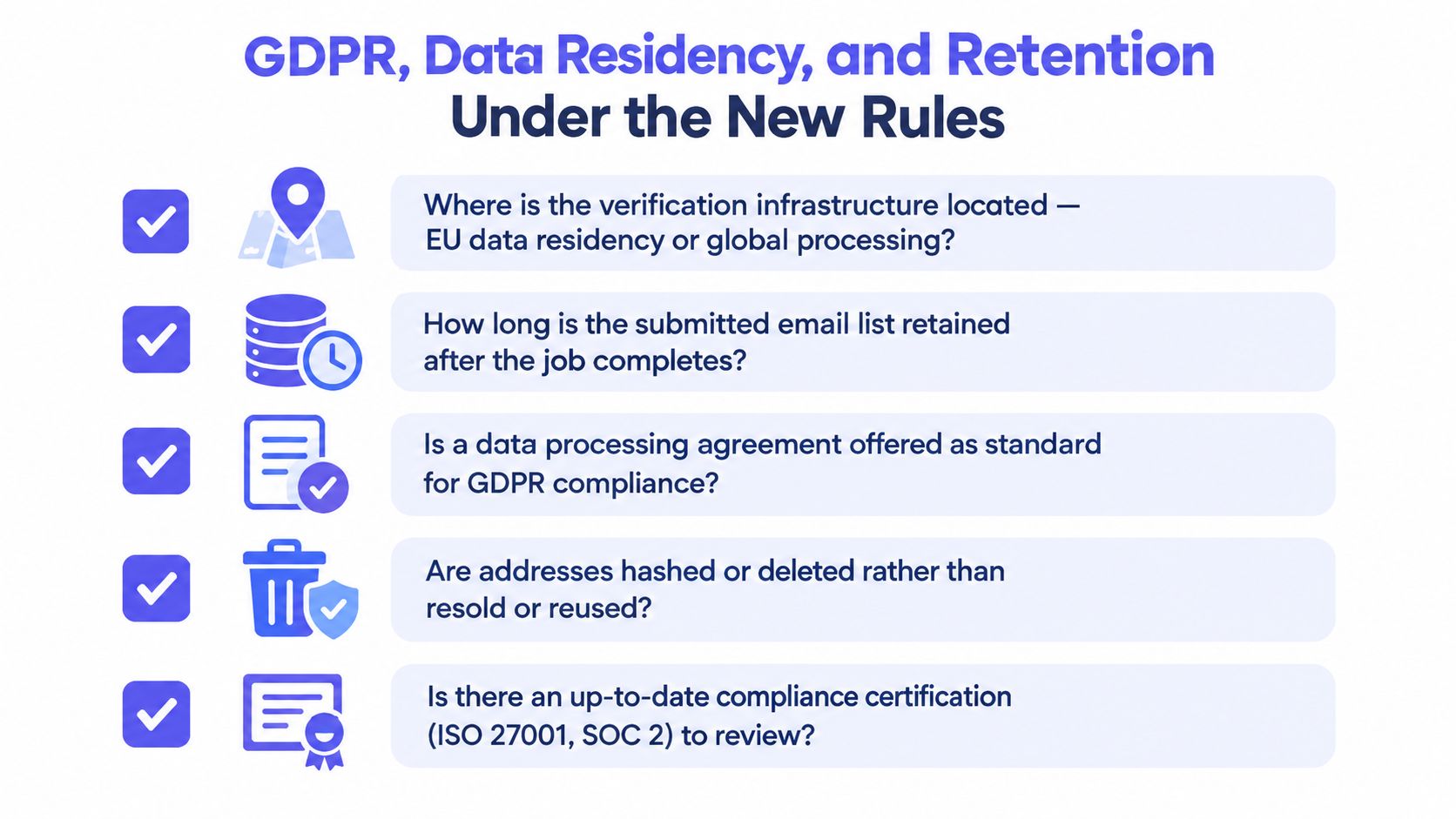
A privacy review for an email list cleaning service should begin before the first address reaches the vendor. The central questions are operational: where does processing occur, how long is data retained, which sub-processors can access it, and can the buyer obtain a signed DPA before production use?
GDPR language alone doesn't answer those questions. A vendor may support EU customers while processing through a global architecture. A provider may delete batch data after completion while retaining logs or derived scores. Procurement should request the exact retention schedule, deletion triggers, processing locations, and subprocessors in writing.
The four questions that belong in the DPA review
- Where is verification performed? Confirm the region for API requests, batch jobs, backups, support access, and subprocessors.
- How long is each data class retained? Separate transient API payloads, batch files, verification results, logs, and account analytics.
- Can the customer enforce deletion? Ask whether deletion is automatic, callable through an API, or dependent on support intervention.
- What evidence is available? Request the DPA, subprocessor list, security controls, audit materials, and current compliance certifications.
For an EU-first implementation, Mailbeam's publisher materials state EU-hosted infrastructure, no cross-border transfers to the United States for verification processing, single-verification deletion after completion, and automatic deletion of batch uploads after roughly 72 hours. Those statements should still be checked against the signed agreement and the actual endpoint configuration. Teams can review the GDPR email verification approach as part of that technical and legal assessment.
Data residency also affects architecture. Synchronous verification can limit exposure when the service discards the address after completion. A batch upload creates a larger processing event, so the team needs a clear job lifecycle, deletion confirmation, and access trail. For regulated organisations, those controls are part of deliverability governance because suppression records and verification decisions may need to be explained during an audit.
API, Webhooks, and Batch Workflows in Practice
An email list cleaning service normally exposes three operational surfaces, and they solve different problems.
| Surface | Typical latency | Pricing unit | Best fit | Compliance caveat |
|---|---|---|---|---|
| Synchronous API | Response time depends on checks, network conditions, and provider behavior | Per verification or plan quota | Signup gating and point-of-capture validation | Address may remain in transient processing systems until completion |
| Batch upload | Asynchronous, with completion time dependent on file size and queue | Verified records, job, or plan quota | Periodic CRM and campaign-list maintenance | Uploaded data may persist for the job lifecycle and configured retention period |
| Webhook | Event delivery after an asynchronous result or status change | Usually included with API or batch workflow | Updating CRMs, CDPs, and internal event pipelines | Payloads and retries need regional routing, authentication, and retention controls |
The API belongs in a signup path when the application must decide before account creation or subscription activation. The implementation should handle timeouts deliberately. A timeout shouldn't automatically become "valid," and a temporary provider failure shouldn't block every legitimate user without a retry or fallback policy.
Batch processing is better for a CRM export or a campaign audience assembled well before send time. It also changes the privacy posture because a file exists outside the originating system. Encrypting the transfer, restricting operator access, and confirming automatic deletion are more important than a polished dashboard.
Webhooks connect the verification result to the rest of the stack. A completed batch can update a CRM segment, while a re-verification event can suppress a previously accepted contact. Require signed webhook payloads, replay protection, idempotency keys, explicit retry behavior, and stable reason-code taxonomies. Also confirm that the provider supports region-specific endpoints rather than assuming the API request and callback travel through the same jurisdiction.
Mailbeam's publisher materials describe a real-time HTTP API, asynchronous CSV and batch processing, webhooks, machine-readable reasons, and EU-only processing. Those capabilities illustrate the architecture a regulated product team should request, but each vendor still needs a test against the team's own timeout, retry, deletion, and audit requirements.
Which Service to Pick for Your Use Case
The right choice depends on where a wrong decision causes the most damage. A marketing team cleaning a dormant audience can tolerate a review queue. A signup funnel cannot leave users waiting indefinitely, and a regulated organisation can't approve a vendor based on a vague privacy statement.
| Persona | Primary requirement | Recommended service | Why it wins | Watch out for |
|---|---|---|---|---|
| High-volume SaaS signup funnel | Low synchronous latency, stable API behavior, and real-time reason codes | Shortlist the vendor that passes the team's EU endpoint latency test | The workflow needs an enforceable response before account activation | Don't accept vendor-wide latency claims without p95, timeout, and retry data |
| Regulated EU organisation | EU processing, DPA, deletion controls, and auditability | Shortlist an EU-first provider whose contractual terms confirm those controls | Residency and retention reduce transfer and governance uncertainty | Validate subprocessors, backups, support access, and deletion evidence |
| Agency cleaning large client files | Batch reliability, exportable reasons, and predictable usage terms | Shortlist the provider with the clearest batch schema and client-level reporting | Agencies need to explain each suppression decision to different customers | Confirm file retention, tenant separation, and repeat-job consistency |
| Growth team preparing a launch | Catch-all treatment and practical segmentation | Shortlist the service that exposes catch-all uncertainty separately | A confidence or risk band supports review instead of blind deletion | Don't place catch-all records in the main send segment without engagement evidence |
| Product team combining signup and campaign data | One policy across real-time and batch paths | Shortlist the provider whose API and batch reason codes align | Consistent classifications reduce policy drift between engineering and marketing | Test whether asynchronous results use the same definitions as synchronous checks |
The decision rule should be explicit. If your organisation operates in the EEA and sends more than 50,000 messages per day, residency and DPA availability should outrank small differences in headline accuracy. That threshold comes from the supplied operational brief, and the sender-authentication context is reinforced by coverage of Microsoft's 2025 requirement for senders over 5,000 emails per day to consumer domains in the email list cleaning services analysis. For other teams, methodology transparency, catch-all policy, and API latency should dominate the scorecard.
Mailbeam fits the shortlist when the requirements include EU-hosted processing, real-time HTTP verification, explainable reason codes, asynchronous batch cleaning, and webhook delivery. ZeroBounce, Hunter, and Bouncer should be evaluated through the same blind dataset and contractual checklist. No vendor should receive approval solely because its marketing page reports a high accuracy figure.
Mailbeam provides real-time email verification through an HTTP API, machine-readable scores and reasons, batch list cleaning, webhooks, and EU-focused data handling. Use your own signup records and campaign export to test catch-all decisions, latency, retention, and suppression workflows, then visit Mailbeam to review the platform and documentation.