
The most popular advice about EU data residency is also the most misleading: put your database in Europe and the compliance problem is solved. A European server location is useful, but it answers only where one part of your system stores data. It doesn't tell you where verification requests are processed, where logs and backups are kept, which country governs your vendor, or whether support staff can access customer information from outside the EU.
For product teams, residency should be treated as a full-lifecycle architecture and procurement decision. The practical question isn't just, "Is the data in Europe?" It's, "Can we prove that personal data, operational metadata, temporary files, human access, and exit processes remain within acceptable legal and technical boundaries?"
Table of Contents
- The Hidden Gap Between Hosting and Sovereignty
- Defining Cross-Border Transfers Under GDPR
- Why Email Verification Demands Localized Processing
- Evaluating Vendors Beyond the Region Label
- Aligning Infrastructure With Legal Safeguards
- Integrating Compliant Verification Into Product Flows
- Scaling Infrastructure for Future Data Demands
The Hidden Gap Between Hosting and Sovereignty
An EU server location does not, by itself, make a service sovereign. A rack in Frankfurt may belong to a company incorporated elsewhere, rely on subprocessors in other jurisdictions, or be managed by administrators accessing systems from outside the EU. The data sits in Europe, while corporate control and remote access create separate legal questions.
That distinction should shape procurement. The EU Cloud Sovereignty Framework assesses more than a region label, including legal, operational, supply-chain, and technological controls. A vendor that advertises “EU hosting” but cannot explain those controls has described infrastructure location, not the full sovereignty position.

Residency answers where, sovereignty asks who
Data residency identifies where data is stored or processed physically. Data sovereignty concerns the jurisdiction that can govern the data, compel access, or control the organization handling it. The terms overlap, but they describe different risks.
An email verification request shows the gap. A user's address may reach an EU endpoint, then appear in observability data, application logs, backups, or support tooling. It may also be accessible to personnel outside the region. A server-location statement does not account for that processing chain.
Product teams should request evidence for each surface:
- Primary processing: Where does the API receive and evaluate the address?
- Temporary storage: Are request bodies, uploaded files, or queued jobs retained?
- Operational metadata: Can logs include the address, request identifiers, tenant names, or diagnostic payloads?
- Backups and disaster recovery: Do replicas and recovery environments remain in the EU?
- Human access: Can support or engineering staff inspect customer data from outside the region?
- Corporate jurisdiction: Which entity controls the service and responds to legal demands?
- Exit rights: Can the vendor return or delete data, logs, and backups when the contract ends?
Practical rule: Treat “EU-only” as a claim that requires a system diagram, contract language, access policy, and documented deletion process.
European infrastructure supports local processing, but capacity does not establish sovereignty for a SaaS vendor. A 2026 industry estimate counts 2,269 data centres across EU countries, while another estimate places Europe above 3,300 locations in 2024 and projects approximately 4,139 by 2035. These figures show expanding regional capacity. They do not verify where a vendor's metadata, support access, subprocessors, or exit processes are controlled. Architecture, contracts, and operating procedures determine that answer.
Defining Cross-Border Transfers Under GDPR
GDPR doesn't impose a blanket rule that every item of personal data must remain inside the EU or EEA. It does, however, regulate transfers to third countries, and the definition of a transfer is broader than many engineering teams expect.
The European Commission's 2024 clarification treats an international transfer as a disclosure of personal data to a controller or processor in a third country, even when that recipient is itself subject to GDPR. In practical terms, a vendor can't avoid transfer analysis just by saying, "Our company follows GDPR." If a non-EU processor receives or can access the data, the transfer question remains relevant.
The Bitkom GDPR time series found that 61% of companies transferred personal data to another country in 2025, compared with 64% in 2023 and 52% in 2021. Cross-border handling remains common, but common practice doesn't remove the need for a documented legal basis and appropriate safeguards.
Why an EU database isn't enough
A signup system might store user records in an EU cloud region while calling a verification endpoint operated elsewhere. The database remains in Europe, yet the email address has already been disclosed outside the region during the request. The same issue can arise through a remote support session, an error-tracking integration, or a backup service.
For a product engineer, the relevant design questions are concrete:
- What data leaves the application? Limit the request to the information required for the verification decision.
- Which entity receives it? Identify the processor, its location, and any subprocessors.
- What safeguards apply? Confirm the contractual and technical measures used for third-country access or transfers.
- Where does access occur? Review support, administration, monitoring, and incident-response paths.
- How long is the data retained? Short retention reduces the amount exposed if a transfer or access event occurs.
An EU-hosted primary database can reduce transfer complexity, but it doesn't replace a GDPR email verification design that accounts for the whole request lifecycle. The legal and technical records should describe what happens at the API boundary, not just where the final customer record is stored.
This is why residency is operationally meaningful even though GDPR doesn't require blanket localization. Keeping processing in an EU region can reduce the number of transfer mechanisms, contracts, and access paths your team must assess. It doesn't create an automatic legal shield.
Why Email Verification Demands Localized Processing
Email verification is often the first service to receive a user's personal data. It can run before account creation, before consent preferences are fully synchronized, and before the address enters your main customer database. That makes the endpoint an important control point rather than a minor utility.
The risk isn't limited to the email address in the request body. Real-time checks can generate request logs, timestamps, tenant identifiers, result codes, and diagnostic traces. Bulk CSV cleaning adds uploaded files, queued jobs, worker storage, result exports, and webhook payloads. Each artifact can create a data shadow outside the region your procurement team approved.
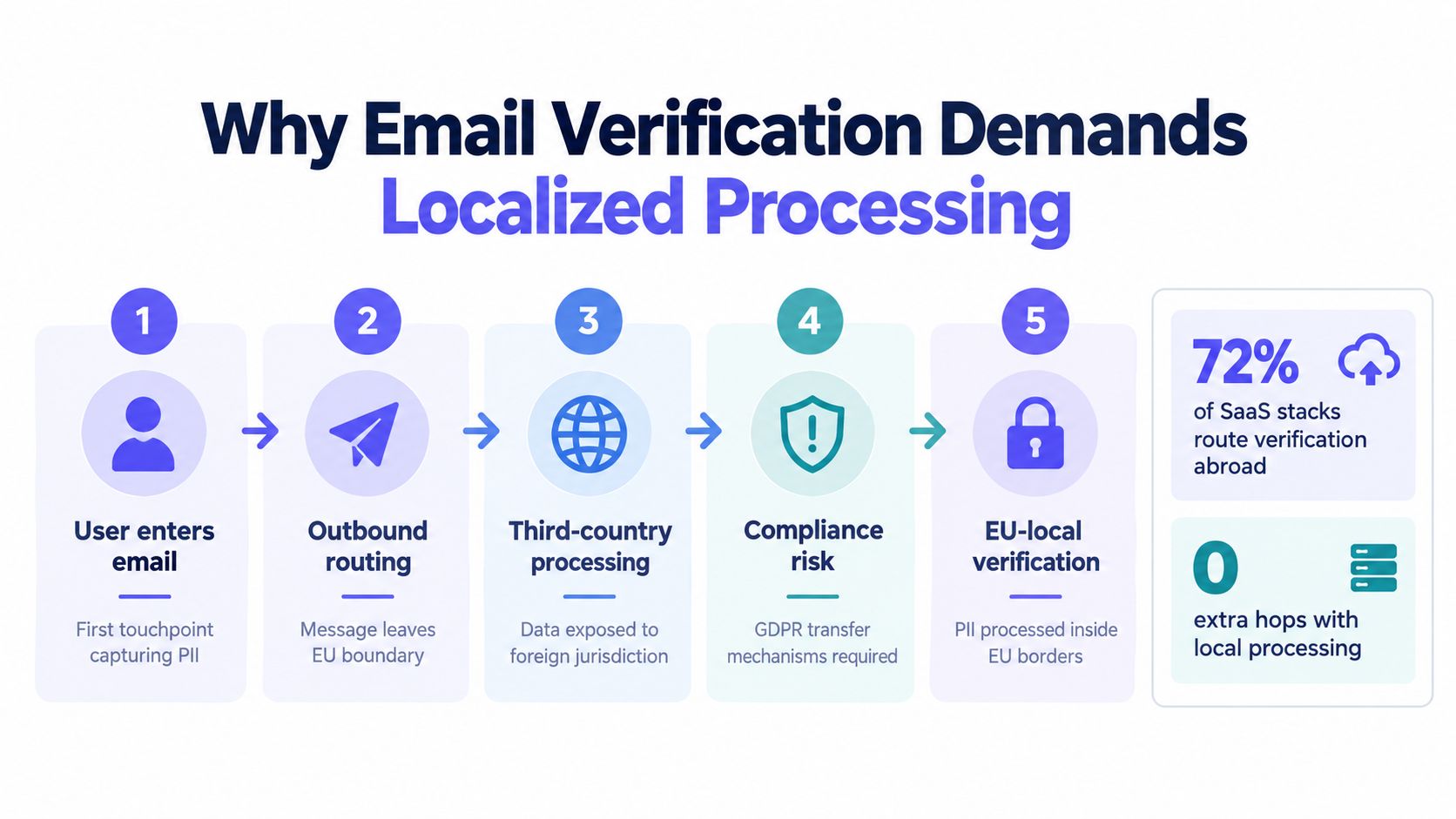
Trace the request, not just the database
Start with the synchronous path. A user submits an address, your backend sends it to the verifier, the verifier performs syntax, domain, and mailbox checks, and your application receives a result. Confirm the location of each stage, including caching and operational telemetry.
Then trace the batch path separately. A CSV upload usually follows a different architecture, and vendors may retain the file while workers process it or while users download results. Ask whether the upload, processing queue, temporary files, result file, and webhook delivery stay in the same approved boundary.
A localized provider such as the EU-hosted email verification option from Mailbeam can reduce the number of cross-border paths your team must evaluate, provided the provider documents processing, storage, backups, and access controls clearly.
Local processing reduces more than legal ambiguity
Processing in Frankfurt or another EU region can reduce residency risk and simplify the evidence you provide during a customer review. It can also keep the verification workflow closer to European users, although performance depends on the entire request path, not the region label alone.
Localization doesn't remove every compliance obligation. You still need a lawful processing basis, appropriate notices, access controls, retention rules, and vendor documentation. It also doesn't solve sender reputation by itself. Verification helps protect list quality only when your application uses the result consistently, for example by rejecting disposable addresses where appropriate and preventing clearly undeliverable addresses from entering sending systems.
Show the vendor a concrete data-flow question: “Where can this email address exist from submission through deletion?” A credible answer should cover API workers, queues, logs, backups, support tools, and incident handling. If the answer stops at “our servers are in Europe,” the assessment is incomplete.
The accompanying explainer illustrates the sequence product teams should inspect, from the first PII touchpoint through outbound routing and third-country processing to an EU-local verification path:
Evaluating Vendors Beyond the Region Label
Vendor evaluation should begin with evidence, not marketing terminology. “Hosted in the EU,” “European cloud,” and “GDPR-ready” can describe useful controls, but none of those phrases tells you whether a provider restricts administrative access or keeps backups in the same jurisdiction.
Use the vendor's answers to build a processing map that security, engineering, procurement, and legal teams can all review. The strongest vendors will identify the relevant entities, subprocessors, retention periods, support model, and deletion behavior without forcing you to infer them from a generic privacy page.
A practical audit checklist
| Evaluation Area | Surface-Level Claim | Required Sovereignty Control |
|---|---|---|
| API processing | “Requests run in Europe” | Documented EU processing region, routing controls, and a clear list of processing entities |
| Databases and queues | “Data is stored in the EU” | EU location for primary storage, caches, queues, and temporary worker storage |
| Logs and telemetry | “We don't sell customer data” | Redacted payloads, EU-resident observability, defined log retention, and restricted log access |
| Backups | “We use secure backups” | EU-only backup and recovery locations, encryption, deletion schedules, and restoration procedures |
| Subprocessors | “We use trusted providers” | Current subprocessor register, purpose for each provider, location, and change-notification process |
| Human support | “Support can help with incidents” | EU-based access where possible, approval workflow, session logging, and no default content visibility |
| Corporate control | “Your data is in Frankfurt” | Legal-entity disclosure, jurisdiction analysis, and documented response to government demands |
| Exit and deletion | “You can export your data” | Usable export, deletion confirmation, retention after termination, and assistance without hidden dependencies |
Ask questions that expose the real boundary
Ask whether a support engineer can view a failed verification request. Ask whether an observability vendor receives request bodies. Ask where disaster recovery runs when the primary region is unavailable. Ask whether the service can disable third-country subprocessors for your account.
Retention deserves special attention. A provider may avoid permanent storage while still retaining request data in logs or queues. Require separate retention statements for real-time checks, uploaded lists, generated results, audit trails, and support tickets.
A vendor's sovereignty claim is only as strong as its least visible operational system.
The final test is whether the answer survives a customer audit. You should be able to provide a DPA, subprocessor list, architecture summary, retention schedule, access policy, and deletion process without relying on verbal assurances. If those documents don't align, treat the mismatch as a product risk.
Aligning Infrastructure With Legal Safeguards
Technical controls and legal documents must describe one operating model. A DPA can assign processing roles and obligations, but it cannot make a non-EU logging service EU-resident. An EU-only deployment also needs contractual limits on international access, retention, and support operations.
Document the processing purpose before choosing controls. Email verification may determine whether an address is syntactically valid, linked to a functioning mail domain, disposable, role-based, or unsuitable for a workflow. That purpose should determine which fields you collect, which result you return, and how long raw input remains available.
Turn minimization into an enforced behavior
Retention policies are stronger when the architecture enforces them automatically. A real-time endpoint can return a decision and discard the submitted address after completion. A batch workflow may require temporary storage for processing and download, but it needs a defined deletion trigger and documented recovery policy.
Mailbeam's stated handling model uses no retention for single real-time checks and automatic deletion of batch uploads after approximately 72 hours, as described in its product information. These are product-specific controls, not universal GDPR requirements. Verify that the contract and current technical documentation match the service configuration you deploy.
Use a retention schedule that separates data classes:
- Request content: Keep it only long enough to produce the result.
- Verification result: Retain it only when the product needs an audit trail or support record.
- Operational logs: Remove raw addresses while preserving technical diagnostics for a defined period.
- Batch files: Delete source and generated files through an automated lifecycle rule.
- Support artifacts: Restrict access and remove attachments when the incident closes.
Make audit readiness part of the design
The DPA should identify the subject matter, processing purpose, data categories, retention approach, subprocessor rules, and assistance obligations. It should match the vendor's stated region and access controls. If procurement requires evidence of EU-only processing, request architecture and operational documents before production integration.
A credible answer must cover API workers, queues, logs, backups, support tools, and incident handling. Ask who can view a failed verification request, whether an observability provider receives request bodies, where disaster recovery runs during regional outages, and whether third-country subprocessors can be disabled for your account.
Do not promise “zero risk” to customers. State which controls the architecture provides, which protections the contract provides, and where residual risk remains. An audit-ready package should include a data-flow diagram, DPA, subprocessor register, deletion policy, access-control summary, incident process, and export procedure. Store these artifacts with the service approval record and review them when infrastructure or subprocessors change.
Integrating Compliant Verification Into Product Flows
A GDPR-aware integration should make the compliant path the easiest path for developers. Keep the verification call on your server, send only the required address, and prevent account creation when the result doesn't meet your product's policy. Don't expose provider credentials in browser code or copy raw provider responses into general-purpose logs.
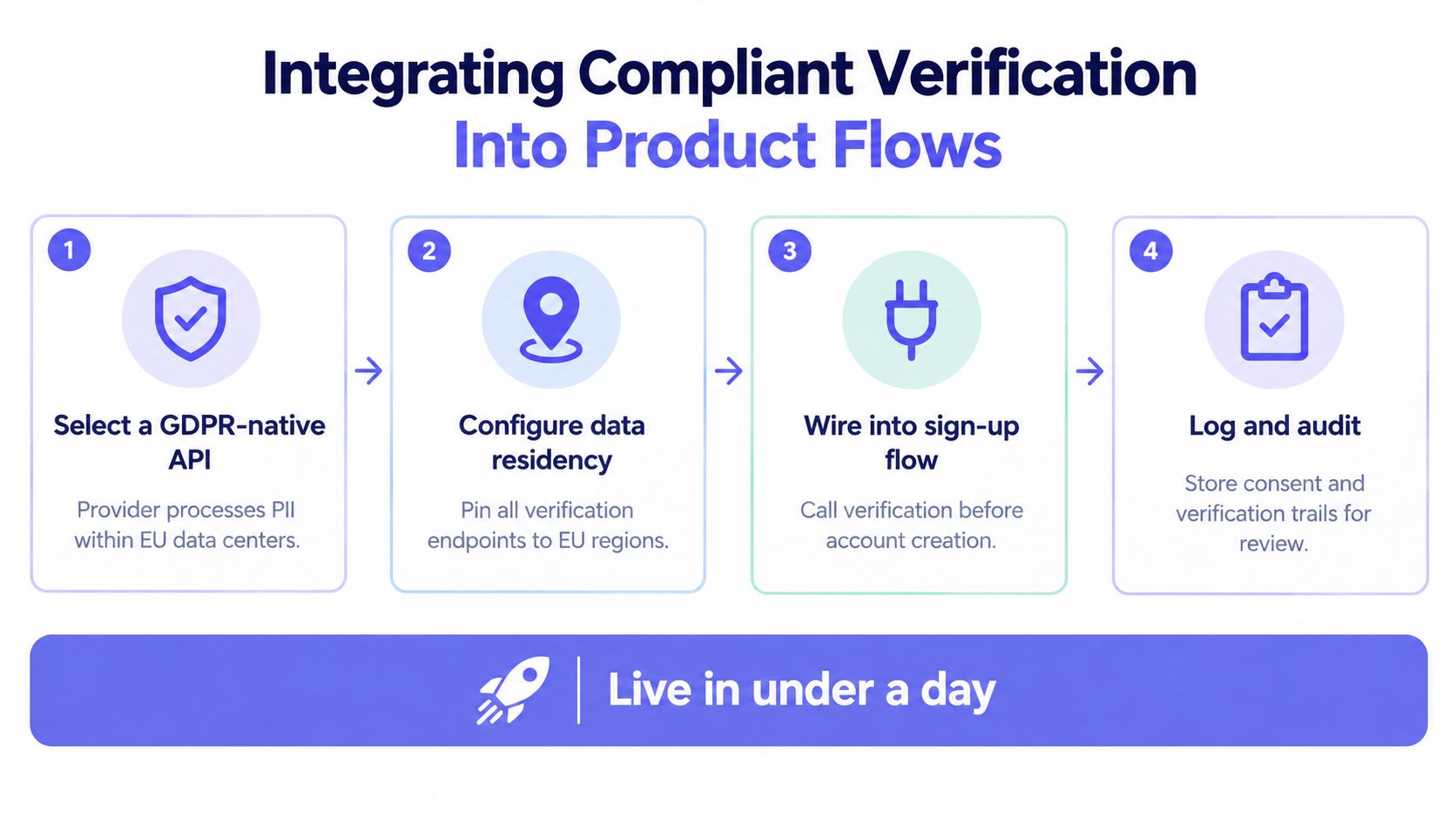
Build the synchronous signup path
A practical flow looks like this:
- Accept and normalize the address. Apply the same normalization rules your account system uses, while avoiding unnecessary copies of the raw value.
- Call the EU-pinned verification endpoint. Keep the request server-side and set a timeout that protects the signup experience.
- Interpret reason codes, not only a boolean. A disposable address, a malformed address, a role account, and a temporary verification failure need different user messages and retry behavior.
- Create the account according to policy. Store the minimum result needed for your audit or product workflow, and don't retain the full provider payload by default.
- Record a narrow audit event. Capture the decision, policy version, timestamp, and internal user reference without placing the email address in every diagnostic stream.
Explainable results matter operationally. If a user sees “invalid email” when the actual issue is a temporary mailbox check failure, they may retry unnecessarily or contact support. Machine-readable reasons let your team distinguish a hard rejection from a recoverable error.
Handle bulk cleaning as a separate workflow
Bulk list cleaning shouldn't block an interactive request. Upload the file through an authenticated backend flow, create an asynchronous job, process it inside the approved EU boundary, and deliver results through a protected download or webhook. Keep source files, generated outputs, and job metadata under separate retention rules.
Webhooks should contain the minimum result needed by the receiving system. Verify their authenticity, make delivery idempotent, and prevent payloads from entering unrestricted event logs. A failed webhook should trigger a controlled retry path, not an ad hoc export to a third-party messaging channel.
Test the integration before launch with failure cases, including timeouts, provider unavailability, ambiguous results, duplicate submissions, and deletion verification. Compliance depends on these operational paths as much as on the successful request.
Scaling Infrastructure for Future Data Demands
European infrastructure gives product teams more options for local processing, but additional capacity does not establish sovereignty by itself. Capacity across the European data-centre market is expanding, supporting regional architectures for workloads that require local storage and processing. The relevant question is whether every part of the service lifecycle stays within the approved boundary.
A provider may scale compute in Europe while placing telemetry, support access, backups, or disaster recovery elsewhere. Treat regional growth as an infrastructure opportunity, not evidence that every European service is sovereign. Request a current data-flow map and verify where submitted addresses, derived results, logs, support tickets, encryption keys, and administrator sessions are handled.
Design for volume without widening the boundary
High-volume verification requires predictable queueing, regional failover, controlled concurrency, and defined deletion behavior. Ask where workers scale during demand spikes, which region handles fallback, and whether temporary buffers remain inside the approved jurisdiction.
Separate the control plane from customer content where practical. Account settings, usage counters, and billing metadata may carry different risks from submitted addresses, yet each still needs documented storage locations, retention periods, and access rules. Keep encryption keys, operational credentials, and audit records within a model that legal and security teams can explain to customers.
A high-volume email verification workflow should support quotas, asynchronous processing, webhook delivery, and export management. These controls matter during maintenance, migrations, and incident response, when teams may otherwise create temporary copies or send data through unapproved tools.
Treat exit rights as part of sovereignty
Vendor assessment is incomplete until the exit path works. Confirm that your team can export verification results in a usable format, delete source and derived data, retrieve audit records, and replace the endpoint without rewriting product logic around proprietary behavior.
The Cloud Sovereignty Framework reflects a broader procurement approach that examines multiple controls rather than relying on a region label. For a startup, that means preserving portability, documenting dependencies, and treating retention rules, API semantics, support access, and recovery procedures as contractual design constraints.
Choose EU data residency as a capability supported by evidence. Map the complete lifecycle, contract the controls, test deletion, review privileged access, and rehearse an export and provider replacement before a customer audit exposes the gaps.
Mailbeam provides an EU-hosted email verification API for real-time signup checks and bulk list maintenance, with GDPR-oriented processing, reason codes, webhooks, and documented retention behavior. Review the full processing path and vendor controls, then visit Mailbeam to assess whether its verification workflow fits your EU data residency requirements.