
Your signup flow looks clean. The form creates an account, stores the customer in the CRM, and triggers a welcome sequence. Then someone notices that the marketing checkbox was bundled with the terms, the CRM has retained every field indefinitely, and a customer asking to be forgotten has no obvious path through the email platform, warehouse, or suppression list.
That situation is common because GDPR compliant email marketing isn't one checkbox or one privacy-policy link. It's a set of connected engineering decisions: why you may process the data, whether you may send the message, what evidence you retain, how you stop future sends, and how a person can exercise their rights.
GDPR took effect on 25 May 2018. For email programs, consent must be freely given, specific, informed, and unambiguous, with an affirmative opt-in rather than a pre-ticked box or silence. The GDPR email-marketing requirements also make evidence and withdrawal central to the design.
Table of Contents
- Why Most Email Programs Are Not Actually GDPR Compliant
- The Three Lawful Bases That Actually Apply to Email Marketing
- Designing Consent That Survives an Audit
- Data Minimisation and Retention Without Losing Defence Evidence
- Handling DSARs, Erasure, and Right to Object in the Marketing Stack
- How EU-Hosted Verification Reduces Compliance Risk at Signup
- Three GDPR Myths That Keep Landing Teams in Trouble
Why Most Email Programs Are Not Actually GDPR Compliant
The most frequent failure is treating the entire email stack as one legal activity. It isn't. Your product processes an email address when it collects, stores, enriches, segments, and exports it. Your sending activity is a separate question, often governed by ePrivacy or PECR rules alongside GDPR.
That distinction matters in practice. GDPR governs the processing around the message, including lawful basis, transparency, minimisation, retention, and rights handling. Electronic-marketing rules govern whether you may send the message in the first place. The ICO guidance on legitimate interests reinforces that direct marketing by electronic mail is not a simple GDPR catch-all. Consent and soft opt-in rules may apply to the send even when another processing activity has a different legal basis.
The signup form is only the first control
A compliant design starts by separating account access from promotional communication. Accepting terms lets you provide the service. Choosing marketing emails is a distinct decision, and the person must be able to make it freely.
The CRM then needs a defined lifecycle. Keeping every field forever creates unnecessary exposure and makes access or erasure requests harder to complete. Marketing data should have a purpose, an owner, a retention rationale, and a clear route into the suppression system when consent is withdrawn.
Engineering principle: Treat every email use case as a small data-processing system, not as a campaign setting.
Four artifacts make that system auditable:
- A lawful-basis matrix: Record the basis for newsletters, promotional campaigns, product messages, and transactional notices.
- An append-only consent log: Preserve what the person saw, when they acted, where they acted, and what channel they selected.
- A lifecycle model: Separate active subscriber data from minimal suppression evidence and define deletion triggers.
- A rights workflow: Connect the CRM, email service provider, analytics warehouse, enrichment vendors, and support process to one DSAR path.
This article focuses on those artifacts. It doesn't replace jurisdiction-specific legal advice, and it doesn't assume that GDPR consent alone answers every electronic-marketing question. The important starting point is to ask two separate questions: what permits us to process this data, and what permits us to send this message?
The Three Lawful Bases That Actually Apply to Email Marketing
GDPR provides several lawful bases, but most email teams repeatedly work with three: consent, legitimate interests, and performance of a contract. Think of them as three different keys. A contract key opens the door to service delivery, a consent key opens an optional communication channel, and a legitimate-interest key requires a documented balancing exercise.
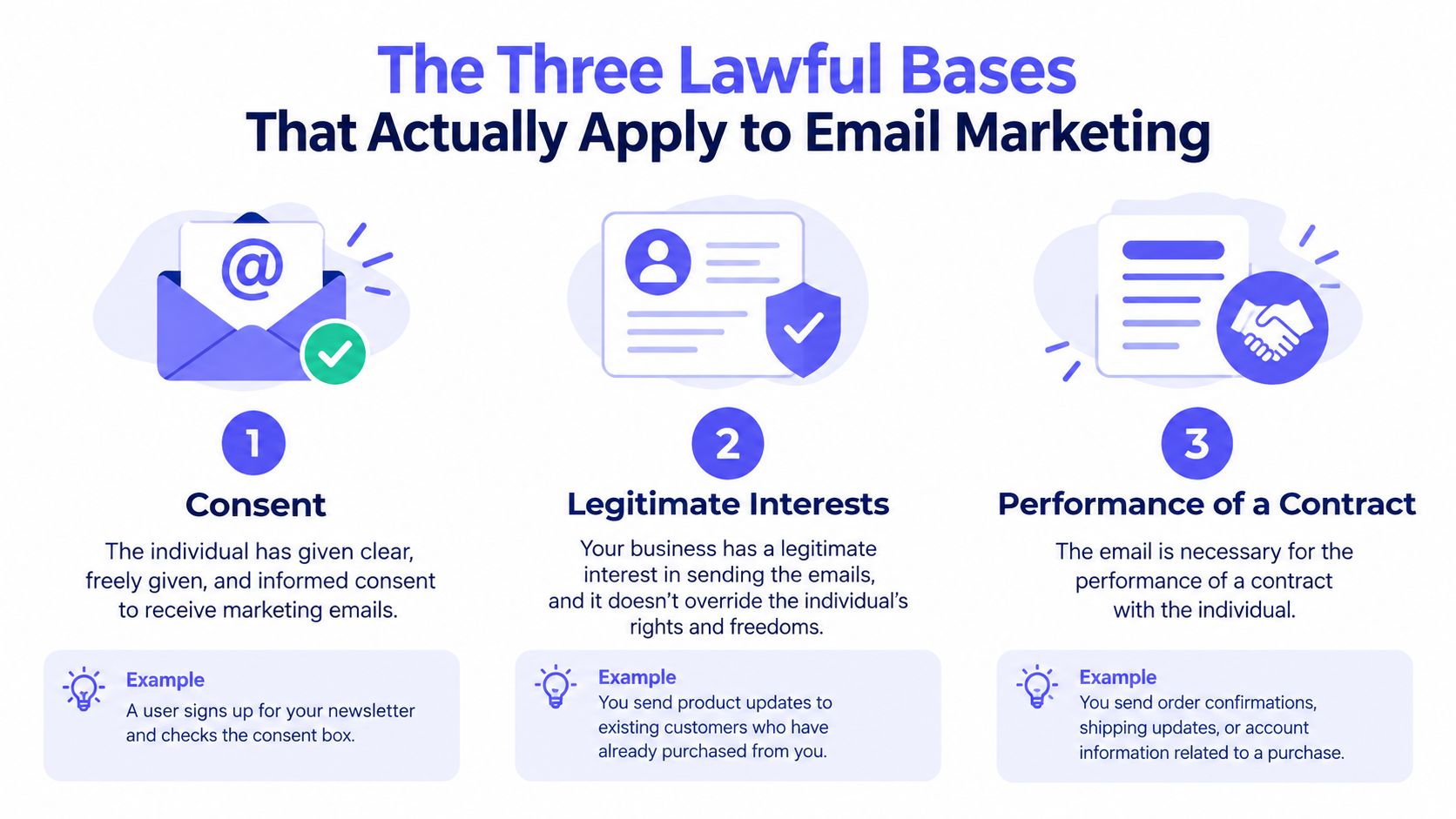
Lawful bases for email marketing at a glance
| Lawful basis | Best fit | Key limitation |
|---|---|---|
| Consent | Newsletters, promotions, and optional product communications | It must be freely given, specific, informed, unambiguous, and easy to withdraw |
| Legitimate interests | A carefully assessed processing purpose, such as certain enrichment activities | It requires necessity and balancing, and it isn't a shortcut around prior consent rules for direct email |
| Performance of a contract | Password resets, service notices, receipts, and other required account messages | It doesn't turn promotional content into transactional content |
Consent is usually the clearest basis for marketing campaigns. The person actively chooses the channel and purpose, and your system records the decision. A pre-ticked box, silence, or a requirement to accept marketing before creating an account doesn't meet the stated consent standard. The consent request should identify the purpose in language a reasonable user can understand.
Contractual necessity applies to messages needed to provide what the user requested. A password reset or account-security notice supports the service relationship. If that message adds a product promotion, cross-sell, or unrelated campaign content, classify that additional use separately rather than assuming the whole email inherits the contract basis.
Legitimate interests is narrower than many outbound teams assume. The EDPB legitimate-interest guidelines state that direct marketing by email generally requires prior consent in the relevant electronic-marketing context and that direct-marketing processing may not use Article 6(1)(f) as a shortcut. Where a team relies on legitimate interests for another activity, it still needs to document the purpose, necessity, and balance, then check whether separate send rules apply.
A useful decision sequence is simple:
- Is the message required to provide the service? Consider contract.
- Is it optional marketing? Collect a separate affirmative opt-in unless a clearly applicable exception has been reviewed.
- Is the activity enrichment, analysis, or another surrounding process? Document its own basis and don't let it automatically authorise a marketing send.
Designing Consent That Survives an Audit
Consent is an output your system produces, not a visual state on a form. A checkbox tells you what the interface looked like today. An audit record must reconstruct what a particular person saw and did at the relevant moment.
Start with the wording. The marketing choice should be separate from terms acceptance, optional, and specific about the channel and purpose. Avoid a single phrase such as “I agree to be contacted” when the program includes newsletters, promotions, product updates, and other categories.
Capture the decision, not just the current status
A durable consent event should contain at least:
- Exact consent wording: Store the text shown to the person, not only a template identifier.
- Notice versions: Record the privacy-notice and consent-language versions displayed at collection.
- Scope: Identify the channel, communication category, brand, and relevant market.
- Time and source: Save a UTC timestamp, source form or campaign, and the collection context.
- Actor and technical evidence: Retain the account identifier and, where appropriate and justified, the IP address or another submission identifier.
- State transition: Record whether the event granted, declined, modified, or withdrew consent.
The ICO email-marketing guidance emphasises keeping evidence of consent and making withdrawal easy. That means your log should be append-only. Don't overwrite “subscribed” with “unsubscribed” and discard the earlier state. Add a withdrawal event that points to the original consent record.
A working unsubscribe link is part of the product surface, not an email-template decoration. It should update the suppression system immediately, without a login wall, and the send service should consult that suppression state before every campaign. If you validate an address during signup, keep that check separate from the consent decision. Real-time email validation can help identify unusable addresses before they become active records, but it doesn't create marketing permission.
Make withdrawal cross-channel
A person may consent to email but later withdraw all promotional communication. Your preference service needs to represent individual purposes and a global suppression state. Every sending stream, including CRM-triggered sequences and manually uploaded audiences, must query that state.
Use a schema that supports investigation:
consent_event_id, subject_id, purpose, channel, action, exact_text, notice_version, source_form, timestamp_utc, submission_identifier, and previous_event_id.
Keep access to the log restricted. Auditability doesn't mean every marketing operator should be able to browse raw personal data. The design goal is to prove the decision while minimising who can see the underlying identifiers.
Data Minimisation and Retention Without Losing Defence Evidence
Deletion and evidence aren't opposites. A well-designed email system deletes data that no longer serves a purpose while retaining a narrow record needed to honour a previous objection or defend a processing decision.
GDPR doesn't prescribe a fixed retention period for email-marketing consent records. Retention must relate to necessity and the organisation's ability to defend its processing decisions. The GDPR retention guidance for email programs describes the practical balance: preserve evidence while relying on consent and for a reasonable period afterward, while avoiding unnecessary personal fields.
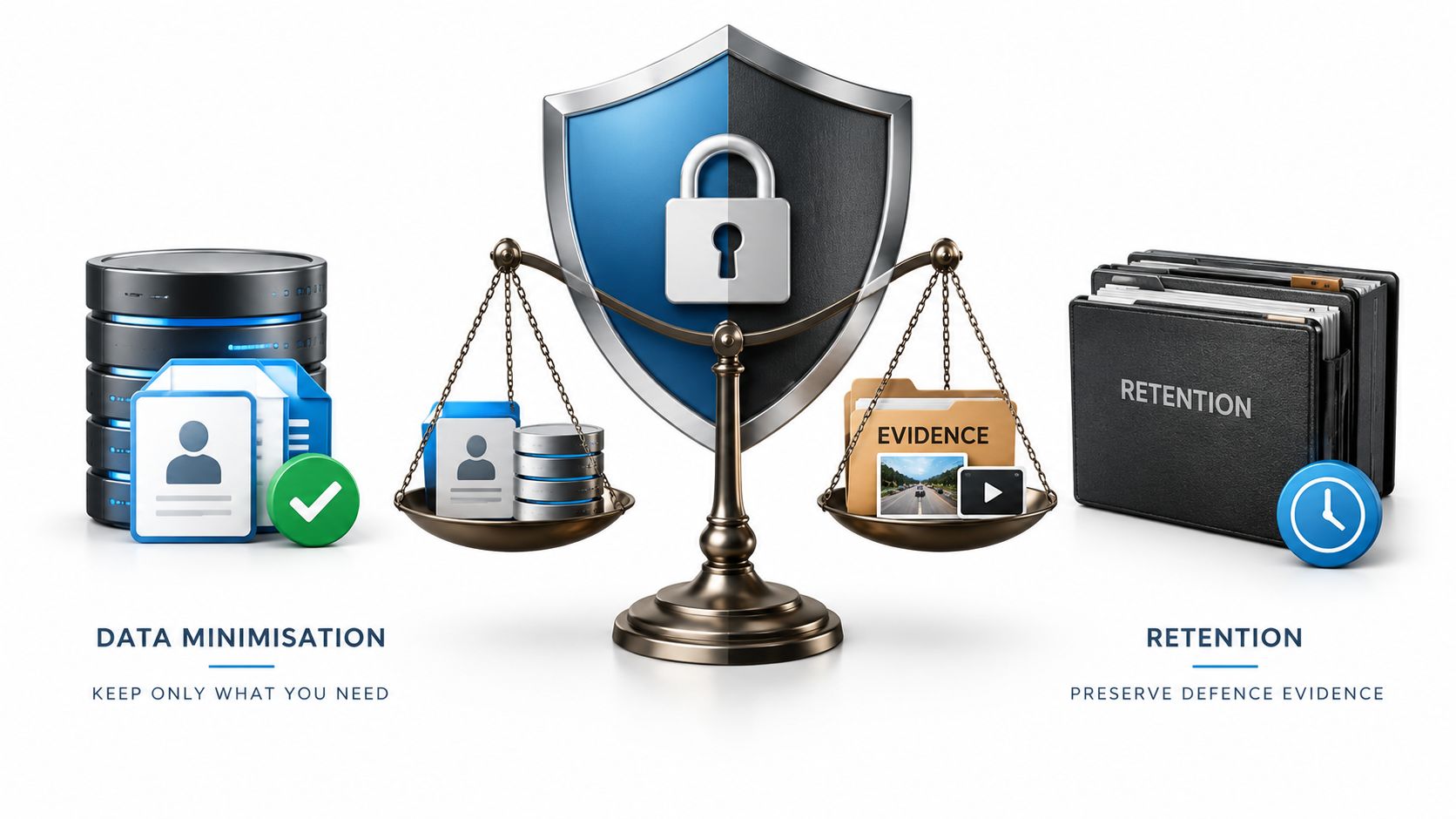
Use two data structures
An active subscriber table and a suppression table serve different purposes.
The active table should contain only what current delivery and preference management require. That may include the address, communication preferences, consent reference, and limited personalisation fields. It shouldn't become a general-purpose archive for every enrichment attribute, event, and behavioural signal your company has ever collected.
The suppression table should contain only what prevents re-marketing and supports a defensible audit trail. Depending on your design and legal review, that can include a protected or hashed address, the original consent reference, the withdrawal or erasure reason, and the event timestamp. It must never be treated as an audience source.
At unsubscribe, remove nonessential fields from the active record, write the suppression event, and propagate the state to the ESP, CRM, warehouse, and campaign tooling. A dedicated email list management workflow helps operations teams keep active, invalid, and suppressed populations distinct, but the legal design still belongs to your organisation.
Retention rule: Keep the smallest record that prevents a new send and proves why the address must remain suppressed.
This separation reduces the scope of future access requests and limits the consequences of a breach. It also gives reviewers a cleaner explanation: active data supports a current service, while suppression evidence prevents the company from undoing a person's choice.
Handling DSARs, Erasure, and Right to Object in the Marketing Stack
A DSAR is not a support ticket that ends when someone clicks unsubscribe. It is an orchestration problem across systems that may each hold a different version of the person's data.
For an access request, export the active marketing record, preference state, consent history, campaign-related identifiers, and relevant processing information in a readable form. For erasure, remove personal data from the CRM, ESP, analytics warehouse, and enrichment tools unless a documented exception applies. A minimal suppression record may remain when it is necessary to prevent the address from being re-added and to honour the erasure request.
The European Commission guidance on third-party contact lists highlights why provenance matters. If your team acquired the address from a vendor, you must be able to demonstrate compliant collection and that the original consent covered onward advertising use. If that evidence is missing, list ingestion should stop until the vendor can substantiate it.
A practical request workflow
- Receive and classify: Distinguish access, erasure, rectification, consent withdrawal, and objection. One message can contain more than one request.
- Verify proportionately: Use an authenticated account session where possible. For an unauthenticated request, ask only for information needed to match the record, and don't request a copy of identity documents unless the risk justifies it.
- Fan out internally: Query the CRM, ESP, consent service, suppression table, warehouse, and enrichment vendors.
- Apply the action: Export, correct, delete, or suppress according to the request and the documented legal analysis.
- Record completion: Store the request identifier, systems checked, action taken, and completion timestamp without retaining unnecessary correspondence.
The response process should be designed around the GDPR response window of one month, as described in the European Commission data-protection rights guidance. Build dashboards that show ownership, pending systems, verification status, and exceptions rather than relying on a shared inbox.
An internal endpoint might expose a controlled shape such as GET /privacy/subjects/{subject_id}/marketing, returning consent events, current preferences, active records, suppression status, and system references. A separate action endpoint can accept erase, object, or withdraw_consent, then publish an auditable event for downstream processors.
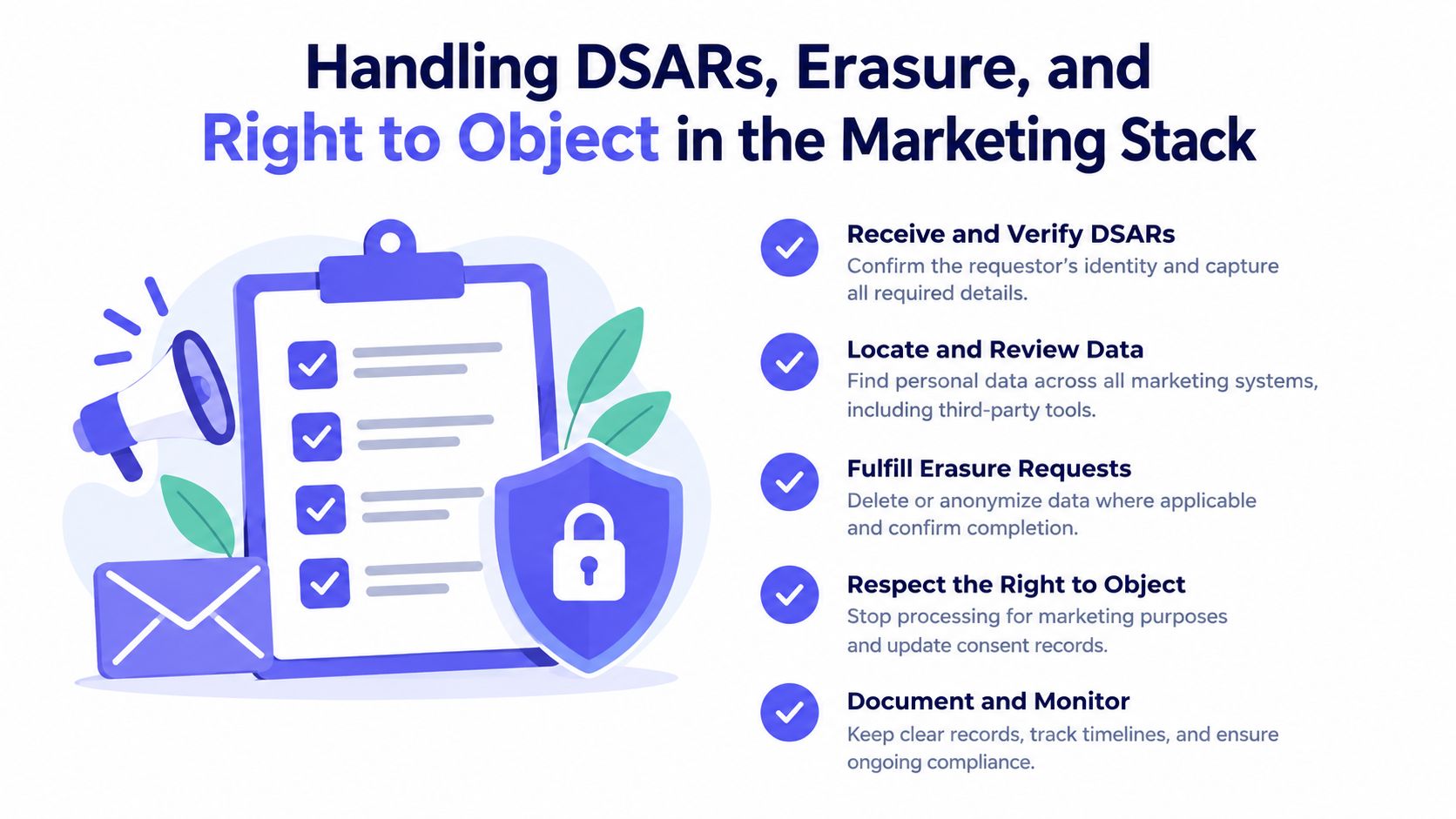
The request path should also cover objections to legitimate-interest processing. Stopping a send is not enough if enrichment or profiling continues elsewhere. Propagate the objection to every process that uses the same identity.
How EU-Hosted Verification Reduces Compliance Risk at Signup
Email verification belongs before the address becomes a durable marketing record. A signup flow can synchronously check whether an address is syntactically valid, associated with a deliverable domain, disposable, role-based, or otherwise unsuitable. If the address fails, the product can explain the issue without storing a contact that never becomes a useful subscriber.
That is both a deliverability control and a minimisation control. Verification doesn't establish consent, validate a lawful basis, or decide whether a message may be sent. It helps reduce unnecessary collection and keeps poor-quality inputs out of downstream systems.
Put the check between submission and persistence
A practical flow looks like this:
- The user submits the form with a separate marketing choice.
- The application sends the address to a verification endpoint.
- The endpoint returns a validity result, score, and machine-readable reason code.
- The application either asks the user to correct the address or continues to the consent-confirmation flow.
- Only the required fields and consent event enter the active systems.
Reason codes matter because they let product teams distinguish a typo from a disposable address or an inconclusive catch-all result. The UI can ask for correction without exposing internal diagnostic detail, while the event pipeline preserves the decision used by the application.
An EU-hosted processor can also simplify the transfer analysis for European organisations, but residency isn't the same as compliance. You still need a lawful basis, a suitable processor agreement, access controls, retention rules, and a way to honour rights.
Evaluate the processor, not just the endpoint
Ask where verification requests run, whether single checks are retained, how batch data is deleted, and whether the provider supplies processor documentation. Mailbeam is one example of an EU-focused verification service. Its published product information describes an HTTP API with validity, scoring, and reason-code responses, EU hosting, a default Data Processing Addendum, automatic deletion of single verifications, and deletion of batch uploads after roughly 72 hours. Those product details should still be checked against the current contract and configuration before adoption.
The EU-hosted email-verification option fits the pattern when a team wants validation inside signup flows rather than only offline list cleaning. Treat it as one layer in the architecture, not as a substitute for consent records or suppression controls.
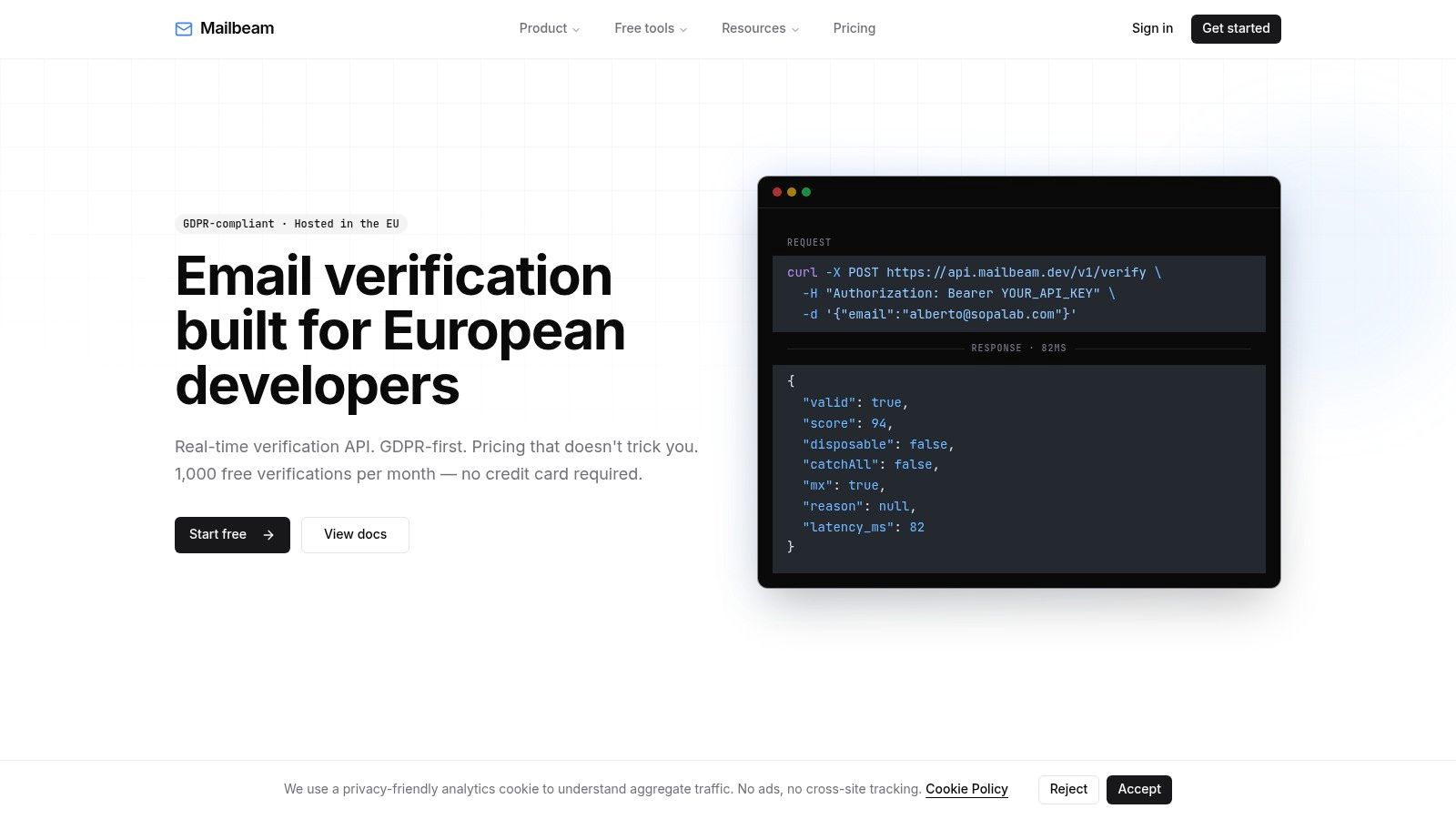
Keep verification telemetry proportionate. You may need the result and reason code to explain a signup decision, but storing the full request indefinitely defeats the purpose of minimisation. Define which fields support product operations, which support security investigations, and which should disappear after the decision is complete.
Three GDPR Myths That Keep Landing Teams in Trouble
Myth one: a privacy policy creates consent. A privacy notice explains processing, but it doesn't replace a freely given, specific, informed, and unambiguous affirmative choice when consent is the selected basis. A bundled terms checkbox or a pre-ticked marketing option remains defective even when the policy is thorough.
The fix is architectural. Put the marketing choice beside clear purpose language, keep it separate from account terms, record the exact version shown, and provide a withdrawal path that is as simple as the opt-in.
Myth two: legitimate interests covers outbound B2B email. Business context can affect the analysis of a processing activity, but it doesn't erase the separate electronic-marketing rules. The EDPB position described earlier is particularly important here: direct marketing by email generally requires prior consent in the relevant context, and legitimate interests isn't a universal Article 6(1)(f) workaround.
Treat B2B outreach as a jurisdictional and channel-specific decision. Ask whether you're discussing sending the email, storing the contact, enriching the record, or measuring the interaction. Those activities may require different analyses.
Myth three: EU hosting makes the program compliant. European residency can reduce transfer complexity and support a clearer processor review. It can't repair a bundled opt-in, missing consent evidence, an unconnected suppression table, excessive retention, or a DSAR workflow that stops at the CRM.
Audit question: If a customer asks why your system sent one particular message, can you identify the send rule, lawful basis, consent event, suppression check, and processor path without reconstructing the answer manually?
That is the practical standard. GDPR compliant email marketing is built, not bought. The durable program is the one whose decisions exist as concrete records, controlled interfaces, and repeatable workflows.
Mailbeam provides real-time email verification through an HTTP API and web tools, with EU-hosted processing, reason-coded results, a default Data Processing Addendum, and documented handling for single and batch verification data. Use Mailbeam to assess whether an EU-first verification layer fits your signup and list-maintenance workflows.