
A product team launches a new SaaS signup flow. The form rejects obvious typos, blocks disposable domains, and sends valid addresses to a verification service before creating an account. The implementation works, the onboarding funnel looks cleaner, and nobody sees a compliance problem in the pull request.
The problem appears when someone asks a simple question: what happens to the email address between collection and deletion? If your backend sends a user's address to a third-party API, your company has started another processing activity. That activity needs a lawful basis, a documented processor relationship, appropriate retention controls, and an audit trail. GDPR email compliance begins before the first marketing campaign and often before the first verification request.
Table of Contents
- The Hidden Compliance Trap in Signup Flows
- Why Email Addresses Trigger Strict Regulatory Scrutiny
- Establishing Lawful Grounds Before Hitting the API
- Engineering Data Minimization into Verification Logic
- The Architectural Advantage of EU-Only Processing
- Navigating the Shifting Rules on Email Tracking
- Implementation Checklist for Product and Engineering
The Hidden Compliance Trap in Signup Flows
The launch plan usually starts with a product requirement: “Prevent bad email addresses from entering the system.” Engineering chooses an API, adds a server-side request, and maps the response to a friendly error message. A user who enters alex@exampl.com sees “Check your email address,” while an address from a disposable domain gets rejected before account creation.
That's good product behavior, but it doesn't answer the privacy questions. The raw address has left your application and reached an external provider. The provider may process it for syntax analysis, domain checks, SMTP probing, scoring, logging, abuse prevention, or service analytics. Each purpose affects the information you need to disclose, the vendor terms you need, and the retention period you can justify.

The request is a data-processing event
A common mistake is to treat verification as an internal quality check, even when the request is made by a separate company. From the user's perspective, they typed an address into your form. From an architectural perspective, your application transmitted personal data to a processor.
That distinction matters during vendor review. A team might document its CRM, payment provider, and analytics platform, yet omit the verification endpoint because the request is short-lived. Short-lived processing is still processing. It may reduce risk, but it doesn't remove the need to establish why the transfer is happening and how the provider handles the data.
The SaaS signup flow guidance should therefore be treated as a product architecture concern, not only a deliverability reference. Map the address across the complete journey:
- Collection: What does the form tell the user about account creation, service messages, and marketing?
- Transmission: Does the browser call the verifier directly, or does your backend act as the controlled gateway?
- Decisioning: Which reason codes block registration, and which merely trigger a warning?
- Storage: Do raw requests appear in application logs, traces, error tools, or vendor dashboards?
- Suppression: Can a rejected or unsubscribed address be prevented from returning to a campaign audience?
Practical rule: If an email address can be connected to a person, handle a verification request with the same design discipline you'd apply to any external personal-data processor.
A solid flow keeps the verifier behind your backend, sends only the address needed for the check, avoids logging the raw payload, and stores the minimum decision needed by the product. That approach gives engineering a clean interface and gives privacy teams something defensible to review.
Why Email Addresses Trigger Strict Regulatory Scrutiny
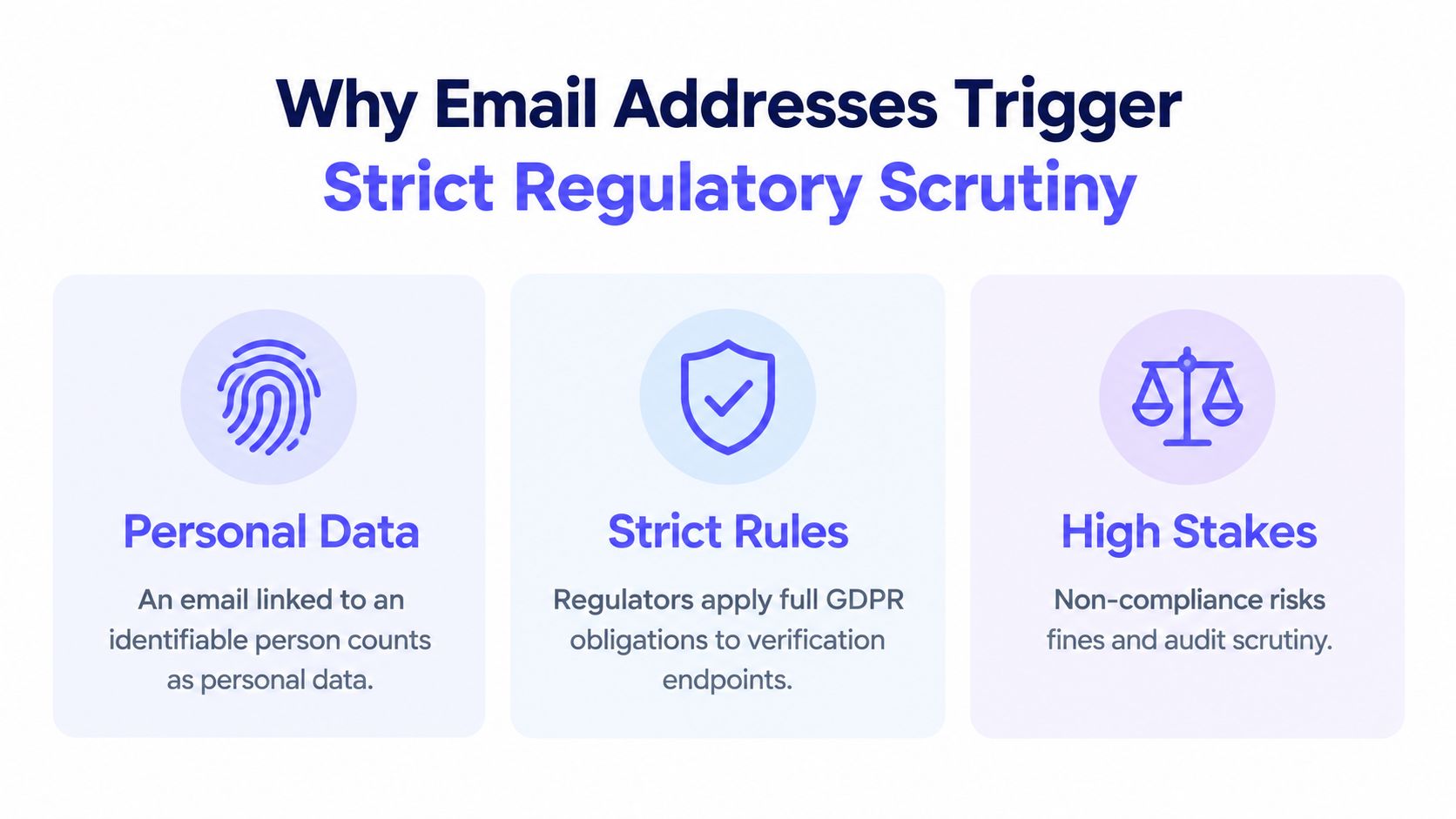
An email address isn't merely a string that passes or fails validation. When it identifies, or can reasonably be associated with, a person, it is personal data. Sending that address to an external verification API means the provider is handling personal data on your company's behalf, even if the service returns only a score and a reason code.
The processing can include more than the visible API response. A provider might inspect the domain, query mail infrastructure, record abuse signals, or retain request metadata. Your organization remains responsible for understanding that processing chain and for ensuring that the vendor's role, purposes, security controls, and retention practices match the information given to the user.
The financial framework changes engineering priorities
Since GDPR took effect on 25 May 2018, EU and EEA email marketing has operated under strict consent and transparency requirements. Consent must be freely given, specific, informed, and unambiguous, and it must be demonstrated through clear affirmative action. Pre-ticked boxes, silence, and inactivity don't qualify as valid consent, as explained in the ICO guidance on direct marketing and data protection.
The maximum administrative fine can reach €20 million or 4% of worldwide annual turnover, whichever is higher. That framework makes consent capture, recordkeeping, sender identification, and unsubscribe handling operational controls rather than marketing preferences.
The wider enforcement environment reinforces the point. Cumulative GDPR fines surpassed €4.4 billion by 2026, while one industry compilation reported €5.65 billion in fines across 2018 to 2025, with an average fine of €2.36 million. These figures are not email-specific, so they shouldn't be used to predict the outcome of a verification incident. They do show why privacy failures involving personal data receive serious attention. The figures and their limitations are discussed in an industry overview of GDPR email verification and compliance.
Verification is part of the control system
Verification, suppression, and lawful-basis tracking work together. A syntactically valid address may still belong to someone who never consented to marketing. A deliverable address may also need to remain on a suppression list after an unsubscribe request. Treating verification as a green light for contact creates a dangerous gap between technical validity and legal permission.
Global SaaS companies can't assume that a headquarters outside Europe removes the issue. GDPR applies to organizations processing the personal data of EU and EEA residents, regardless of where the company is based. A cross-border product should therefore design its email collection and verification controls for the strictest relevant audience from the start.
The embedded video provides another practical explanation of the regulatory scrutiny around email addresses and verification.
Establishing Lawful Grounds Before Hitting the API
The verification request is not the beginning of compliance. It starts when your product collects the address and decides why it needs to process it.
For a SaaS account, the address may be necessary to create the account, send an activation message, recover access, or provide requested service notifications. Marketing is a separate purpose in many signup journeys. Product teams should model those purposes separately instead of putting one broad consent checkbox above every use.
Build the decision before the integration
Start with a purpose map:
- Account operation: Explain why the address is needed to create and secure the account.
- Verification: Document the narrow purpose of checking whether the address can receive the relevant message.
- Marketing: Ask separately for promotional communications where consent is required.
- Measurement: Treat open tracking, profiling, and behavioral personalization as distinct processing questions.
- Withdrawal: Connect unsubscribe and consent withdrawal events to suppression systems and preference records.
For direct email marketing in many EU contexts, consent is the default under ePrivacy rules. Valid consent requires active, informed agreement. A preselected marketing box, silence after account creation, or a statement hidden inside general terms doesn't create the evidence a compliance review needs. The GDPR email marketing guidance also emphasizes informing individuals at or before the first contact when their data is used for marketing.
A narrow soft-opt-in or similar exception may apply in specific circumstances, but teams shouldn't treat it as a shortcut. Confirm the conditions with qualified counsel, document the reasoning, and ensure the messages stay within the purpose and expectations that support the exception.
Put the vendor relationship in writing
When an external verifier processes addresses for your instructions, procurement should establish an Article 28 processor arrangement, commonly through a Data Processing Addendum. Review the DPA alongside the technical documentation, not after integration. The contract should match the actual data flow, including subprocessors, hosting locations, security measures, deletion behavior, support access, and incident handling.
The email validation API implementation guide is useful as an engineering reference, but no API guide can replace your own lawful-basis analysis. A compliant provider can process an address lawfully only within the controller's documented purposes and instructions.
Store evidence that connects the collection event to the processing decision. Useful records include the form version, notice version, timestamp, consent choice where applicable, purpose selected, and the verification outcome needed for the signup decision. Don't store more than the team can explain. An audit log that contains raw addresses, unnecessary payloads, and unbounded diagnostic data may create a larger privacy liability than the original integration.
Engineering Data Minimization into Verification Logic
Article 5(1)(e) requires personal data to be kept no longer than necessary. For verification systems, that principle has a direct implementation consequence: the result needed to make a signup decision is not automatically a reason to retain the entire verification transaction.
A useful design separates transient processing from durable product state. The verifier receives the address, performs the checks, and returns a deterministic outcome. Your application stores only what it needs to enforce the product rule, such as a normalized decision, a reason code, and a reference to the relevant account event. Whether even those fields need long-term retention depends on the documented purpose.
Keep the hot path small
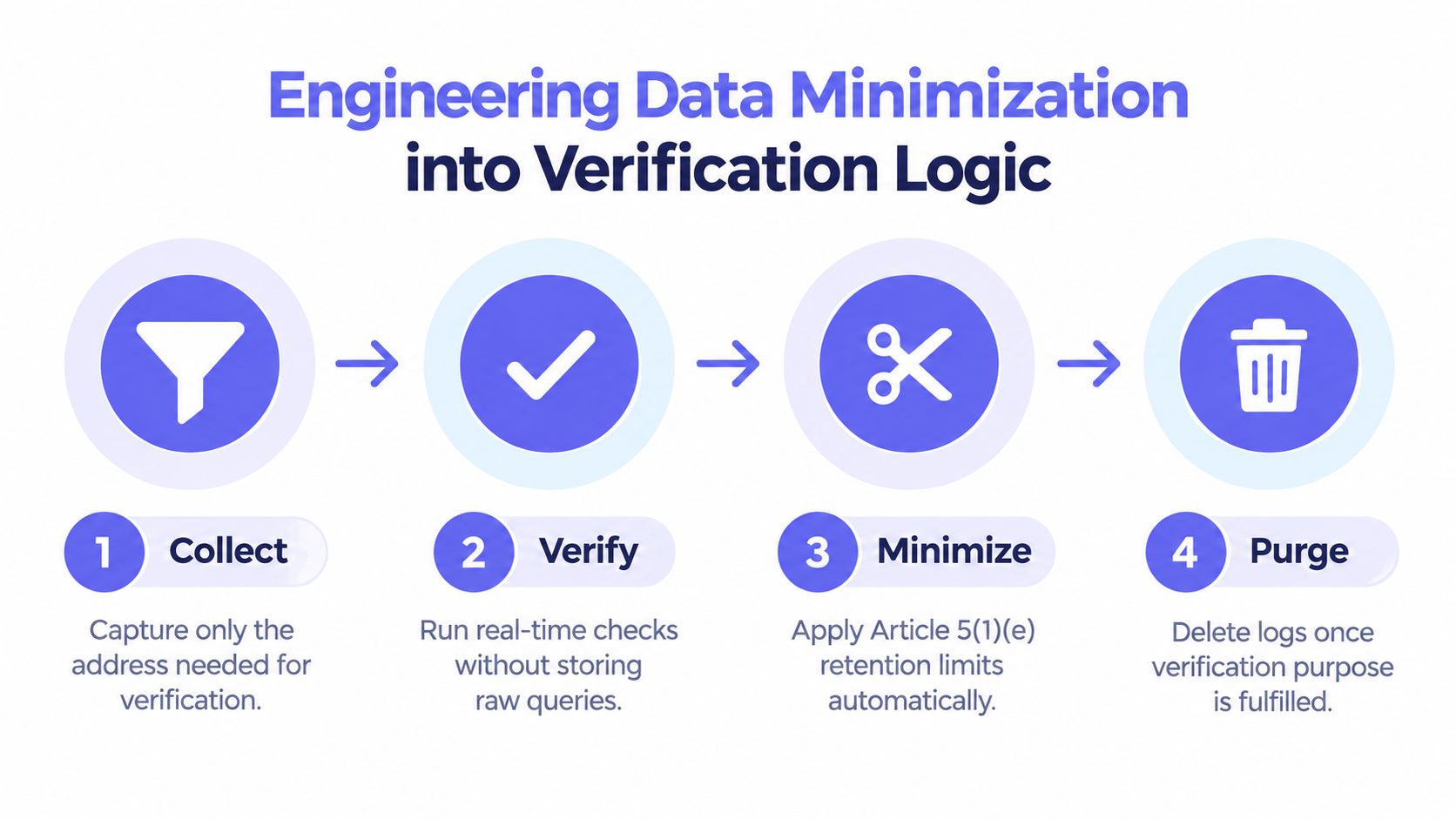
A practical synchronous flow looks like this:
- Collect only what you need. Accept the address for the stated signup purpose. Don't add unrelated enrichment fields to the verification request.
- Verify without creating a shadow database. Use the response to decide whether to continue, challenge, or reject. Avoid persisting raw request and response bodies by default.
- Minimize the durable result. Store a narrowly defined status or reason code rather than every provider signal, diagnostic detail, and intermediate observation.
- Purge verification artifacts. Apply deletion rules to application logs, traces, backups, queues, support exports, and processor systems, not only the primary table.
A vendor's retention promise should be testable. Run an integration test that confirms what happens after a successful check, a timeout, an invalid input, a retry, and a failed request. Review observability settings too. Reverse proxies, error trackers, request profilers, and debugging middleware often capture payloads that the application team assumes are transient.
Make reason codes do the work
Deterministic reason codes let the product respond without retaining excess personal data. For example, the interface might tell a user to correct a malformed address, while a disposable-domain result triggers a different message or a review path. A catch-all result may warrant a verification email rather than an immediate hard rejection, depending on the account risk and user experience you've chosen.
Avoid turning the score into an unexplained eligibility gate. Product, support, and privacy teams should know which outcomes block registration, which outcomes allow it, and which outcomes are retried. The logic belongs in version-controlled application code, with changes reviewed like any other policy-sensitive feature.
Architecture choice: Make the API response disposable, make the product decision explainable, and make deletion automatic. Manual cleanup is not a retention policy.
Purpose-bound retention also narrows the scope of access requests and breach investigations. Shorter retention doesn't remove all risk, but it limits how much historical verification data exists to discover, export, secure, and explain.
The Architectural Advantage of EU-Only Processing
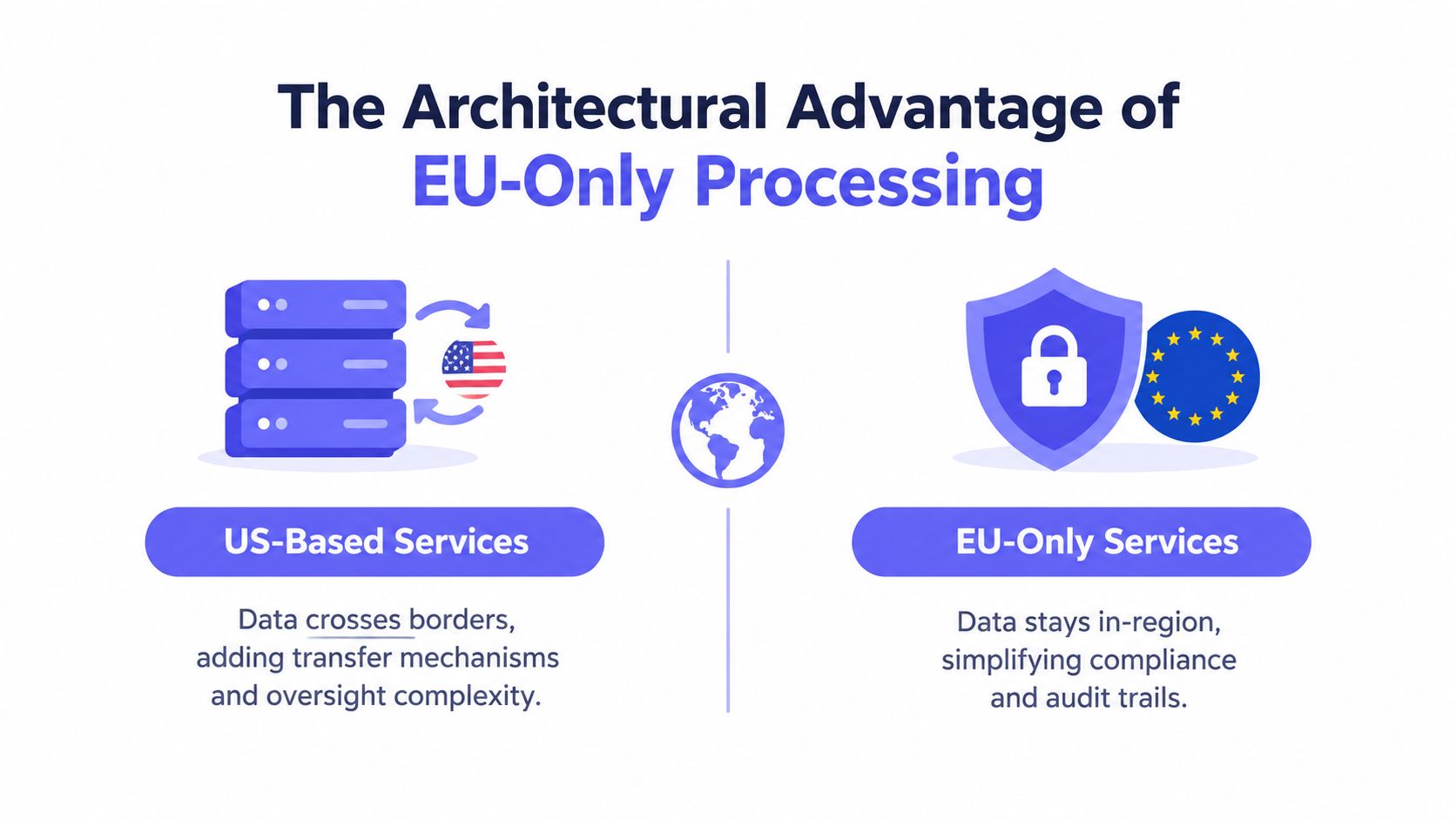
Hosting location doesn't decide every GDPR question, but it changes the amount of operational work required to answer them. A US-based verification service may introduce cross-border transfer analysis, transfer mechanisms, oversight of subprocessors, and customer questions about access from outside the EEA. An EU-hosted service can simplify that architecture when it also provides clear residency guarantees and appropriate contractual controls.
Compare the actual data path
The important question isn't only where the provider's primary database sits. Trace the full path:
| Review area | Cross-border service | EU-only architecture |
|---|---|---|
| Processing location | Addresses may leave the EEA, depending on the provider and subprocessors | Processing can remain within the EU when the provider guarantees that arrangement |
| Contract review | Requires attention to transfer mechanisms and international access | Still requires a DPA and processor review, but may reduce transfer complexity |
| Support operations | Support personnel or diagnostic tools may access data from other regions | Residency claims must still cover support, logs, backups, and subprocessors |
| Enterprise due diligence | Customers may request extensive transfer documentation | A clear regional boundary can make supply-chain explanations simpler |
This isn't an argument that every EU-hosted provider is automatically compliant. An EU address can still be retained too long, exposed through logs, or processed for undisclosed purposes. Data residency is one architectural control, not a substitute for lawful basis, minimization, security, or transparency.
Reduce the audit narrative
An EU-only design gives a team a simpler explanation: the address enters the signup service, reaches a verifier within the chosen region, produces a decision, and is deleted according to a documented schedule. That narrative is easier to verify than a chain involving multiple jurisdictions and unclear operational access.
Ask providers for evidence rather than relying on a marketing label. Confirm hosting regions, subprocessors, backup behavior, support access, deletion timing, and whether batch workflows follow different rules from real-time checks. Review the EU-hosted email verification option against those criteria, then record the decision in your vendor and processing documentation.
EU-only processing can also help during a DPIA because the team can describe fewer transfer scenarios and fewer external access paths. It won't eliminate the assessment, but it can make the system boundary more legible to security, legal, procurement, and enterprise buyers.
Navigating the Shifting Rules on Email Tracking
A transactional label doesn't automatically make every tracking technique harmless. An activation email may be necessary to secure an account, while an individualized open pixel embedded in that message can collect information about when and how the recipient accessed it. Those are different functions and deserve separate analysis.
Tracking pixels can reveal an opening event and associated technical information, allowing senders to measure individual behavior. The compliance question becomes sharper when a team uses those events to profile recipients, adjust campaign frequency, or personalize promotional content. Calling the surrounding email “transactional” doesn't change what the pixel does.
Separate delivery from surveillance
The practical boundary is purpose. Security, authentication, and essential deliverability functions may have a stronger necessity argument in a service message. Individual marketing measurement and profiling generally require a more careful consent and transparency analysis. A team shouldn't assume that a user who agreed to receive an account email also agreed to invisible behavioral tracking.
Regulatory attention is moving in this direction. A 2026 guide reports that France's CNIL opened a public consultation in June 2025 on email opening tracking, while another account describes formal 2026 recommendations requiring affirmative opt-in consent for tracking pixels, with narrow exceptions for authentication, security, and deliverability measurement in transactional messages. These developments are described in the email tracking disclosure and compliance guide, and teams should validate the current position for each market with counsel.
Change the measurement design
Open rate is already an imperfect signal. The same guide cites a 2023 survey in which open rates fell below 20% for 61% of B2B marketers, a finding that illustrates how stricter consent and technical changes can affect measurement. The statistic shouldn't be treated as a universal benchmark, but it's a useful warning against building growth reporting around one hidden signal.
Product and marketing teams can respond by:
- Declaring the purpose: State whether a pixel supports authentication, delivery diagnostics, aggregate measurement, or individual profiling.
- Separating preferences: Let users receive necessary service emails without implicitly opting into promotional tracking.
- Recording evidence: Store the consent version, timestamp, scope, and withdrawal event when consent is required.
- Respecting withdrawal: Ensure a tracking preference can stop future pixels without breaking required account messages.
- Testing message content: Keep promotional material out of operational emails when it would blur the transactional boundary.
The architecture should make the compliant path the default. Don't inject a marketing pixel through a shared template that automatically wraps password resets, invoices, account alerts, and campaigns. Give transactional and promotional systems separate templates, permissions, event schemas, and review owners.
Implementation Checklist for Product and Engineering
A useful audit starts with the live data path, not the vendor's feature page. Reproduce a signup in a test environment and record every place the address appears. Include browser requests, backend payloads, API gateway logs, traces, error monitoring, queues, analytics events, dashboards, exports, backups, and support tools.
Then review the controls below with product, engineering, security, and privacy owners.
Before sending an address
- Define the purpose: Document why the product collects the address and why verification is necessary for that purpose.
- Separate marketing consent: Use an independent, affirmative choice for promotional email where consent is required. Don't bury it in terms and conditions.
- Update the notice: Tell users what happens to the address, including relevant third-party processing and retention practices.
- Review the DPA: Confirm the provider offers an Article 28 processor agreement and that it matches the actual service behavior.
- Map transfers: Identify hosting, subprocessors, support access, backups, and any movement outside the EEA.
- Set the retention rule: Decide what the application and provider may retain, for how long, and why.
In the request and response path
- Use a backend gateway: Keep provider credentials and policy decisions on your server rather than exposing them in browser code.
- Send the minimum: Transmit the address and only the fields required to complete the check.
- Disable payload logging: Inspect gateway, framework, tracing, and error-monitoring settings for raw request capture.
- Use reason codes: Map deterministic outcomes to clear user messages and documented product actions.
- Handle uncertainty deliberately: Define behavior for timeouts, catch-all results, temporary failures, and provider outages.
- Test deletion: Verify that real-time results, failed requests, retries, logs, and batch artifacts disappear according to policy.
After launch
- Monitor suppression: Make unsubscribe and consent withdrawal events authoritative across marketing, CRM, and activation systems.
- Review templates: Keep tracking pixels and promotional content out of messages that exist only to deliver a requested service.
- Recheck vendors: Revisit subprocessors, regions, retention terms, and support access when the provider changes its service.
- Run an evidence review: Confirm that consent records, notice versions, processor documents, and deletion tests can be produced without collecting new unnecessary data.
Shipping standard: A signup verifier is ready when the team can explain its purpose, prove its boundaries, reproduce its decisions, and demonstrate deletion.
For teams that want to reduce the amount of verification infrastructure they maintain themselves, Mailbeam offers a real-time email verification API with machine-readable reason codes, EU-hosted processing, and documented data-handling controls for signup and list-hygiene workflows. Review the API behavior, DPA, residency terms, and retention model against your own requirements before putting it in production.