
The popular advice is to pick the disposable email API with the biggest blocklist and hard reject every match. That builds a signup flow that is both leaky and unfair. A disposable flag answers one question: whether the address is a durable identity anchor. Mailbox existence, catch-all behavior, role accounts like info@, and the risk of a recovery link sitting in a public inbox are all separate questions the flag stays silent on.
That distinction matters because deliverability and identity persistence are different problems. The Mailvalid disposable email domains study found that 78.2% of 9,963 disposable domains passed a DNS mail check. Most throwaway addresses accept mail just fine. MX and SMTP checks alone won't catch them, and a domain list alone won't tell you whether a non-disposable address will bounce.
Bigger lists help. They are not the whole answer.
This comparison splits the field into two groups. Disposable-only tools answer one narrow question quickly and cheaply. Full verifiers answer several questions in one call, at the cost of added latency and more data leaving your system. I weighted signup path latency, explainability of the response, and EU data handling over headline list size, because those are the factors that decide whether a check ships in a registration flow.
The same reasoning applies beyond human signups: securing agent inboxes with Molted Email treats a weak inbox as an attack surface rather than a bad lead.
Table of Contents
- 1. Mailbeam
- 2. Mailsurity
- 3. Email Hippo MORE
- 4. ZeroBounce
- 5. Abstract Email Validation API
- 6. Bouncer
- 7. Emailable
- 8. Hunter Email Verifier API
- 9. DeBounce
- 10. TempMailChecker
- How the 10 disposable email API providers compare on disposable detection, free allowance, entry pricing, and best fit
- Choose the Narrowest Tool That Covers Your Signup Risk
1. Mailbeam
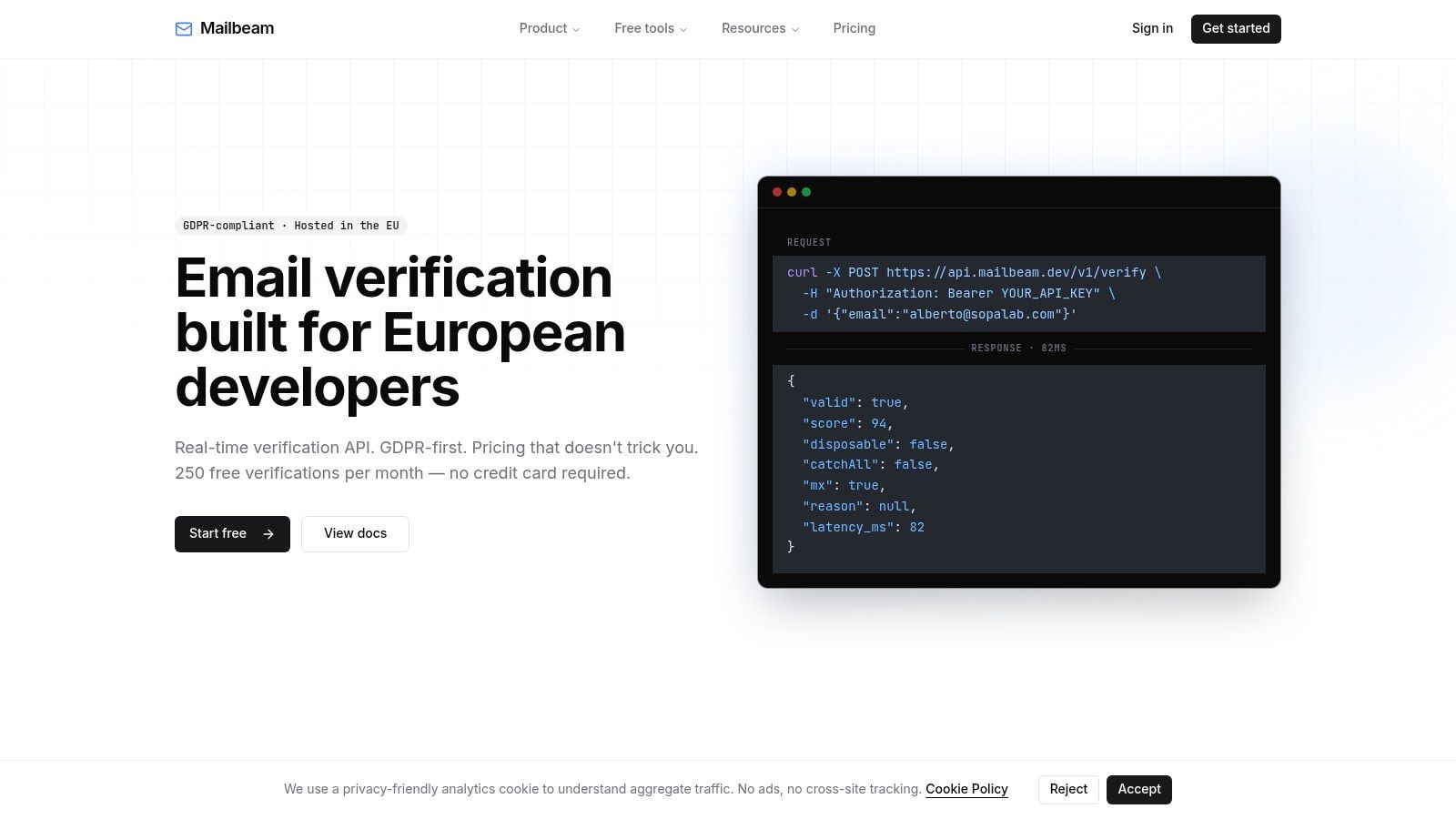
Mailbeam is the full-verifier option when the disposable answer has to sit beside deliverability context in the same signup-path call. One HTTP request runs syntax, MX, SMTP existence, disposable, role-address, free-provider, and catch-all behavior checks in parallel. The response returns a verdict, a numeric score, and a machine-readable reason code. Product code can then reject an address, require another identity check, or allow it with a warning without building a decision layer around a bare boolean.
Its disposable email detection API covers Mailinator, YOPmail, Guerrilla Mail and 50,000+ other throwaway services, returning the result as a boolean in the checks object. Role detection separately identifies mailboxes such as info@ and admin@. The SMTP existence check simulates an SMTP handshake to confirm a mailbox exists without sending an email.
Where It Fits and Where It Doesn't
Latency is the practical reason to use it inline. Mailbeam reports roughly 80 ms for cached or DNS-only responses and under one second for full SMTP probes. A cached result fits comfortably inside synchronous form submission, while the deepest mailbox check adds a visible wait. Email addresses are processed in memory, discarded after the verdict, and hosted within the EU, including Frankfurt. The default DPA and HIPAA-compatible handling reduce the compliance burden for regulated or EU-facing products. Batch lists and their results remain available for 72 hours, then Mailbeam deletes them.
Pricing is per verification, with monthly plans and pay-as-you-go tiers rather than credits, multipliers, or expiring bundles. The free plan includes syntax, MX, disposable, and role checks, REST API access, bulk CSV upload, webhooks, and community support.
The main limitation is ecosystem maturity. The HTTP API is the primary interface today, while official SDKs for Node.js, Python, PHP, Ruby, and Go are still planned. Some higher-tier capabilities are also still being expanded. For teams needing mature SDKs immediately, that adds integration work. For teams prioritizing EU data handling and explainable signup decisions, the broader response covers more risk than a disposable-only check. The Mailbeam disposable email detection guide draws on 856,886 emails across four disposable services to document why public inbox exposure should also be treated as a recovery-flow risk.
2. Mailsurity
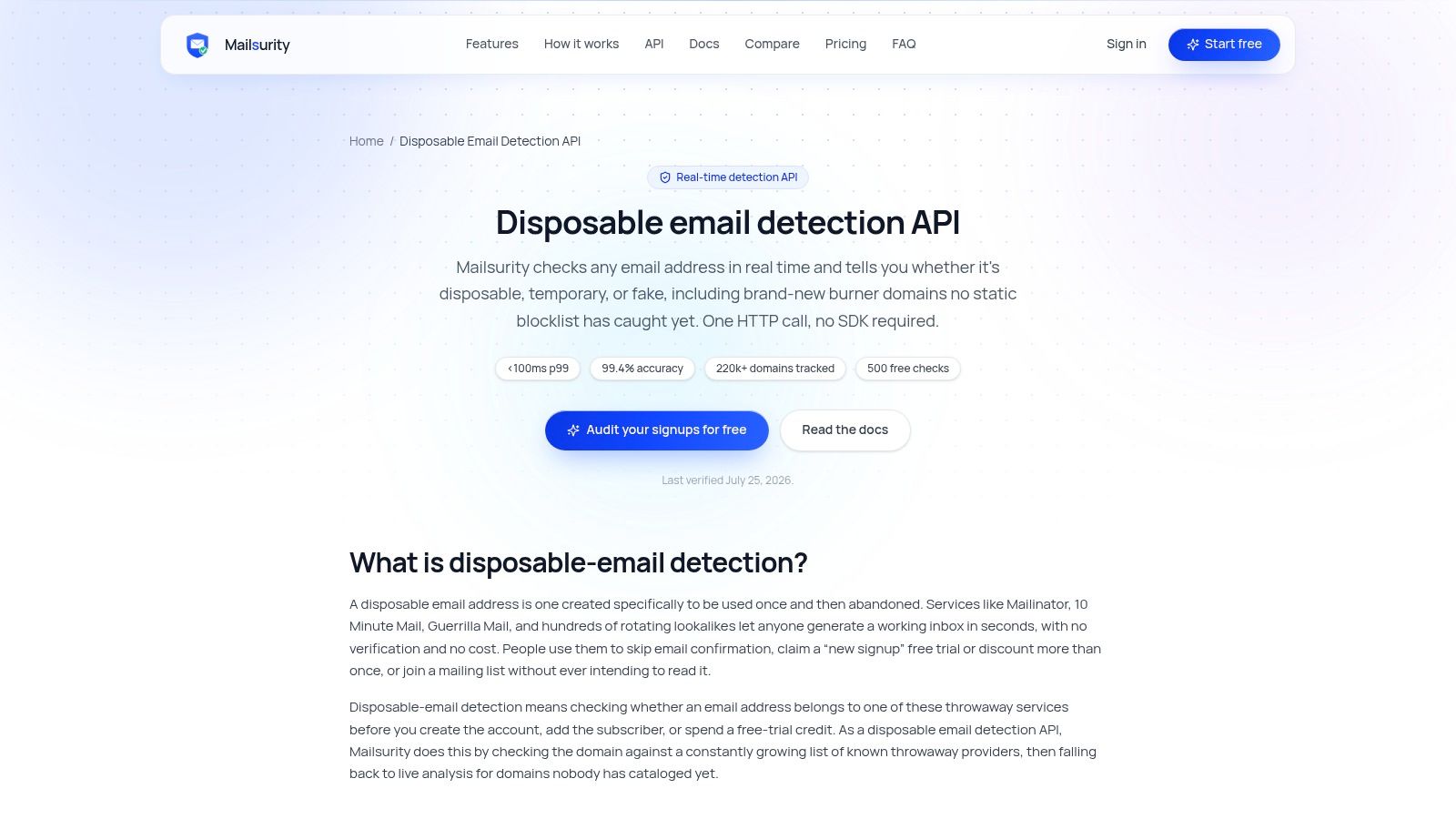
Mailsurity does the opposite of Mailbeam. It's purpose built for disposable detection and doesn't pretend to be a full verifier. For teams whose only problem is throwaway signups abusing trials or referral credits, that narrowness is a virtue, not a limitation.
Detection is layered rather than a static list lookup. It combines domain lists, cached results, live heuristics, and an AI classifier for borderline cases, and it lets you set per account allow and deny rules. That last part matters in production, because every team eventually finds a legitimate niche provider that looks disposable, or a disposable provider its users keep abusing.
- Real time REST API: returns a disposable or not disposable result you can branch on immediately
- Bulk checking: CSV checks and a dashboard for cleaning an existing user table
- Pricing: plans start at $5 per month for 5,000 checks, with 500 free checks to test against real traffic
Don't expect it to answer deliverability questions. It won't replace SMTP mailbox, catch-all, or role checks, so if your bounce rate is the problem you'll still need a second service. Published performance and accuracy figures are provider reported rather than independent benchmarks, and unused monthly credits don't roll over. I recommend it when you already trust your other validation and just need a better disposable signal than a public text file.
3. Email Hippo MORE
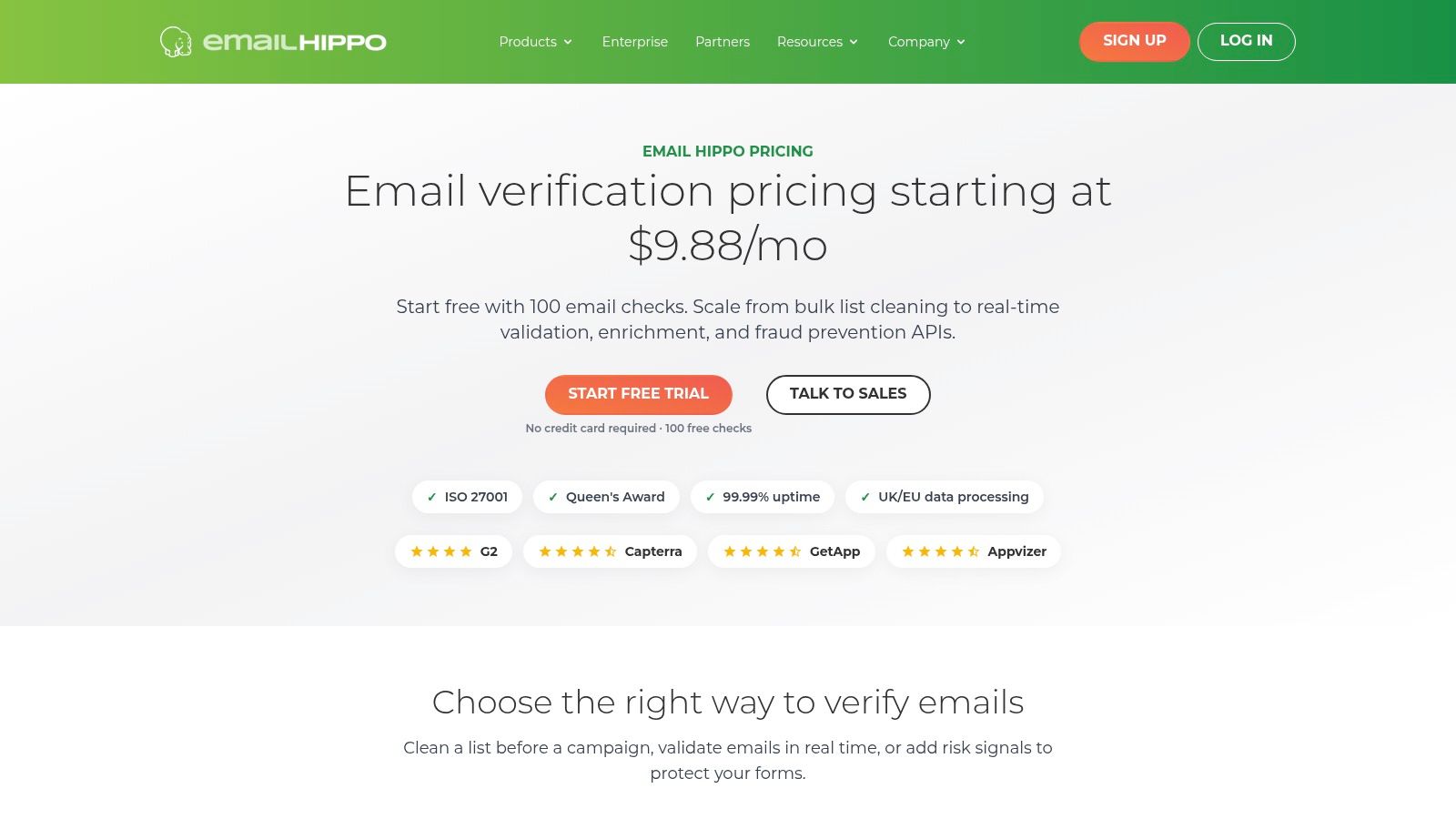
Say you run signup screening in the morning and list cleaning before a campaign in the afternoon. Email Hippo MORE is built for that combined workload, with disposable detection sitting alongside DNS, MX, and SMTP checks plus flags for freemail, role based, and catch-all addresses.
That breadth makes the response more useful than a yes or no. You can distinguish a disposable address from a catch-all corporate domain and from a perfectly valid freemail account, and those three cases deserve three different policies. Treating them as one bucket is where most false positives come from.
A catch-all domain and a disposable domain look similar to a lazy checker. One is a real company that accepts everything, the other is a shared inbox. Your policy shouldn't treat them the same.
The trade off is weight. If you only need a disposable answer, you're paying for and waiting on checks you won't use, and SMTP probing is slower than a domain lookup. The provider lists 100 free checks and API plans starting at $9.88 per month, which is reasonable for a trial but thin if you want to test against a representative week of signups. Real time API and CSV verification are both supported, so it's a sensible consolidation pick for small teams that don't want two vendors.
4. ZeroBounce
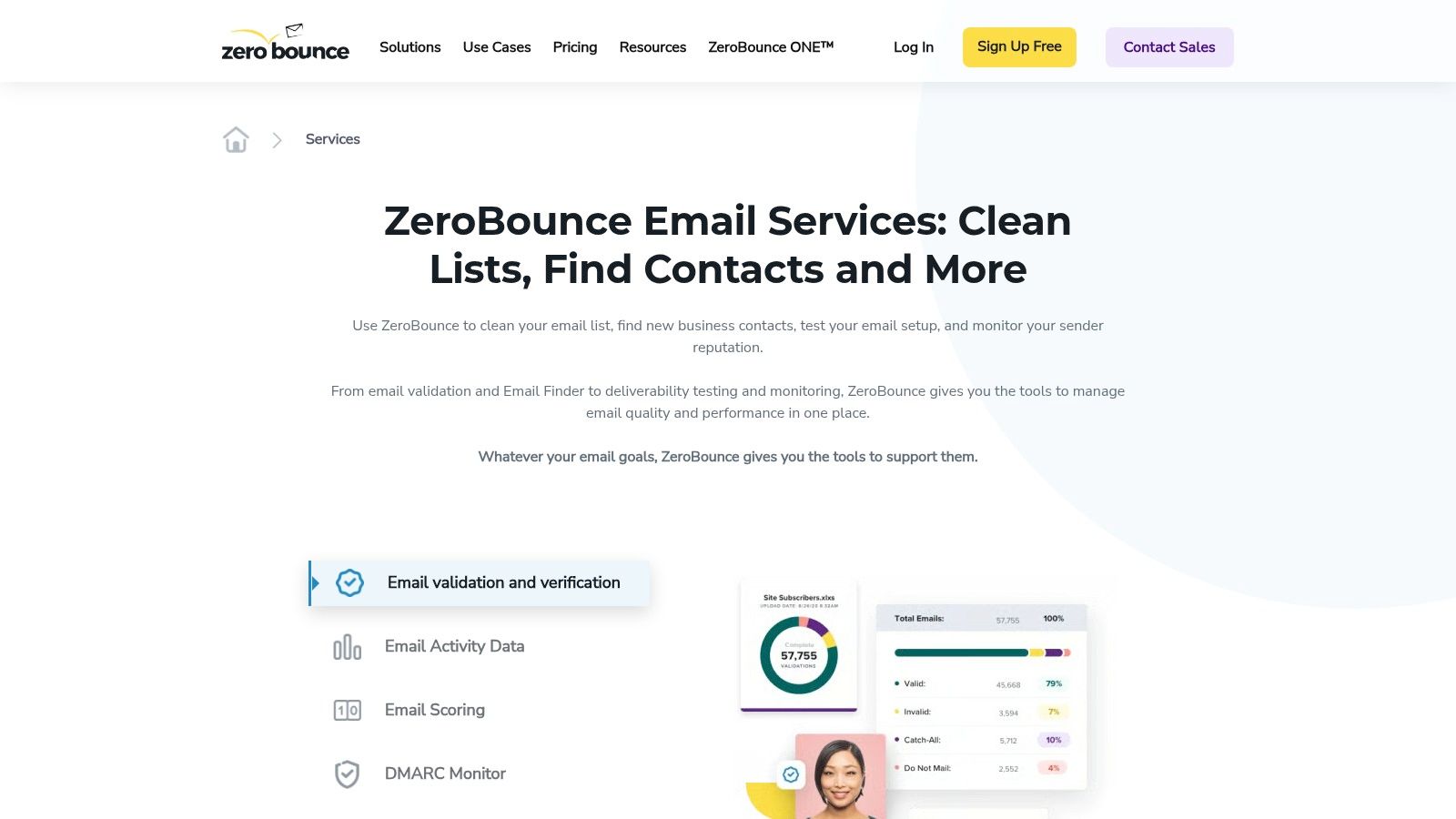
ZeroBounce sits at the full-verifier end of this list. Disposable status is one output among many, returned next to risky-address flags, catch-all signals, scoring, and a wider set of deliverability tools. For a marketing operations team that wants list hygiene, single-address checks, and adjacent email quality work under one contract, the consolidation is worth paying for.
The scale behind the platform is real. The ZeroBounce email list decay page reports that it identified more than 5 million disposable email addresses in data evaluated during 2025. Throwaway signups at that volume are a structural feature of large lists, not a rounding error that stays invisible until a campaign bounces.
Cost and Fit
The pricing model matches that platform ambition. Pay-as-you-go entry sits well above what a disposable-only check justifies, and the free allowance is sized for evaluation rather than production traffic. Each call also runs deeper verification work than an inline gate will read, which costs latency as well as money on the signup path.
If you are weighing it against a signup-first verifier, read the Mailbeam and ZeroBounce comparison before you commit. The pricing model and data handling posture differ more than the feature checklist suggests, and for EU residency requirements or a tight latency budget at signup, that difference decides the pick. My judgement is simple. ZeroBounce fits marketing operations teams cleaning large lists and running broader deliverability programs. Product engineers who need one boolean at the form are buying a platform they will not use.
5. Abstract Email Validation API
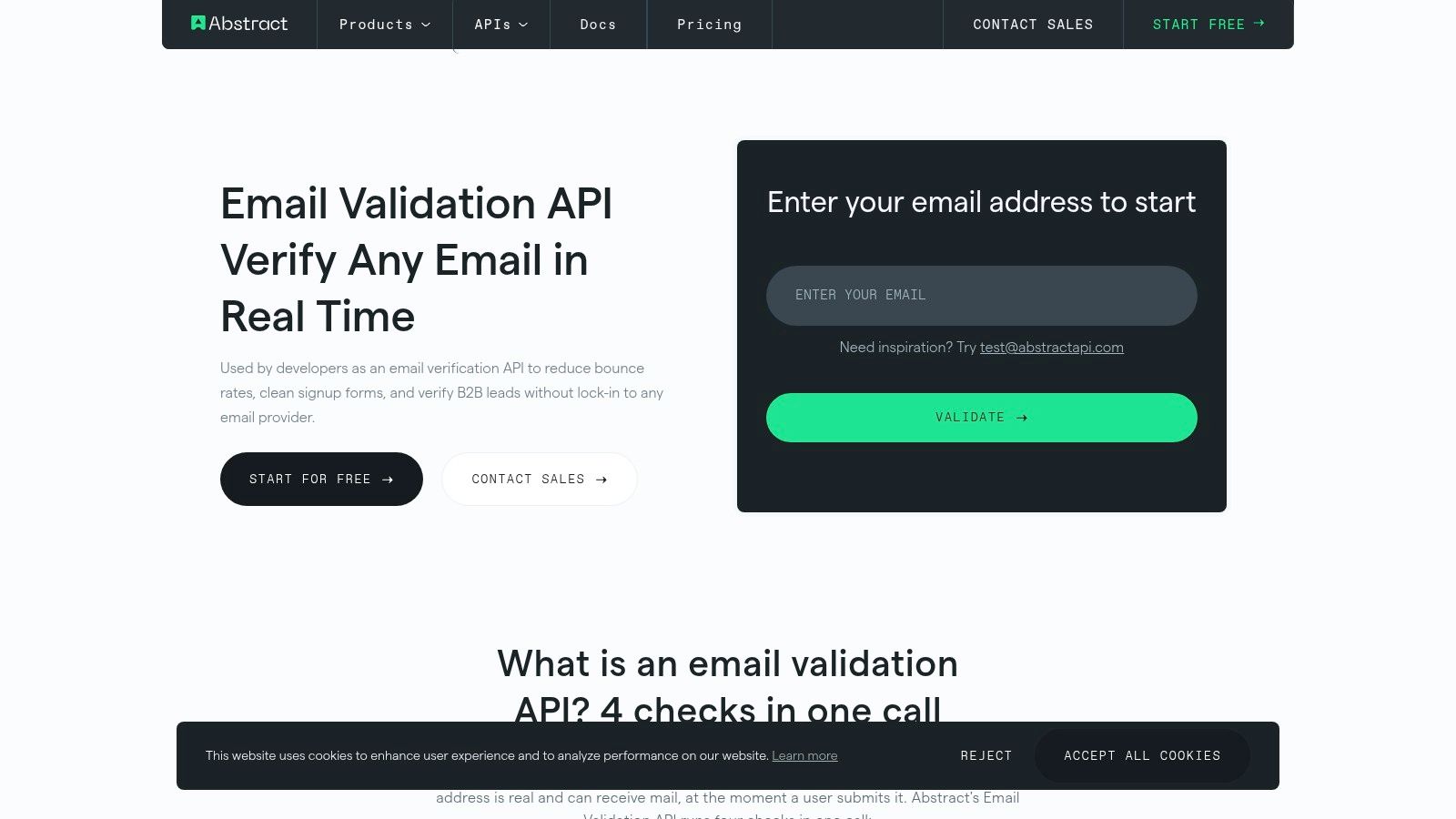
The appeal of the Abstract Email Validation API is response detail. One call returns format, MX, and SMTP results together with indicators for disposable, catch-all, role account, and free email provider status. If you're building your own risk scoring downstream, structured fields beat a single verdict every time.
It supports both real time and bulk validation, so you don't need a separate integration for backfill work. That matters when you're retroactively cleaning a user table after discovering that a promotion was farmed. You can run the same logic over old accounts that you now run at signup.
- Structured response: multiple signals in one payload for your own policy engine
- Optional enrichment: quality, risk, and domain data available on higher plans
- Free tier: useful for integration testing and low volume prototypes
The catch is tier gating. Some of the risk and enrichment fields that make this API interesting sit behind higher plans, so check exactly which fields your tier returns before you design around them. The free allowance is also modest for production traffic. I'd choose Abstract when a team wants raw signals to feed an existing fraud or onboarding system, rather than an opinionated score that decides for them.
6. Bouncer
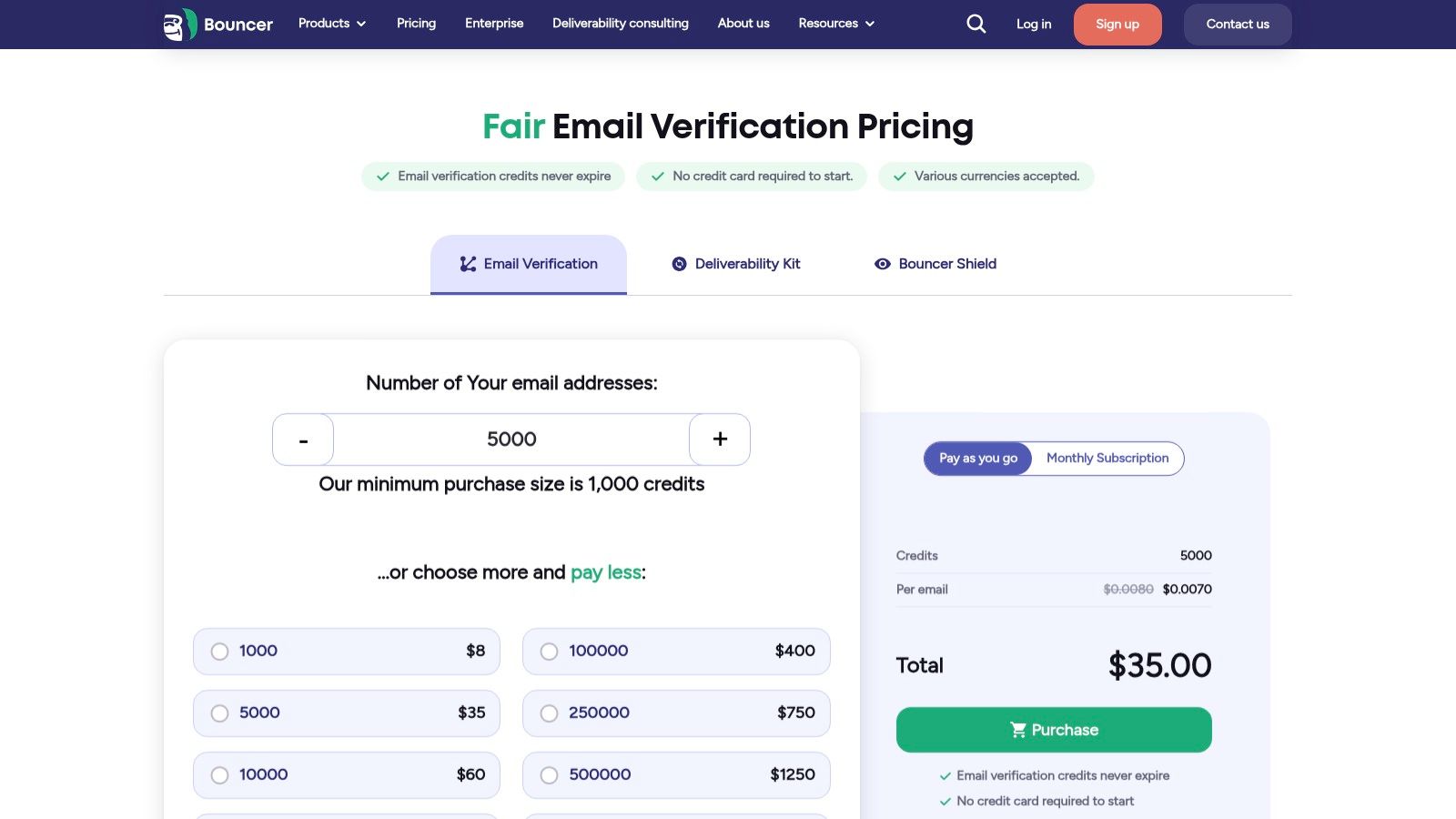
Bouncer earns its place here on billing mechanics, which sounds dull until you've burned a month of credits on duplicate rows. The provider says pay as you go credits don't expire and that duplicates and unknown results aren't charged. For teams with irregular verification needs, that model is materially better than a monthly quota that evaporates.
Functionally it's a full verifier with an API and bulk workflows, returning disposable, role, free provider, and catch-all indicators. Pricing lists 100 free credits and pay as you go packages starting at $8 for 1,000 credits, with monthly subscriptions also available. That's a low commitment way to test real traffic.
What separates it is Bouncer Shield, a separate product for real time form protection. That's useful if you want form level blocking without building the integration yourself, but it carries separate pricing, so don't assume your verification credits cover it. Read the two products as two products.
Practical rule: If your verification volume is spiky, expiring credits cost you more than a slightly higher per check price. Model the waste, not just the headline rate.
The base product covers much more than disposable detection, so it's overkill for a single question. But for campaign driven teams that verify in bursts, the credit policy alone can justify shortlisting it.
7. Emailable
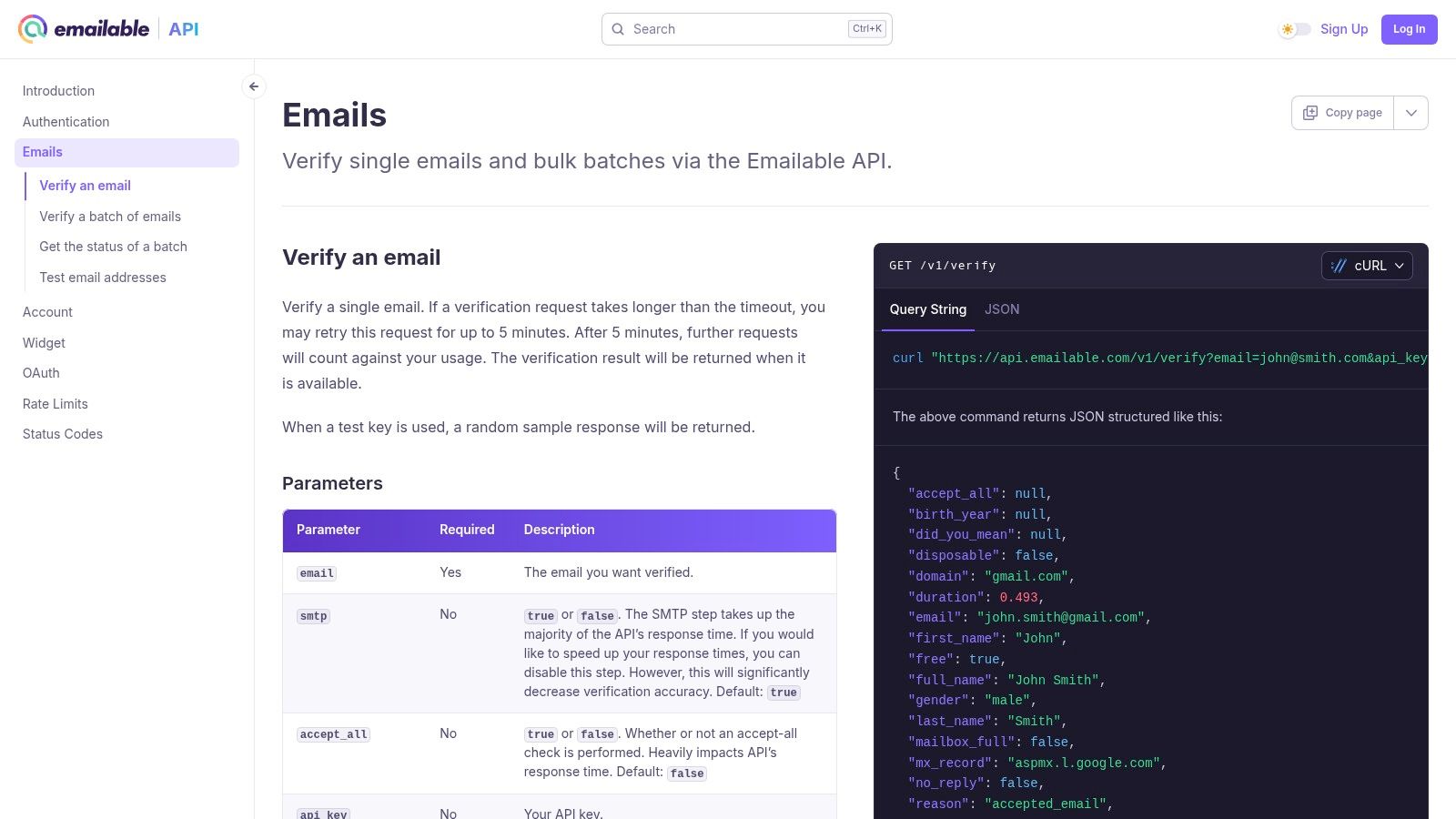
Latency versus accuracy is the argument every email verification integration eventually has, and Emailable lets you tune it instead of picking a side in advance. You can adjust SMTP and accept-all checks and set retry controls for uncertain results, so the same API can run shallow on the signup path and deeper in a nightly list job.
The response is usefully granular for a full verifier: alongside the disposable field you get state, reason, score, role, free provider, and catch-all indicators for single address and batch checks. That reason field earns its keep when support has to explain a rejection, and the score lets you separate obvious throwaways from addresses that deserve review rather than a hard block.
Billing and Limits
Emailable offers a free allowance; confirm the current credit expiry rules and whether unknown or duplicate results are billed on its pricing page before you model cost.
The trade-off is the usual one for full verification. Turn every check on inline and form completion can suffer; keep the signup call to disposable plus fast deliverability signals, then reserve SMTP-heavy work for batches. For a disposable-only gate it is more tool than you need, but for teams that want one verifier across signup and cleanup, the tuning is the point.
8. Hunter Email Verifier API
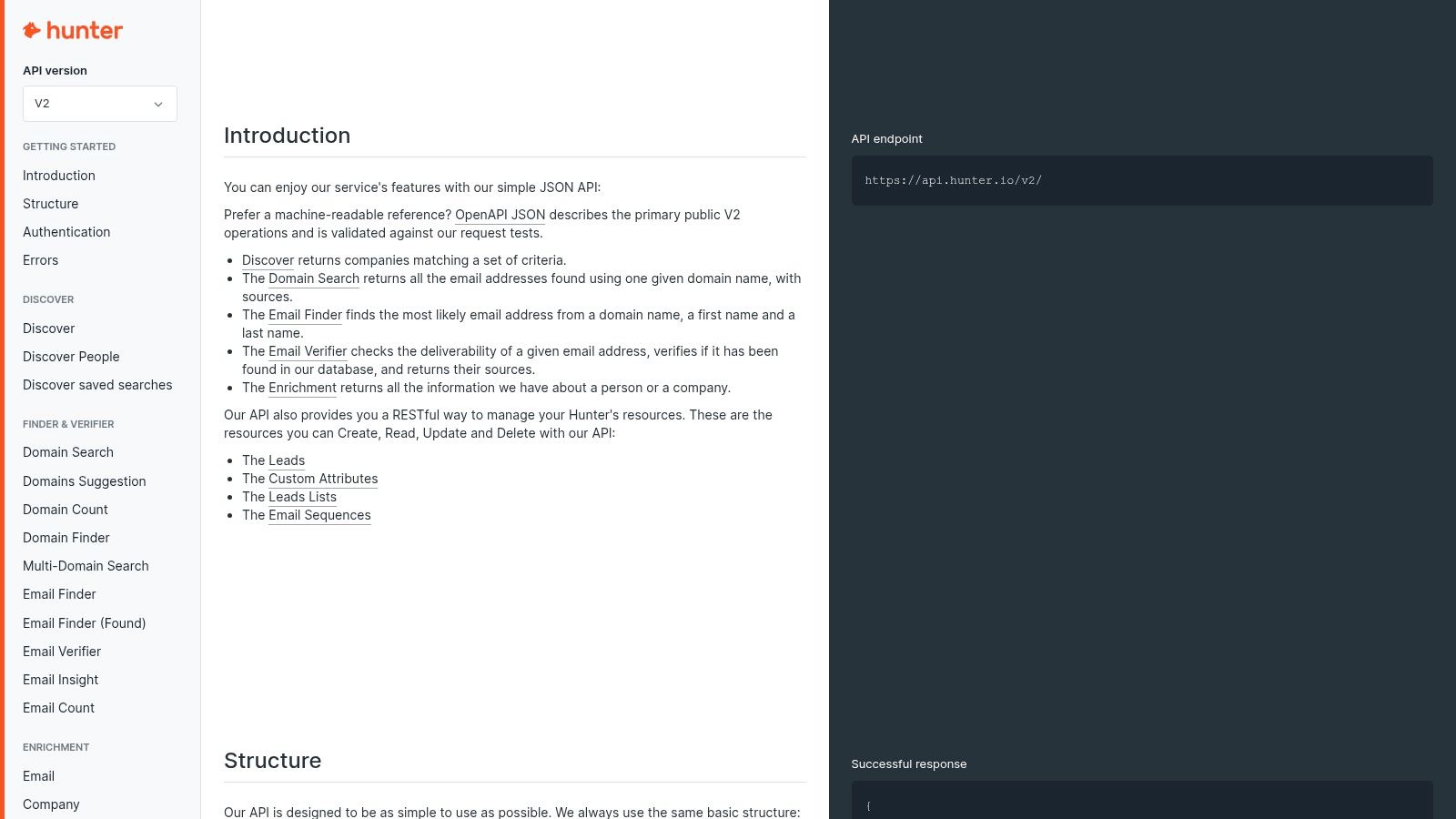
Users often reach Hunter through email finding and outreach, and that's exactly where its verifier makes sense. The single address endpoint returns clear statuses including disposable, valid, invalid, accept-all, and unknown, and under the described billing rules disposable and unknown results don't consume credits. If Hunter is already in your stack, adding verification is nearly free in integration terms.
Don't force it into a high throughput signup gate, though. The API doesn't support batch requests in one call, the documented rate limit is 10 requests per second, and disposable addresses are skipped rather than mailbox verified. Those are sensible choices for an outreach workflow. They're awkward constraints for a consumer signup form during a launch spike.
- Clear categories: easy to map onto accept, reject, and review buckets
- Credit rules: disposable and unknown results don't consume credits
- Pricing: a free plan is available and Starter is listed at $34 per month
Web and bulk verification tools exist outside the API, so list work is still possible. My recommendation is narrow. Use Hunter's verifier if you already pay for Hunter and your volume is modest. Choose a signup first service if verification sits directly in your registration path.
9. DeBounce
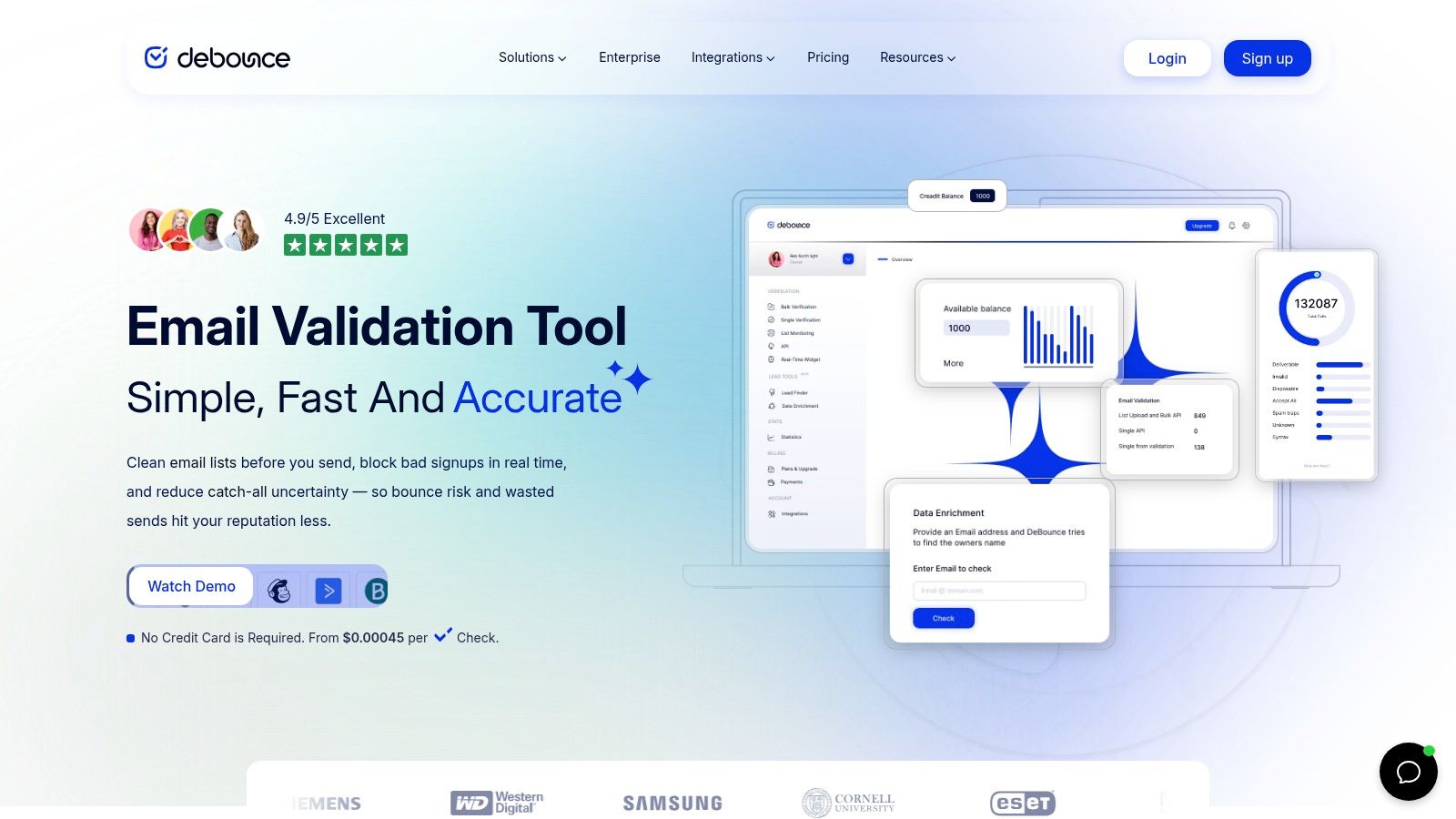
DeBounce covers both ends of the problem: API based verification for live checks, dashboard driven tools, and bulk list cleaning, alongside a public disposable check meant for lightweight screening. That mix suits teams that want individual screening now and periodic cleanup later without paying a second vendor.
Keep the two jobs separate in your head. A disposable check tells you an address is temporary. It says nothing about whether a permanent looking address hides a live mailbox, so it can't stand in for SMTP validation when bounce rate is the actual problem. Registration teams conflate these constantly, then blame the tool when deliverability doesn't improve.
The category has history. The Oberlin College poster on disposable email services describes a dataset of 856,886 emails across four disposable services where inboxes were often publicly accessible without individual passwords. Any inbox a stranger can open is the wrong destination for a password reset link, so treat every flagged address as unsuitable for anything sensitive.
If the only question you need answered is disposable-or-not, DeBounce's screening endpoint is the light option, and the verification API earns its place once bounce rate and list hygiene join the requirements.
Either way, confirm quotas under load before launch, because undocumented API limits surface during traffic spikes, exactly when a signup form can least afford them.
10. TempMailChecker
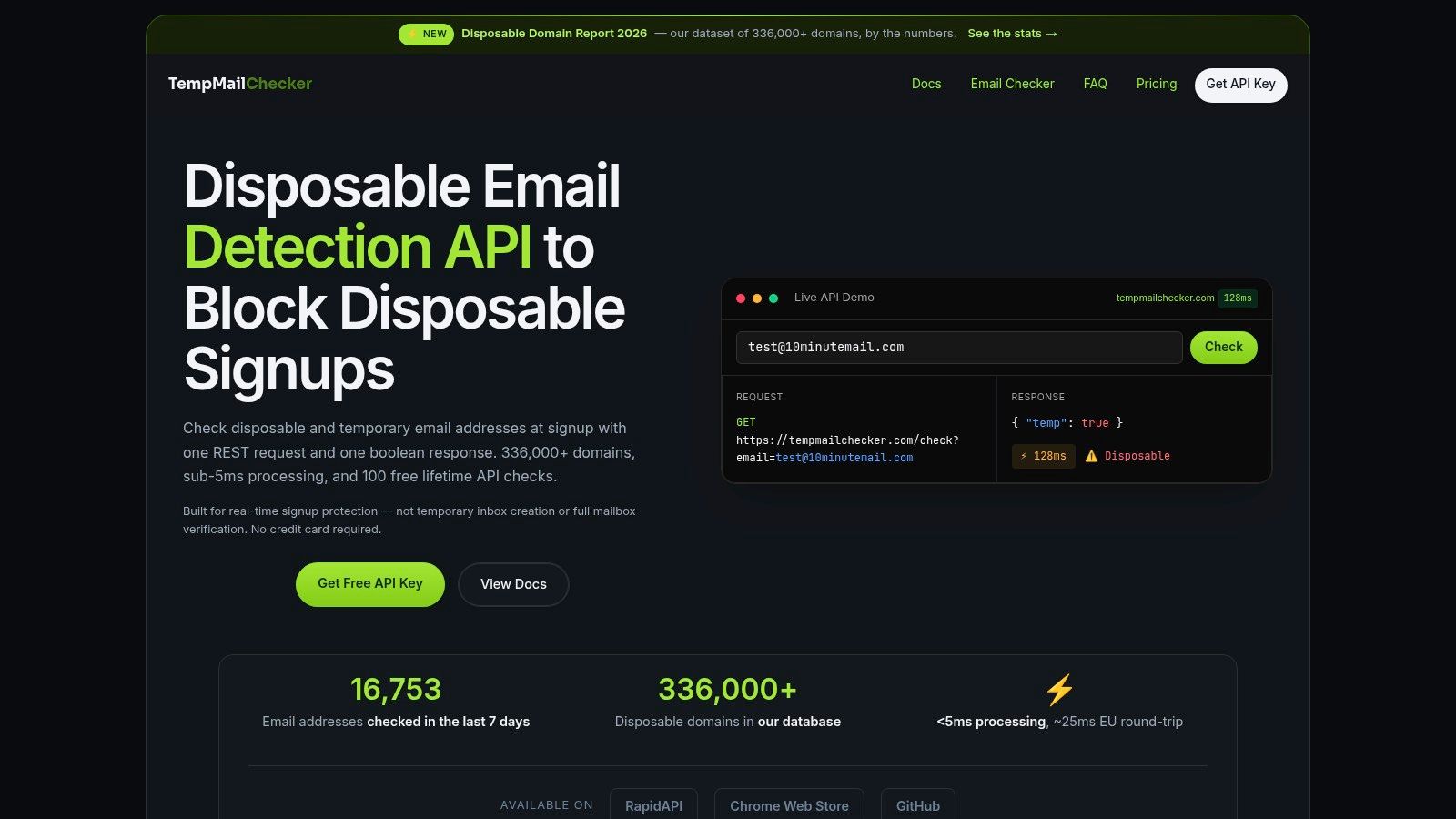
TempMailChecker is the narrow end of the market: an authenticated REST endpoint that accepts an email address or a bare domain and returns a simple temp boolean in JSON. That is useful when the only decision is whether a domain is throwaway, and the small integration surface keeps a form handler easy to reason about.
Paid tiers add custom allow and deny lists, which matters once a legitimate customer segment collides with a domain on the blocklist. Entry pricing is low enough that a spike test and a short production trial are cheap to run; treat that tier as a fit check and size production signup traffic separately.
A negative result only means the address was not classified as disposable. It does not establish mailbox existence, catch-all status, role ownership, or whether the account should be trusted for recovery.
So the placement is clear. Use TempMailChecker as a lightweight gate for newsletter signup, comments, or a low value form where blocking a throwaway domain is the whole policy. For billing, account recovery, or EU residency requirements, use a full verifier that returns SMTP, role, free-provider, and scoring signals and documents where verification runs. If you need context before writing that rule, the overview of disposable email domains explains how these services multiply and why lists go stale.
How the 10 disposable email API providers compare on disposable detection, free allowance, entry pricing, and best fit
The split that matters is signal depth. Disposable-only tools answer one question cheaply. Full verifiers cost more per lookup, but they return enough context to reject, flag, or route an address instead of forcing a binary decision.
| Item | Disposable Detection | Free Allowance | Starting Paid Price | Best Fit |
|---|---|---|---|---|
| Mailbeam | Boolean disposable flag alongside syntax, MX, SMTP, role and free-provider checks | Free plan | Per-verification pricing with monthly and pay-as-you-go tiers | EU-hosted signup gating plus bulk list cleanup |
| Mailsurity | Dedicated disposable-email detection | 500 checks | $5/month | Signup flows needing a focused disposable check |
| Email Hippo MORE | Included with broader validation checks | 100 checks | $9.88/month | Teams combining signup checks and list cleaning |
| ZeroBounce | Included with broader validation results | 100 monthly credits for qualifying accounts | $39 for 2,000 verifications | Teams needing a broad email-quality platform |
| Abstract Email Validation API | Included with broader validation signals | Free tier | Tiered paid plans | Teams wanting structured quality and risk signals |
| Bouncer | Included with email verification; Shield supports form protection | 100 credits | $8 for 1,000 credits | Teams needing flexible, non-expiring pay-as-you-go credits |
| Emailable | Included with broader verification attributes | 250 credits | Tiered paid plans | Teams needing single and batch checks with configurable validation |
| Hunter Email Verifier API | Returns disposable status | Free plan | $34/month | Organizations already using Hunter for outreach |
| DeBounce | Disposable checks plus broader verification | Tiered | Tiered plans for individual and bulk checks | Teams needing both individual checks and bulk cleanup |
| TempMailChecker | Dedicated disposable or temporary-mail check | 100 lifetime checks | $12/month | Developers needing a simple disposable-only decision |
For EU signup paths, look past the domain count. Check where addresses are processed, whether a single verification is retained, how fast the inline verdict returns, and whether the response separates disposable, role, free-provider and catch-all signals.
Choose the Narrowest Tool That Covers Your Signup Risk
Start by naming the failure you're paying for. If promo abuse and multi accounting are eating your trial budget, a disposable only check from Mailsurity or TempMailChecker solves the problem at the lowest latency and the simplest integration cost. Adding SMTP probing there buys you nothing except slower forms. Narrow tools also fail more predictably, because there's only one signal to audit when a user complains.
Move to a full verifier when the symptoms change. Rising hard bounces, role addresses polluting your CRM, catch-all domains you can't classify, or a compliance review asking where addresses are processed all point to a broader check. In that world the response shape matters more than the domain count. You want a score, a reason code, and separate flags for disposable, role, free provider, and catch-all, so your policy can be graduated instead of binary.
Graduated is the right default because disposable usage isn't uniform. The 2019 measurement study of disposable email services monitored 70,000 disposable inboxes across seven services for three months, and disposable inboxes of that kind are often shared among strangers or left weakly protected. That makes disposable status a strong reason to refuse password reset and identity workflows, even in cases where you might tolerate the address for low value access.
Volume distribution argues the same way. In the longitudinal study of disposable email usage, about 48% of disposable addresses received only one message while roughly 5% of popular addresses received more than 100 messages. A single use address and a heavily shared public inbox are different risks, and a policy that treats every match identically will either over block privacy conscious users or under block abuse.
So write the policy before you pick the vendor. Hard block known disposable domains on free trials, referral programs, and anything with a monetary reward. Use step up verification, such as a second factor or a delayed entitlement, for uncertain or high volume cases. Always leave an appeal or alternative verification path, because some legitimate users route mail through privacy services and a dead end error message just converts them into support tickets or lost customers.
Then test against your own traffic rather than a vendor's sample list. Run two finalists in shadow mode for a week, log the verdict, the reason code, and the latency, and compare disagreement rates on addresses that later engaged or bounced. Watch false positives by geography and by funnel, since a provider that's rare in one market can be mainstream in another. Check the data handling terms at the same time: retention, sub processors, whether a DPA is included by default, and whether verification happens on EU infrastructure or crosses borders. Latency on the signup path deserves the same scrutiny, since a check that adds a second to form submission costs you conversions even when its verdicts are accurate.
Switching costs stay low if you don't create them yourself. Keep the verification call behind a thin internal interface, store only the outcome you need for audit, and avoid long contracts until you've seen a full billing cycle of real volume. Services with no lock in and dashboard cancellation make that easy to honour. Pick the narrowest tool that covers the risk you've measured, and expand only when your logs tell you to.
If you need a disposable check that also tells you whether the mailbox exists, start with Mailbeam, where one inline call returns the disposable flag alongside syntax, MX, SMTP, role, and free provider results with a score and reason code you can act on in your signup flow. Addresses are processed in the EU and discarded once the verdict is returned, so you get the decision without keeping the data. Try the free tier against your own signup traffic and compare the false positive rate before you commit.