Salt e mail isn't one single thing. It usually means either salting an email before hashing it for privacy or a muddled reference to signup email tactics like disposable-address filtering, and the right answer depends on which problem you're trying to solve.
That gap trips up a lot of developers. One person is asking how to hide raw email addresses in logs and analytics. Another is trying to stop throwaway signups, reduce bad records, or stay compliant when verifying addresses in an EU product flow.
Those are related, but they aren't the same job.
If you treat them as the same, you end up with bad advice. Privacy salting won't tell you whether a mailbox can receive mail. Disposable-email blocking won't protect a raw address that leaks into events, support tools, or internal exports. A solid signup stack usually needs both a privacy layer and a verification layer.
Table of Contents
- Understanding the Ambiguous Meaning
- What Salting an Email Actually Does
- How Email Salting Works in Practice
- Signup Privacy and Verified Email Tools
- From Verification to Deliverability and Authentication
- Why Disposable Email Is Only Part of the Problem
Understanding the Ambiguous Meaning
Salt E Mail is often a phrase that collapses two separate ideas into one.
The first meaning is security-oriented. In that version, you take an email address, combine it with a secret value, and hash the result. The point isn't deliverability. The point is to avoid storing or exposing the raw identifier when all you need is a stable internal token for matching, analytics, or fraud review.
The second meaning is operational. It usually comes from typo-driven searches, confusion with disposable email services, or questions about aliases, burner signups, and privacy-friendly verification tools. That path is about what happens at registration time when a user enters an address and your app needs to decide whether to accept it, reject it, or flag it.
Two very different questions
A quick way to separate them is to ask what outcome you need:
| If you need to... | You're probably asking about... |
|---|---|
| Hide the real email in storage, logs, or events | Salting and hashing |
| Decide whether an entered address is usable for signup | Verification and risk checks |
| Match users across systems without exposing raw PII | Deterministic salted identifiers |
| Stop fake or temporary inboxes from polluting your funnel | Disposable-email detection |
That distinction matters because the implementation tradeoffs are different.
With privacy salting, your concern is how identity moves inside your systems. With signup verification, your concern is what kind of address the user just gave you, how much confidence you have in it, and what your product should do next.
Practical rule: If your question starts with “should we store the raw email,” think salting. If it starts with “should we allow this signup,” think verification.
How to recognize your real intent
A few common examples make the fork clearer:
- Product analytics team: wants to join events across services without exposing personal data. That's a salting question.
- Growth team: sees low-quality signups and abandoned accounts. That's a verification question.
- Security team: wants fewer raw addresses in logs and support exports. Again, salting.
- Compliance team: asks where verification data is processed and retained. That's verification architecture and data residency.
Most organizations eventually hit both.
What Salting an Email Actually Does
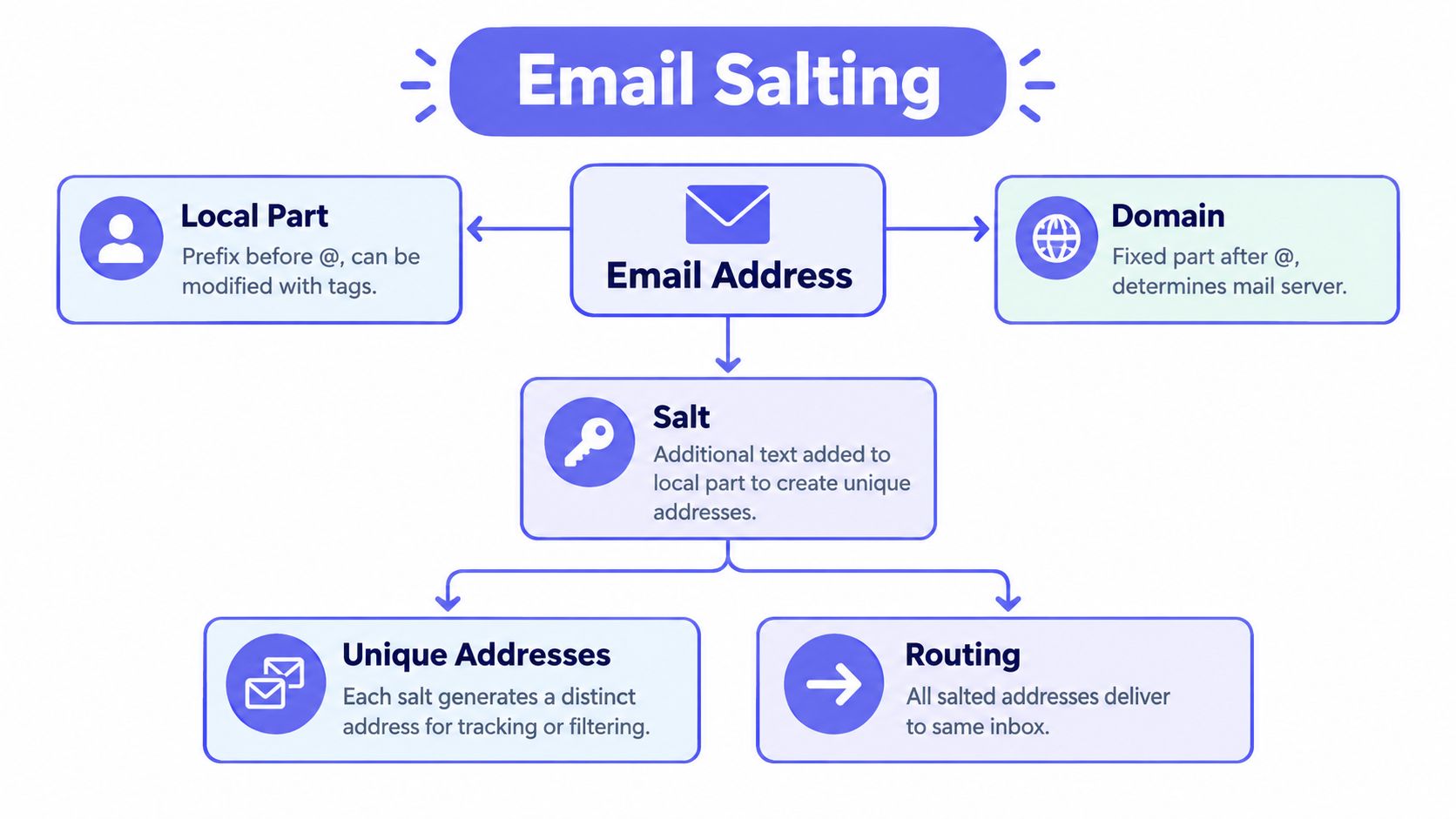
Email addresses are rigid enough to be useful identifiers and sensitive enough to need careful handling. Under SMTP rules, an email address is a local-part followed by @ and a domain. The local-part can be case-sensitive, the domain is not, and RFC 5321 sets the local-part length limit at 64 characters according to RevenueFlow's RFC-focused explanation.
That strict structure is one reason engineers often avoid spreading raw addresses everywhere. Email looks simple in UI, but it becomes sticky once it lands in logs, data warehouses, webhooks, support systems, and event streams.
Salting is about protection, not delivery
When engineers say they “salt an email,” they usually mean:
- take the email string
- combine it with a secret salt
- hash the combined value
- store the hash instead of the raw email where possible
That changes the role of the email from directly readable personal data into a token your systems can compare deterministically. If the same input and same salt are used again, you get the same output. That lets you correlate records without exposing the actual address to every tool in the path.
What it doesn't do is prove the inbox exists, improve inbox placement, or tell you whether a signup is low risk.
Why email syntax history matters
Email syntax has been strict for decades, but it didn't stay frozen. RFC 6530, published on 2011-03-02, formalized the framework for internationalized email, extending the model beyond ASCII-only local parts, as described in the RFC 6530 text/doc/rfc/rfc6530.html).
That matters for salting because many old implementations assume email is plain ASCII and trivially normalized. It isn't always. If your hashing pipeline normalizes too aggressively, or normalizes inconsistently across services, your “stable identifier” stops being stable.
Salting should happen after you decide exactly how your system canonicalizes the email for your own use case. Otherwise two services can hash the same user differently.
A simple mental model
Think of salting as identity shielding.
- The raw email is the sensitive identifier.
- The salt is the secret ingredient.
- The hash is the internal token.
You can still match records. You just don't hand the plain address to every downstream system that asks for it.
How Email Salting Works in Practice
Teams don't need a grand security framework here. They need repeatable rules.
A workable pattern is to keep the raw email only in the narrow part of the system that needs it, such as account communication or user-facing support operations. Everywhere else, analytics pipelines, event exports, abuse dashboards, and internal joins can often run on a salted hash instead.

Where it fits well
Salting tends to work cleanly in a few places:
- Event tracking: product events can reference a salted identifier instead of the raw mailbox.
- Fraud analysis: reviewers can spot repeated patterns across signups without seeing the full address in every tool.
- Audit logs: internal actions can remain traceable without making logs a second customer database.
- Third-party analytics: you can limit what external processors receive.
That's often enough to reduce accidental exposure without changing the customer-facing flow.
What salting does not replace
Salting helps, but it doesn't solve everything.
| Salting helps with | Salting does not replace |
|---|---|
| Reducing raw-email spread | Access control |
| Safer internal matching | Encryption at rest |
| Lowering exposure in logs | Consent management |
| Limiting third-party visibility | Signup verification |
If a service must send email, recover accounts, or support the user directly, it still needs controlled access to the address somewhere in the system.
Don't use salting as an excuse to skip data mapping. You still need to know which systems hold the raw address and why.
Implementation habits that age well
A few habits make salted workflows less fragile:
- Pick one canonicalization policy: Decide how you treat case, whitespace, and input normalization before hashing.
- Separate salts by context: A single shared secret across unrelated systems creates wider blast radius than you want.
- Document reversibility assumptions: Hashes aren't for “recovering” the original email later.
- Respect consent boundaries: Even hashed identity can still be personal data in practice if you can single a person out with it.
That last point is where many teams get sloppy. Salting reduces exposure. It doesn't turn identity into non-identity by magic.
Signup Privacy and Verified Email Tools
A lot of people searching for Salt E Mail aren't asking about hashing at all. They're trying to avoid giving their main inbox to every signup form on the internet.
That's a different problem. Here, the question isn't “how do we hide an email internally?” It's “what kind of address is entering the system, and what should we do with it?”
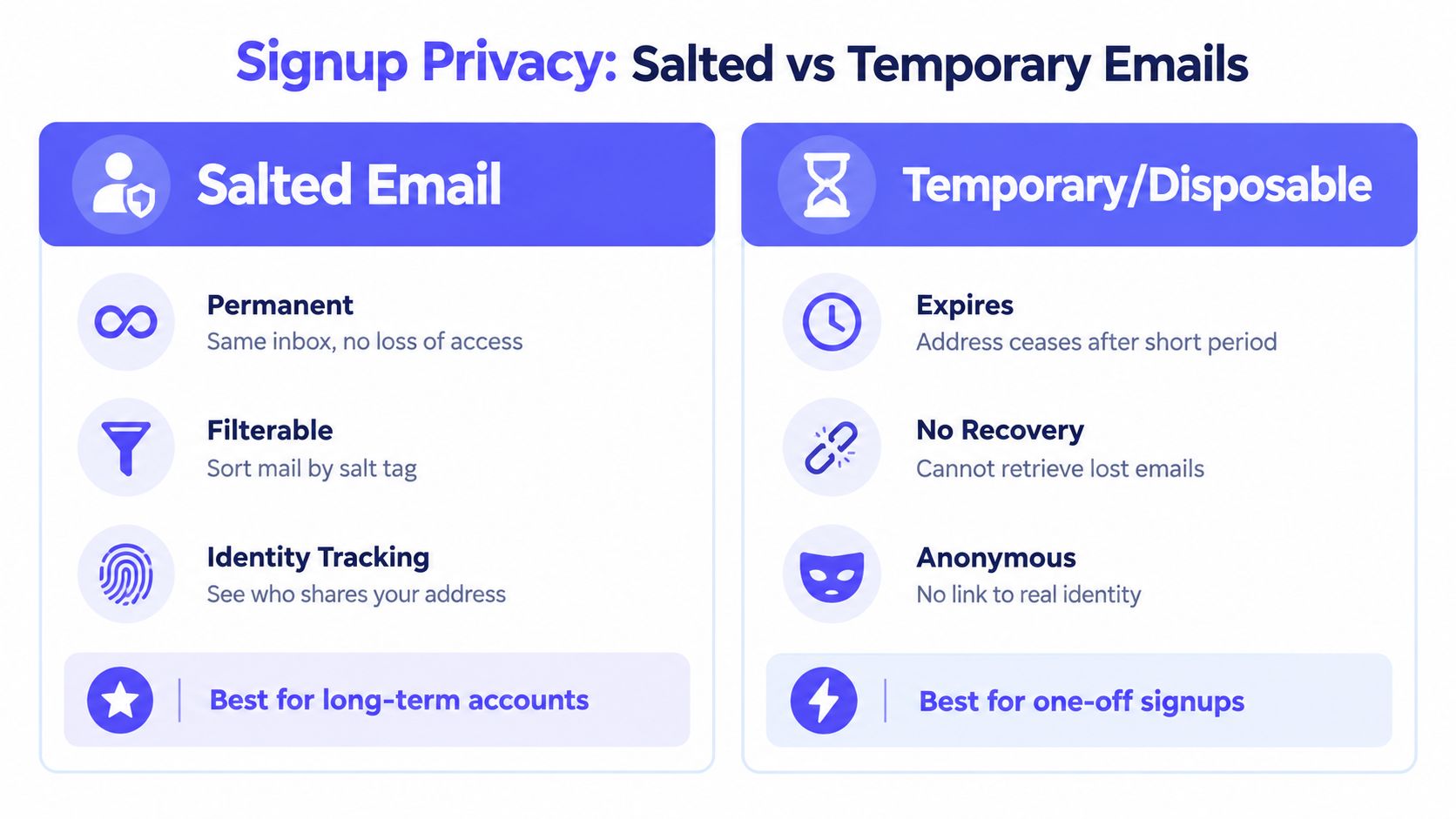
Disposable addresses are part of that picture. Temporary inboxes are created for one-off registrations and then abandoned, which leads to zero engagement, raises fake-account and bot-registration risk, and can hurt deliverability through more bounces and weaker inbox placement, according to MailTester's guidance on disposable-email detection.
Salted identity versus temporary identity
These two approaches solve different user behaviors.
A user who relies on aliases or privacy-preserving patterns usually still wants long-term access to the inbox. A user on a disposable service often wants short-term access only, or no ongoing relationship at all. That's why product teams shouldn't lump them together as “suspicious.”
Here's the practical comparison:
- Salted or alias-like usage: better for durable accounts, recoverability, and ongoing communication.
- Temporary inbox usage: more common in one-off, low-commitment, or evasive signup behavior.
- Brand or company email confusion: often shows up when users expect a work address to be accepted but your flow rejects role-based or risky patterns.
If you work on anonymous or privacy-sensitive products, that distinction also shows up in communication design. The tradeoffs are similar to the ones discussed in Ciphar's guide on burner phones vs encrypted chat tools, where temporary reachability and long-term identity serve different goals.
What responsible verification looks like
A useful verification stack checks more than syntax. Industry guidance recommends checking each address at entry against known disposable providers and returning reasoned classifications such as valid, invalid, catch-all, risky, or disposable so the product can respond deterministically instead of guessing. If you're evaluating implementation patterns, this overview of an email verification API workflow is a good model for how signup-time gating usually fits into product logic.
For regulated teams, architecture matters as much as verdict quality. If personal data is processed outside the EEA, that becomes an international transfer that generally needs a valid mechanism such as Standard Contractual Clauses. EU-hosted processing reduces transfer complexity and audit burden, and minimization practices like not retaining single verifications and deleting bulk uploads after a short retention window reduce exposure, as outlined in QualiSend's GDPR email verification analysis.
One tool category, different priorities
When developers compare tools in this space, the checklist usually looks like this:
- Reason codes: Can the app tell the user or support team why the address was blocked or flagged?
- Real-time usability: Can the check run inside the signup request without wrecking form UX?
- EU data handling: Where is the submitted address processed and stored?
- Risk granularity: Can the system distinguish disposable, role-based, catch-all, and other mixed outcomes?
Mailbeam is one example in that category. It exposes a real-time verification API and companion tools for syntax, MX, SMTP, disposable, role-based, and catch-all checks, with EU-hosted processing and machine-readable reasons suited to signup flows.
From Verification to Deliverability and Authentication
A verified address is only the first gate. It tells you whether you should trust the recipient data enough to proceed. It doesn't tell mailbox providers to love your mail.
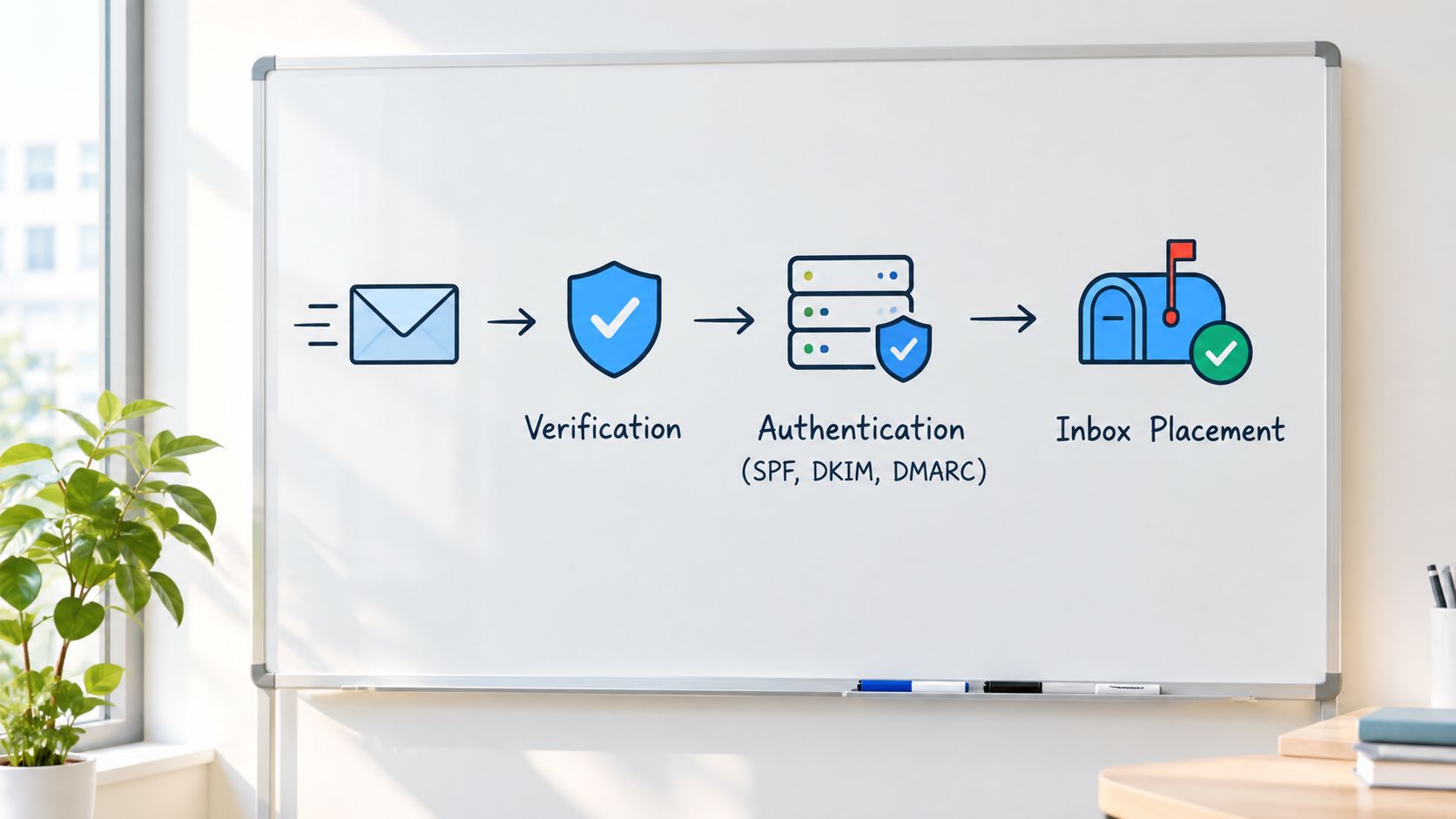
That distinction matters more now because deliverability is increasingly tied to authentication and reputation, not just list cleanliness. Recent 2026 coverage summarized by Bouncer reports that primary inbox placement improved to 63% in 2026, while DMARC adoption fell from 59% to 48% of tested domains, even as SPF and DKIM rose, according to Bouncer's deliverability trends review.
What that means for engineering teams
That combination is a useful warning sign. Better inbox outcomes aren't coming from verification alone. Teams still need verification to avoid invalid-recipient bounces, but inbox placement also depends on whether sending domains are authenticated, whether reputation stays healthy, and how providers score the mail after send.
So the modern flow looks less like a single yes-or-no check and more like a chain:
- verify the address at signup
- classify risk clearly
- authenticate your sending domain
- monitor post-send reputation and placement
- adjust policy when signals drift
If your internal ownership is split, product usually owns step one and infrastructure or lifecycle messaging owns the rest. Users don't care which team owns the failure. They just see “I never got the email.”
Verification is a layer, not the whole system
A lot of signup architectures go wrong. They block obvious bad addresses, declare victory, and ignore the sending side.
A clean list reduces avoidable bounces. It does not guarantee inbox placement.
That's why the handoff between onboarding and messaging systems matters. Engineers working through recurring email deliverability issues usually get better outcomes when they connect signup validation with authentication monitoring instead of treating them as unrelated stacks.
The practical takeaway is simple. Protect identity early, verify intelligently, and then maintain sender trust after the user record exists.
Why Disposable Email Is Only Part of the Problem
Developers often overestimate disposable email because it's visible and easy to explain. A signup comes in from a known throwaway domain, the rule fires, and the case feels solved.
But recent independent data points in a different direction. MailCleanup's 2026 report found disposable addresses at 0.30% of 3,596,809 verified emails, while role-based addresses were 1.49% and non-deliverable, accept-all, and unknown outcomes totaled 26.73%, according to MailCleanup's email verification statistics.
The larger risk bucket is messier
That should change how you design your flow.
If disposables are relatively rare in many real-time datasets, the bigger operational challenge isn't “block every suspicious inbox.” It's deciding what to do with the much larger mixed bucket of addresses that aren't clearly good or clearly bad.
A useful decision model looks like this:
| Address outcome | Typical treatment |
|---|---|
| Clearly invalid | Reject immediately |
| Disposable in a high-trust flow | Usually reject |
| Role-based or mixed-risk | Allow with flags or step-up review |
| Accept-all or unknown | Route carefully and monitor downstream |
That kind of policy is harder than a blunt blocklist, but it usually maps better to real product risk.
Why aggressive blocking backfires
If your verifier is too aggressive, you can create a false-positive problem that's larger than the disposable problem you were trying to solve. That's especially true in top-of-funnel signup flows where friction costs more than a small amount of uncertainty.
Teams asking how to block disposable signups still need that capability, and this guide on how to block disposable emails is useful background. But the stronger design question is when to reject instantly versus when to allow the signup and mark the account for downstream handling. If you're building those controls, this reference on disposable email detection is the more relevant implementation layer.
A better product decision
For most SaaS products, the cleaner rule is:
- Reject what you know is broken
- Flag what you only partly trust
- Learn from post-signup behavior
That keeps your funnel usable while still protecting deliverability and data quality.
Salt E Mail, in the privacy sense, helps reduce unnecessary exposure of personal data inside your stack. Verification helps you decide whether the address entering the stack belongs there in the first place. You usually need both, but they should never be confused for the same control.
Mailbeam gives product engineers a way to validate addresses in real time, classify risky outcomes with machine-readable reasons, and keep verification processing aligned with EU-first data handling. If you're building signup flows that need both practical gating and cleaner deliverability inputs, visit Mailbeam.