
The most common advice about an SMTP email checker is also the most dangerous: connect to the recipient's server, get a successful response, and mark the address valid. That approach confuses an observation with a guarantee. A production signup flow needs a narrower answer: what did the receiving server reveal, how trustworthy is that evidence, and what should the application do next?
Table of Contents
- Why an SMTP Response Is Not a Verdict
- The Five-Stage Verification Pipeline
- Handling Timeouts, Retries, Greylisting, and Catch-Alls
- Integrating the Checker into Signup Flows
- Signup Validation Versus Bulk List Cleaning
- Verification Is Not Transport Security
- Benchmarking a Checker Against Real Bounces
Why an SMTP Response Is Not a Verdict
A successful SMTP conversation doesn't establish that a person owns the address, that a specific mailbox exists, or that your next message will reach an inbox. It establishes something about the receiving server's behavior during that particular conversation. Your application shouldn't promote that observation into a stronger claim.
Mailbox checking isn't a modern extension bolted onto email. SMTP's original specification, RFC 821, published in 1982, included mailbox-verification capabilities; its successor explains that VRFY asks whether a supplied name identifies a user or mailbox, while EXPN requests mailing-list contents. The successor also prohibits a 250 verification success without actual verification, permits disabling those commands for security, and specifies 252 when verification is unavailable, as described in RFC 5321's SMTP verification requirements.
Read the response in context
The command matters as much as the response. Acceptance of a greeting says nothing about the recipient; acceptance of the sender describes a different decision from acceptance of the recipient. Even recipient acceptance must be interpreted alongside the receiver's verification policy.
That distinction should survive every abstraction layer. An SDK that converts all successful conversations into valid: true removes information your signup policy needs. A dashboard that labels those results “verified users” makes an even larger leap.
| Observation | Supported interpretation | Unsupported interpretation |
|---|---|---|
| Domain has receiving infrastructure | The domain appears mail-capable | The supplied mailbox exists |
| Recipient accepted during a probe | The receiver accepted this recipient in this session | Future delivery is guaranteed |
| Receiver conceals recipient validity | Mailbox status remains uncertain | The address is invalid |
| Confirmation completed | The applicant demonstrated access to the address | SMTP probing proved their identity |
Keep transport evidence separate from product decisions
A useful checker separates syntax validity, domain reachability, mailbox likelihood, and policy risk. These fields answer different questions, so combining them into an unexplained boolean makes debugging harder.
Disposable-domain classification, role-account detection, and historical bounce signals can influence policy without changing what the SMTP server said. A reachable mailbox can still violate your account policy, while an uncertain mailbox can belong to a legitimate applicant.
Treat the response as evidence with a scope, not as permission to claim more than the server revealed.
The practical architecture is a staged pipeline with an explicit outcome model. Preserve the observations first, derive confidence second, and let the product choose whether to reject, confirm, defer, or monitor.
The Five-Stage Verification Pipeline
Build the checker so that cheap, deterministic checks happen before network-dependent work. There's no reason to occupy an SMTP connection for input that can't pass structural validation. Equally, a syntax pass shouldn't bypass domain checks just because the address looks familiar.
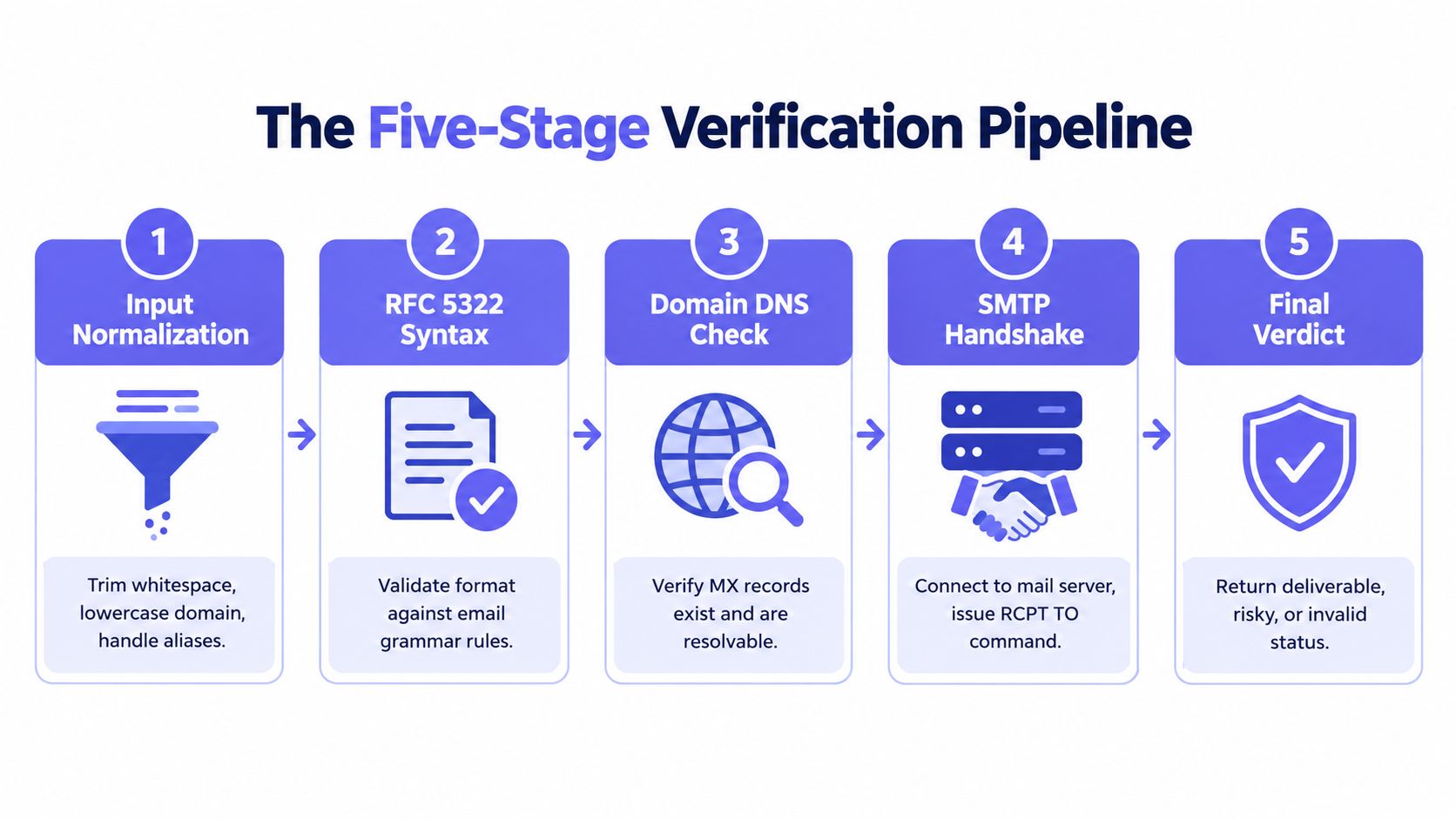
Normalize and validate without rewriting identity
Trim surrounding whitespace and normalize the domain for comparison. Preserve the submitted address separately from the value used for checks, and don't remove alias information merely to make matching easier. Normalization should clean input, not invent a different destination.
Use a maintained parser rather than an improvised regular expression. A practical implementation validates RFC 5322-style structure, applies limits of 64 octets for the local part and up to 255 octets for the domain, and probes destination servers over TCP port 25, consistent with the email-address structure and SMTP checking guidance.
Resolve the destination before opening a connection
Query for MX records and resolve the receiving hosts. Missing MX records alone aren't enough to declare a domain invalid: SMTP permits fallback to the domain's A or AAAA host.
Keep a failed DNS lookup distinct from a definitive absence of usable receiving infrastructure. The distinction becomes important when a resolver times out, because retrying the resolver is a different operation from retrying a mailbox probe.
The network portion should follow a controlled sequence:
- Establish the session. Apply separate connect, greeting, and command deadlines rather than relying on a library's default socket behavior.
- Negotiate capabilities. Issue EHLO and optionally negotiate STARTTLS according to the checker's transport policy.
- Present the envelope. Send MAIL FROM, then RCPT TO, recording which command produced each response.
- Stop before message transfer. Don't send DATA or deliver a message as part of the existence probe.
Score evidence and return reason codes
The final stage should classify the observation as deliverable, undetermined, temporary failure, or invalid. Treat “deliverable” as the checker's operational label for positive evidence, not a promise of future inbox placement.
Return a machine-readable reason alongside the category. Suggested internal reasons might include syntax_invalid, dns_unavailable, recipient_accepted, and recipient_status_hidden; these are implementation examples, not a prescribed vendor schema.
A numeric score can help order review queues, but it shouldn't erase contradictory observations. Keep the score explainable through the underlying checks, and expose the decisive reason so application code doesn't have to reverse-engineer policy from a threshold.
Handling Timeouts, Retries, Greylisting, and Catch-Alls
A receiver that responds slowly can consume your signup budget without providing any useful mailbox evidence. The solution isn't an arbitrarily generous timeout. It's a bounded foreground request, a separate retry path, and destination-aware controls.
Set explicit deadlines for connection establishment, the initial greeting, and each command. Also impose an overall request deadline so individually bounded operations can't accumulate into an unbounded form submission. When the foreground deadline expires, return uncertainty and schedule eligible work outside the request.
Retry deferrals, not every rejection
For 4xx responses, use exponential backoff in a background queue. Preserve the original response and retry history so a later outcome doesn't hide the fact that the receiver initially deferred the probe. Add scheduling jitter to avoid having workers reconnect together.
Don't automatically retry 5xx responses as if they were temporary failures. First distinguish a recipient-specific permanent rejection from a sender-policy or connection-policy rejection; the latter may reveal nothing about the mailbox itself.
| Failure mode | Foreground result | Background action |
|---|---|---|
| Connection or greeting timeout | Undetermined | Retry within the destination budget |
| Temporary recipient deferral | Temporary failure | Back off and retry |
| Permanent recipient-specific rejection | Invalid when evidence is clear | Don't blindly retry |
| Sender-policy rejection | Undetermined | Investigate probe configuration |
| Deliberately slow conversation | Undetermined | Reduce pressure on the destination |
Greylisting temporarily defers unfamiliar traffic, so an immediate rejection can be a request to try later rather than evidence of a nonexistent mailbox. A later attempt may succeed, but that doesn't justify holding the applicant on the form while the retry completes.
Tarpitting is different: the receiver deliberately slows responses. Raising command deadlines and launching more probes usually makes the integration less responsive and increases pressure on the destination.
Catch-all acceptance isn't mailbox confirmation
A catch-all receiver may accept arbitrary recipients during RCPT TO. If your checker detects that behavior, report accepts arbitrary recipients or an equivalent uncertainty reason rather than declaring the submitted mailbox independently confirmed.
Any catch-all assessment adds probing work. Keep it bounded and avoid repeated enumeration attempts just to force a confident-looking answer. If the receiver won't disclose recipient validity, uncertainty is the technically honest result.
Operational rule: Exhausting your probe budget means the checker couldn't decide. It doesn't mean the applicant supplied a bad address.
Choose per-destination concurrency caps from observed behavior rather than a universal setting. Reduce those caps when deferrals or slow greetings increase, cache DNS outcomes according to TTL, and stop retrying when a destination's budget is exhausted. Protecting the verifier's IP reputation is part of maintaining useful results, not merely an infrastructure concern.
Integrating the Checker into Signup Flows
Put verification behind your backend, not directly in the browser with a privileged API key. The frontend should receive an application decision and a safe explanation, while the backend retains the detailed observations needed for support and debugging.
An in-house implementation gives you control over probes and scheduling. A managed option such as Mailbeam exposes an HTTP API with scoring and machine-readable reasons, alongside web tools for inspecting individual addresses. Its documented response paths are designed for synchronous form submissions, but you should still measure end-to-end latency from your application rather than assuming every destination behaves alike.
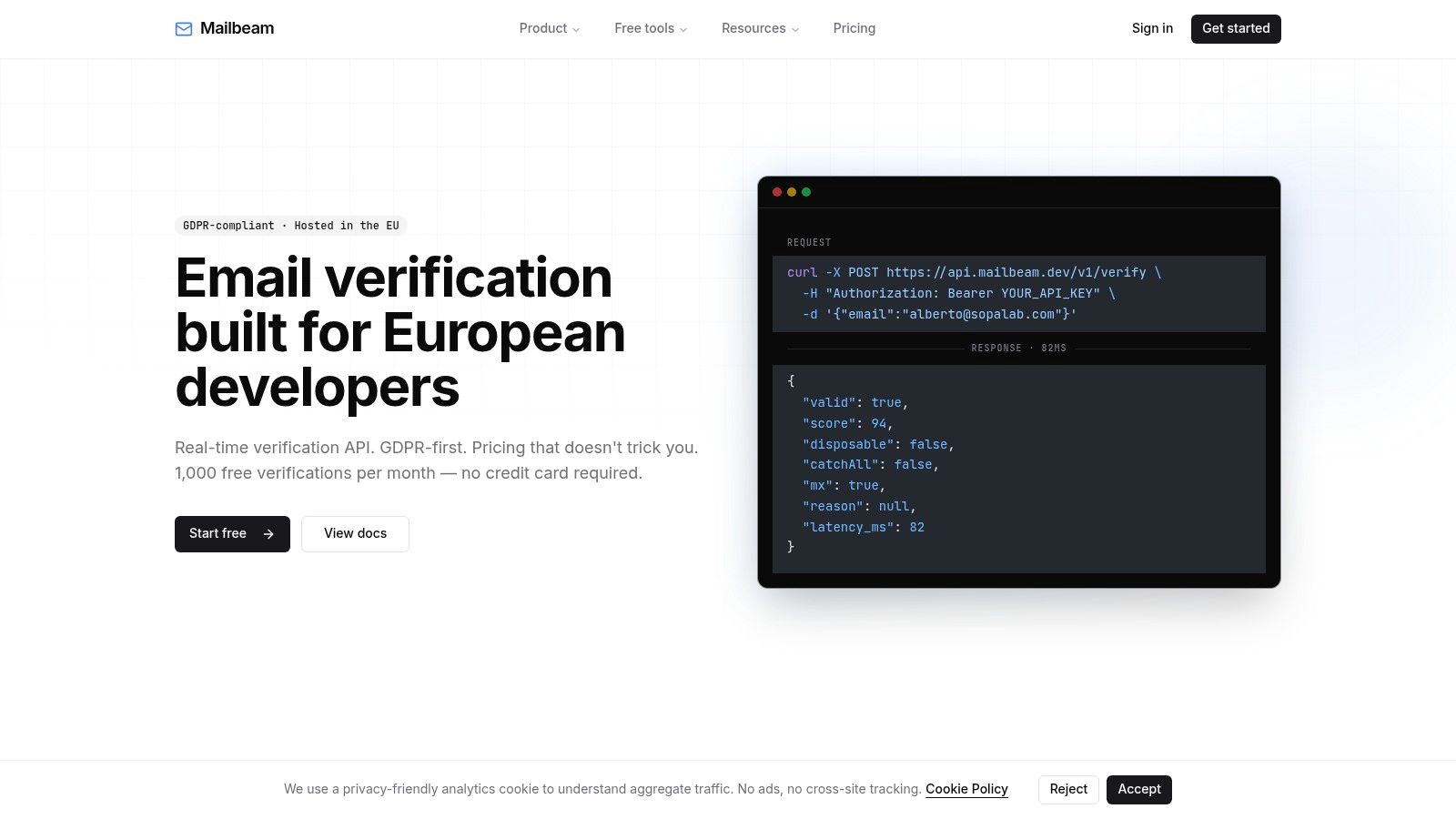
Choose the integration shape deliberately
A synchronous HTTP request fits a submit-time check when the verifier can return within your form's deadline. Checking on blur can provide earlier feedback, but don't probe every keystroke, and invalidate the old result if the applicant edits the address.
For heavier work, create a pending verification job and continue the signup with appropriate restrictions. A webhook can later update that job, provided your handler authenticates the event and tolerates repeated delivery. Keep an adapter around either integration so your domain logic doesn't depend on a vendor's response field names.
| Integration | Appropriate use | Main engineering concern |
|---|---|---|
| HTTP API | Immediate form decision | Deadline and fallback behavior |
| Asynchronous webhook | Deferred checks | Event authenticity and duplicate handling |
| Official SDK, when available | Convenient API access | Library lifecycle and preserved error detail |
HTTP remains a workable integration even when an official SDK isn't available. Don't delay shipping a small, tested adapter while waiting for a client library, and don't assume a planned library is already supported.
Make uncertainty usable in the interface
Separate technical reasons from user-facing messages. A policy rejection might say “This address appears to be a temporary mailbox. Use another address to continue.” An inconclusive probe should say “We couldn't verify this address yet,” not “Your email is invalid.”
Block high-confidence invalid addresses and classifications explicitly prohibited by your product policy. Role accounts shouldn't be rejected by default because they're shared; whether they're suitable depends on the account's purpose.
For unknown results, allow progress with confirmation or throttling appropriate to your threat model. Keep the verification state separate from account activation and permission assignment. This real-time email validation integration guide provides a useful companion when turning checker outcomes into form behavior.
Signup Validation Versus Bulk List Cleaning
Signup validation and list cleaning can use the same underlying checker without sharing the same decision policy. A signup decision affects an applicant who can correct a typo or confirm access immediately. A cleaning job affects stored contacts, where you usually have room to defer a decision.
For signup flows, prioritize avoiding false negatives that exclude legitimate applicants. For bulk cleaning, isolate uncertainty from the active sending segment while you gather more evidence. Neither workflow benefits from pretending an inconclusive result is certain.
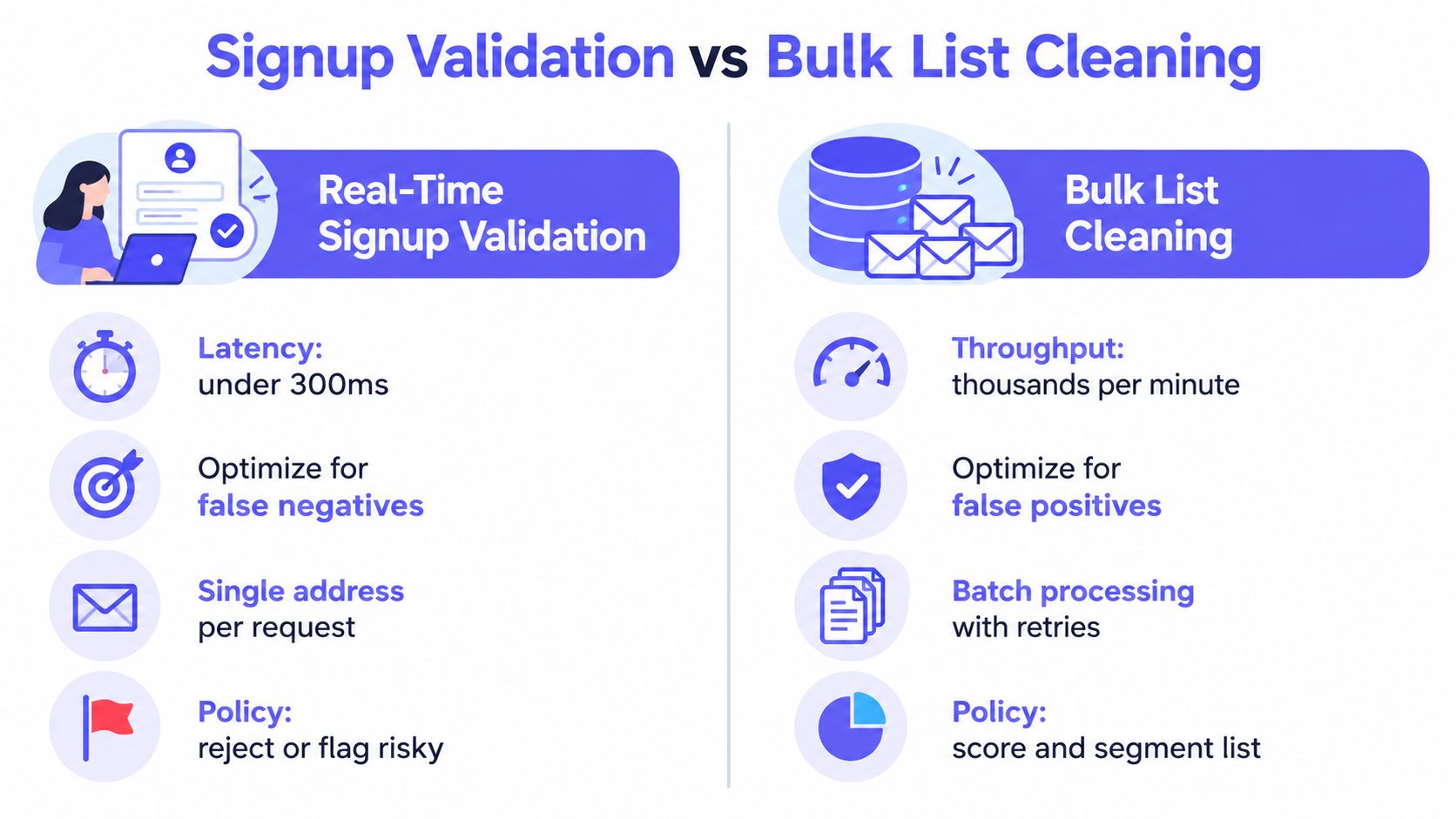
Treat latency and throughput targets as properties to test in your environment, not as inherent guarantees of either workflow. Destination behavior, retry policy, and the proportion of cached results affect what your implementation can sustain.
Different queues need different policies
| Decision area | Signup validation | Bulk list cleaning |
|---|---|---|
| Primary constraint | Applicant waiting on the form | Controlled processing capacity |
| Unknown outcome | Continue with safeguards | Quarantine and re-test |
| Retry location | Outside the foreground request | Inside the batch workflow |
| Result delivery | Immediate application response | Export or completion event |
| State management | Current submitted address | Stable contact identifier and job history |
A single-address HTTP call is straightforward for a form. A batch endpoint or CSV workflow needs durable job state, restartable processing, and a reliable way to map every result back to its original contact. Treat duplicate rows and interrupted jobs as ordinary conditions, not exceptional cleanup work.
Quarantine should be reversible. Keep the original contact identifier, the checker's reason, and enough timing context to decide when a re-test is useful. Don't delete unknown addresses merely because the batch completed successfully.
Retention belongs in the design
Uploading a contact list creates a separate data-handling decision from sending an individual address for verification. Before choosing a batch service, check where processing occurs, who can access uploads, how exports are protected, and whether deletion happens automatically.
Request documented retention and deletion behavior rather than relying on a broad compliance label. Your own downloaded reports need a lifecycle too; deleting a vendor upload doesn't remove copies from a shared drive or an analyst's workstation.
Use the email list cleaning workflow as an operational checklist, then adapt segmentation rules to your sending permissions and contact history. A cleaned list is an input to a sending decision, not authorization to contact everyone in it.
Verification Is Not Transport Security
An address can pass syntax, domain, and mailbox checks while the eventual message travels under a weak transport policy. Verification and transport assurance answer different questions. Combining them into a single green status prevents engineers from seeing which control needs attention.
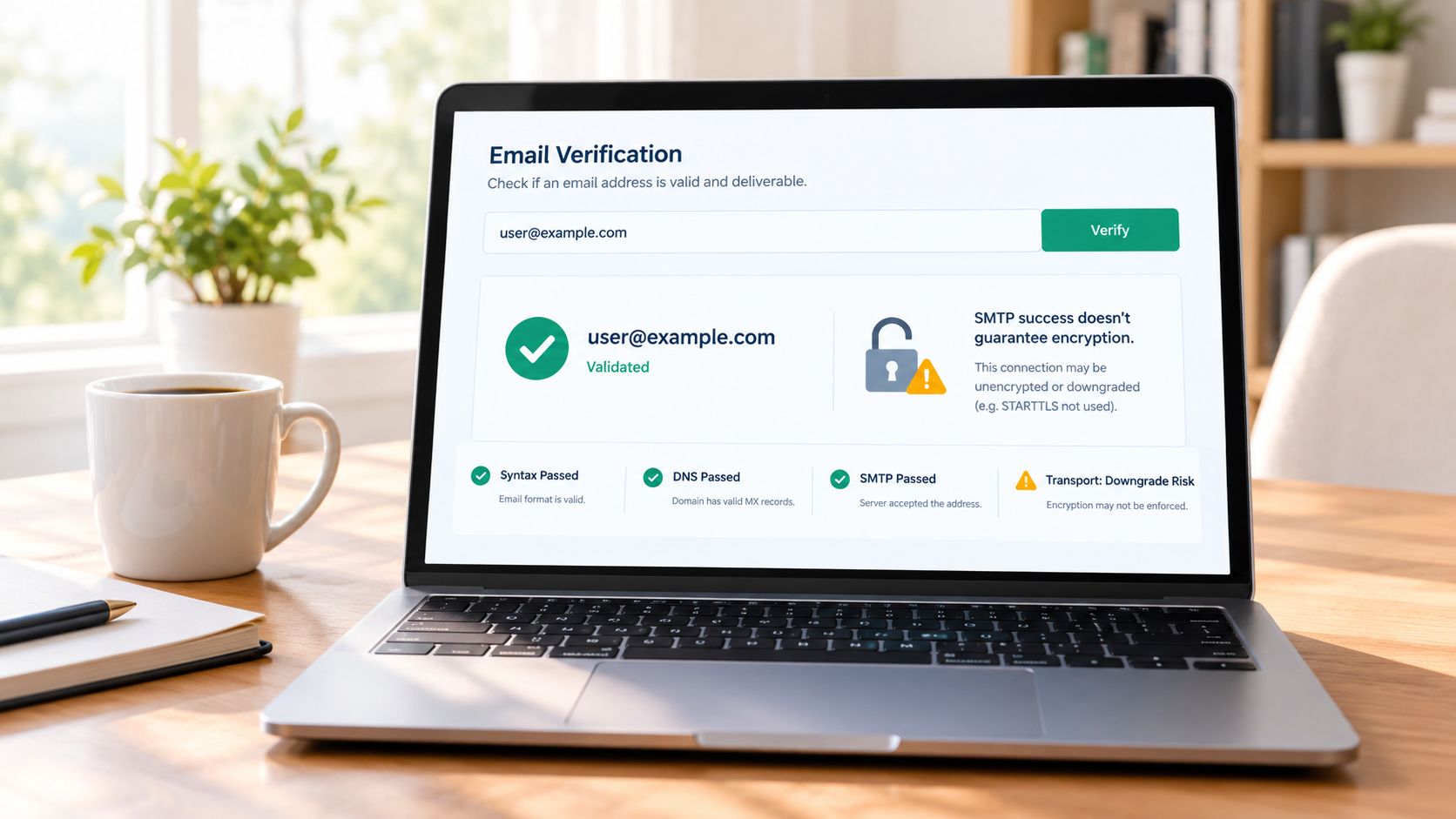
A measurement covering more than 87 million domains found that, as of September 2024, about 0.07% of .com domains with MX records published MTA-STS, 29.6% of publishing domains were incorrectly configured, and only 19.6% of observed sending domains performed MTA-STS validation, according to the MTA-STS deployment and validation study. These findings concern transport policy deployment, not mailbox-checker accuracy.
Report independent diagnostic layers
Keep mailbox likelihood, sender authentication, and transport assurance separate in both the API and the operator interface. A result in one layer shouldn't automatically mark the others healthy.
- Mailbox likelihood. Syntax, domain resolution, and SMTP observations describe whether the destination appears reachable.
- Sender authentication. SPF, DKIM, and DMARC belong to the controls around authenticated sending and domain policy, not recipient existence.
- Transport assurance. MTA-STS, TLS-RPT, and DANE belong in transport-security diagnostics rather than mailbox-validity scoring.
A probe that negotiates STARTTLS provides an observation about that connection. It doesn't establish that the eventual sending system will enforce an appropriate policy or that every later delivery will receive equivalent protection.
A clean mailbox result isn't a security assessment, a privacy assessment, or a guarantee of inbox placement.
Review privacy independently of reachability
For EU organizations, the checker's processing boundary deserves its own review. Ask whether individual addresses are retained, where batch jobs run, which subprocessors receive data, and how deletion is documented.
Minimize what you send to the checker. The address may be necessary; the applicant's full profile, account activity, or unrelated personal fields generally aren't necessary for mailbox probing. Apply the same discipline to logs and support exports.
A DPA and regional hosting can support your compliance process, but they don't replace your assessment of purpose, access controls, retention, and lawful processing. Successful SMTP verification doesn't establish GDPR compliance.
Keep remediation ownership explicit. Backend engineers can investigate probe behavior, sending-infrastructure owners can review transport and authentication controls, and privacy teams can evaluate processing arrangements. Those tasks shouldn't disappear behind an “email is fine” badge.
Benchmarking a Checker Against Real Bounces
Evaluate an SMTP email checker against the addresses your product encounters. A provider-wide accuracy claim won't tell you whether its uncertainty handling is suitable for your applicant mix or whether your rejection policy is too aggressive.
Build a holdout cohort and compare recorded predictions with subsequent hard-bounce outcomes from legitimate, permitted sends. Sample across provider, country, domain age, role/free/disposable classification, and prior engagement; run structural and domain checks before probing eligible candidates. Distinguish permanent delivery failures from temporary delivery problems when assigning evaluation labels.
Measure decisions, not just acceptance
Report these metrics separately for major mailbox providers, and document how you define the positive class:
- Precision and recall. Measure the checker's ability to identify the outcome you've defined, rather than relying on an ambiguous “accuracy” label.
- False-positive and false-negative rates. Track both missed bad addresses and legitimate addresses your policy would reject.
- Timeout and unknown rates. Include inconclusive checks instead of excluding them from the denominator.
- Operational context. Retain reason codes and relevant configuration versions so changes can be explained.
Delivery outcomes are the useful benchmark, not just the checker's immediate acceptance count. The distinction between address structure and downstream deliverability is also covered in email syntax and delivery-outcome guidance.
Troubleshoot distribution changes
If timeouts increase, inspect the affected command stage and destination before increasing deadlines. Check resolver behavior, outbound connectivity, worker saturation, and destination concurrency.
If a major provider changes behavior abruptly, reduce probing pressure and route uncertain results through your fallback policy. When reason-code distributions shift, compare checker releases, source-network changes, and applicant composition before concluding that list quality deteriorated. No universal success rate replaces that investigation.
Mailbeam offers a developer-friendly email verification API and companion web tools that combine SMTP observations with syntax, MX, and policy checks. Visit Mailbeam to test representative signup addresses, inspect the returned reasons, and map them to reject, confirm, or defer decisions before enabling production blocking.