
Your signup funnel looks healthy until the bounce alerts arrive. A typo slips past the form, a disposable inbox creates another low-quality account, and a role address enters a workflow meant for an individual user. By the time the problem appears in campaign metrics or sender-reputation reports, the address has already contaminated your data.
That's why email validation with Mailgun deserves to be treated as a product control, not a list-cleaning chore. A validator can inspect whether an address is structurally valid, routed through DNS, and accepted during an SMTP conversation. It can't prove that the person owns the mailbox, wants your product, or will engage with your messages. Those distinctions determine what your application should do next.
Table of Contents
- Why Email Validation Matters at Signup
- How Mailgun's Validation Product Came to Exist
- What Mailgun's Validator Actually Checks
- Using Mailgun's Validation API in Practice
- Why a Valid Result Is Not the Whole Story
- How Mailbeam Fits for EU-First Teams
- Choosing the Right Verifier for Your Stack
Why Email Validation Matters at Signup
A signup form usually checks whether a field looks like an email address. That's useful, but it only answers the easiest question. name@example.com can have valid syntax while the domain has no usable mail route, the recipient server rejects the mailbox, or the address belongs to a temporary service.
The operational consequences appear in different systems:
- Product analytics: Fake or low-intent accounts distort activation and retention signals.
- Sending infrastructure: Hard bounces create avoidable delivery failures and can weaken sender reputation.
- Marketing operations: Disposable addresses consume campaign capacity without creating a durable audience.
- Support workflows: Invalid addresses produce failed password resets and confusing account-recovery tickets.
A real-time validator sits between the form and account provisioning. It gives your application more information before it creates a user, schedules a message, or adds a contact to a CRM. The best implementation doesn't reject everything that looks unusual. It distinguishes permanent failure from uncertainty, then maps each result to a reversible product action.
Practical rule: Use validation to decide what should happen next, not to make a claim about who the user is.
Consider a new B2B signup using support@company.example. The address might be technically reachable, but it may represent a shared inbox rather than the person registering. Blocking it could reject a legitimate buyer. A disposable domain creates a different risk, especially for abuse prevention. A temporary SMTP response calls for retry logic, not an immediate rejection.
The real-time email validation guide frames this as an in-flow decision. Run the check before provisioning when the result can prevent a clear failure, but preserve a path for uncertain users through confirmation or manual review. Validation is most valuable when it protects delivery and data quality without turning ambiguous technical signals into unnecessary account denial.
How Mailgun's Validation Product Came to Exist
Mailgun's history helps explain why its validator feels like a deliverability component rather than an isolated data-cleaning utility. The company was founded in 2010 to address the lack of developer-friendly, API-based email infrastructure, then joined Y Combinator's 2011 cohort. Rackspace acquired Mailgun in 2012, and Mailgun launched its first email-validation API in 2013, initially to help customers identify problematic addresses before sending. These milestones are documented in Mailgun's company history.
The sequence matters. A team building transactional email sees validation at the point where an address affects sending performance. A malformed or unreachable recipient isn't just an untidy database row. It can produce a bounce, trigger an operational investigation, and create downstream work for the team responsible for delivery.
Mailgun later became independent from Rackspace in 2017, with $50 million in growth capital from Turn/River Capital and participation from Scaleworks and Rackspace, according to the same company history. Thoma Bravo acquired Mailgun in 2019, and Sinch acquired Mailgun's parent company, Pathwire, in 2021.
What the lineage suggests for developers
Mailgun's validator evolved beside a transactional sending platform. That heritage encourages a practical question: can this address be trusted enough to include in a sending workflow, and what should the sender do if it can't?
A focused verification service may expose the same underlying signals through a narrower product surface. The distinction isn't that one category can validate and the other can't. It's where the validation result lives in your architecture. With Mailgun, validation naturally sits alongside sending, bounce handling, suppression logic, and other deliverability controls.
The 2013 validation API launch also places the feature more than a decade into the broader history of modern cloud-email infrastructure. It shows that address verification was treated as a core deliverability problem, not merely as an offline hygiene operation.
That context should shape your evaluation. Compare the actual response fields, reason codes, retention terms, and integration behavior. Don't assume that a provider's history as an email sender answers every question about GDPR, signup UX, or explainable product decisions.
What Mailgun's Validator Actually Checks
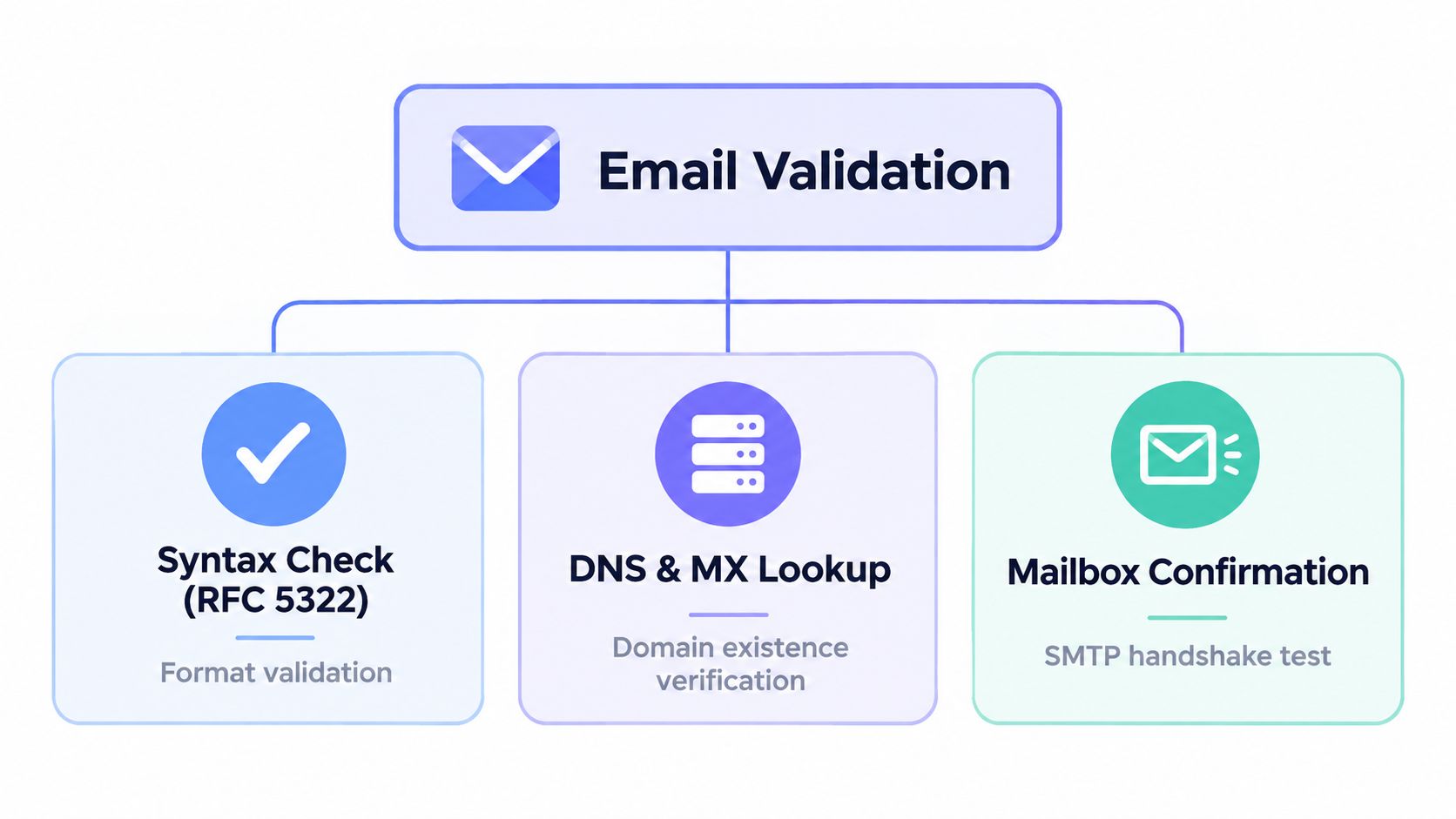
A useful validator separates its signals instead of collapsing them into a single unexplained verdict. Mailgun-focused validation workflows commonly consider address syntax, domain routing, SMTP behavior, disposable domains, role accounts, free providers, and catch-all behavior. Each check answers a different question.
Syntax is only the first filter
Syntax validation checks whether the address follows the expected email format. It catches missing domains, malformed local parts, and other input errors before your system spends time on network checks. A syntactically correct value still says nothing about whether a destination exists.
DNS routing supplies the next layer. A production validator should inspect MX records and, where appropriate, the fallback to A or AAAA records described by RFC 5321. The relevant question is whether the domain identifies a host to which SMTP delivery can be attempted.
A domain can pass this test while the recipient remains unusable. Valid routing proves that the domain has a mail path, not that person@domain.example is an active mailbox.
SMTP adds recipient-server behavior
An SMTP probe opens a session and evaluates the recipient-stage response, commonly after EHLO, MAIL FROM, and RCPT TO, without transmitting message content. RFC 5321 defines VRFY and EXPN, but receiving systems often restrict or disable them, so a verifier usually relies on the session behavior instead.
The remaining signals add context:
- Disposable-domain detection identifies temporary inbox services.
- Role-account detection flags addresses such as
postmaster,info, orsupport, which may represent teams rather than individuals. - Free-provider identification separates consumer mailbox domains from business domains.
- Catch-all assessment checks whether a domain accepts mail for many or all recipient names, making mailbox existence difficult to establish.
A strong response preserves these distinctions. Instead of returning only valid, it can expose reason codes such as syntax_failure, no_mail_route, temporary_smtp_deferral, mailbox_rejection, catch_all, disposable_domain, or role_account. That explainability lets your product code respond to the actual cause rather than guessing from one score.
Using Mailgun's Validation API in Practice
Treat validation as a synchronous dependency with failure handling, not as a magical field-level rule. A signup request usually sends the address to the provider, receives a structured result, and applies a local policy before creating the account. Your application should also set a timeout, avoid exposing provider internals to the user, and decide what happens if the verifier is temporarily unavailable.

A practical request-response flow looks like this:
- Normalize the submitted address for the checks your application supports.
- Send it to the validation endpoint over an authenticated server-side request.
- Read the verdict and individual signals, rather than relying on one boolean.
- Store only the minimum application state needed for the signup decision.
- Ask the user for confirmation when the result is uncertain.
- Continue monitoring bounces after the first message is sent.
The response shape matters more than the marketing label. A reason-coded result can distinguish a confirmed rejection from a temporary deferral or a catch-all domain. That gives engineers deterministic branches and gives support teams an explanation they can understand.
Design for latency and failure
Cached or DNS-only paths can feel close to an ordinary form submission, while a full SMTP probe introduces more network uncertainty. Don't make the browser wait indefinitely. Set a bounded timeout, treat provider errors separately from address failures, and consider an asynchronous follow-up when the risk of blocking a legitimate signup is greater than the risk of delaying confirmation.
A provider's validation endpoint should complement, not replace, the rest of your email controls. Mailgun's email list management guidance recommends combining validation with double opt-in, bounce monitoring, suppression handling, and unsubscribe controls. The resulting architecture has several layers:
- At signup: reject clear syntax and routing failures, then apply your abuse policy.
- At confirmation: require the user to prove mailbox access.
- After sending: process bounces and complaints through suppression logic.
- During messaging: honor unsubscribe decisions and avoid reactivating suppressed recipients.
For teams comparing implementations, the Mailbeam verification API reference is a useful example of the developer surface to inspect: endpoint behavior, response fields, reason codes, and error handling. The same evaluation criteria apply whether validation is part of a broader sending platform or a dedicated verification service.
Why a Valid Result Is Not the Whole Story
A technically deliverable address isn't necessarily a welcome user. Verification can indicate that a domain routes mail and that a recipient server appears to accept the address. It can't prove ownership, intent, consent, identity, or future engagement.
That distinction changes the product question. Don't ask only, “Did Mailgun mark this valid?” Ask, “What should this category do in signup, authentication, CRM, and messaging workflows?”
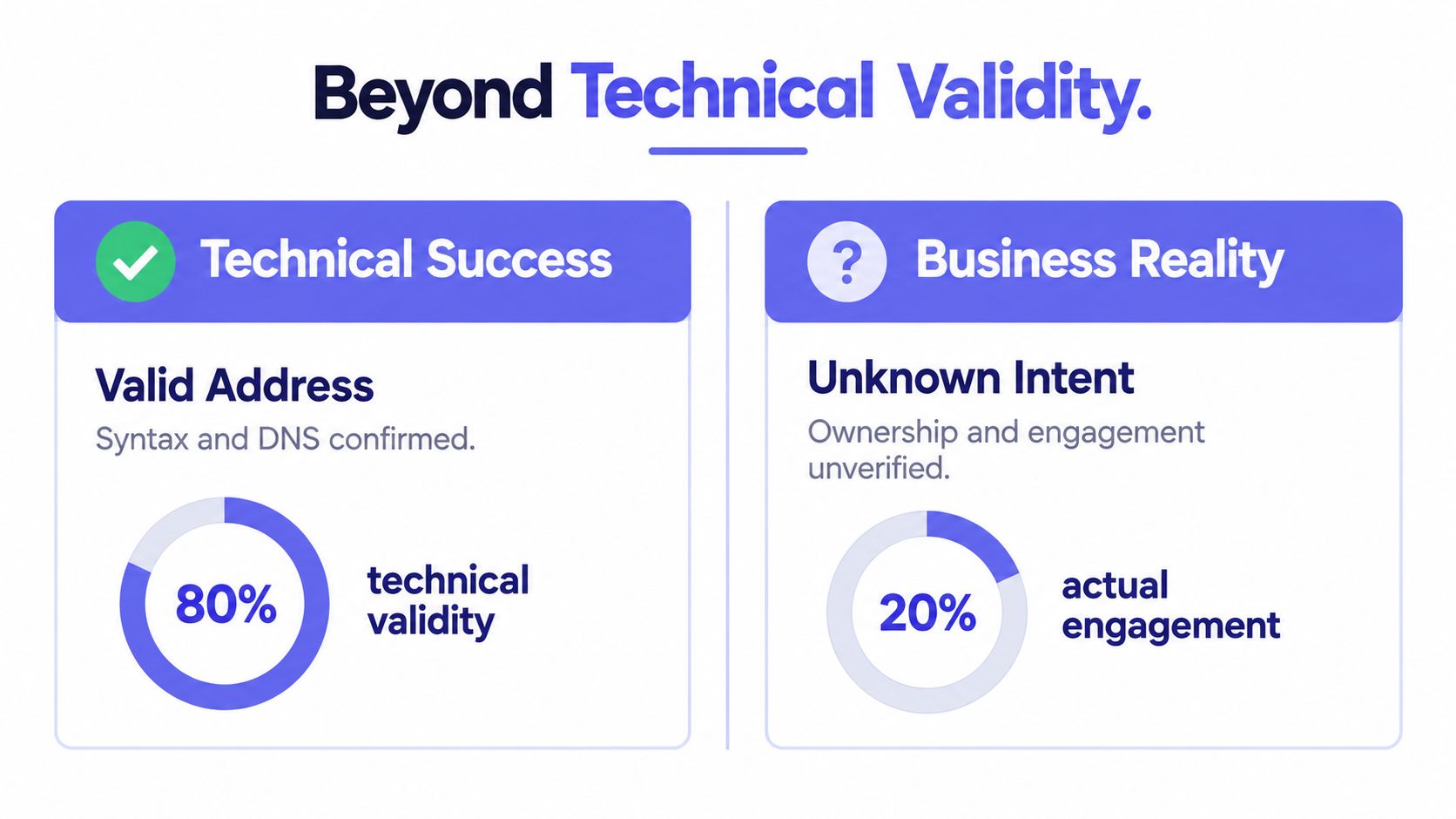
The infographic's percentages are illustrative, not verified performance data. The underlying product lesson is sound: technical validity and business engagement are separate dimensions.
A decision matrix for ambiguous results
| Result category | What the signal tells you | Sensible product action |
|---|---|---|
| Confirmed syntax or routing failure | The address cannot pass a basic delivery prerequisite | Reject the submission and show a correction message |
| Temporary SMTP deferral | The recipient server has not given a permanent answer | Retry or soft-block, rather than deleting the signup |
| Catch-all domain | The domain may accept many recipient names | Allow with double opt-in or an additional confirmation step |
| Role address | The mailbox may be shared or function-based | Warn in consumer flows, but avoid automatic rejection in B2B workflows |
| Disposable domain | The address is associated with temporary use | Block when abuse prevention is the priority, or apply stronger confirmation |
| Free-provider address | The mailbox uses a consumer email service | Usually allow unless your business policy requires a domain restriction |
| Apparent mailbox acceptance | The server appears to accept the recipient | Continue with ownership confirmation and later bounce monitoring |
SMTP probing also has limits. Receiving providers may use anti-enumeration behavior, accept messages for later filtering, or return responses that don't cleanly reveal mailbox state. Treat a probe as evidence, not as proof.
A valid result authorizes a workflow decision. It doesn't establish a relationship with the person behind the address.
Your application should keep those concepts separate in storage and messaging. A user-facing error can say that the address couldn't be verified without exposing recipient-server details. Internally, reason codes can guide retries, fraud rules, confirmation requirements, and suppression decisions.
Double opt-in remains the ownership check. Bounce monitoring is the post-send reality check. Validation belongs between them as an early technical filter, not as a replacement for either.
How Mailbeam Fits for EU-First Teams
For an EU organization, the deciding factor may not be whether two validators can inspect syntax and SMTP behavior. It may be where the processing occurs, how long raw addresses remain available, and whether the provider can document its handling clearly.
Mailbeam is an EU-first verification option with infrastructure hosted within the European Union, with stated hosting in Frankfurt. Its published design describes single verifications as ephemeral after completion, automatic deletion of batch uploads after roughly 72 hours, and a default Data Processing Addendum, as outlined in its EU data residency guidance. Those choices can simplify the architecture for teams that treat residency and retention as hard requirements, although residency alone doesn't establish GDPR compliance.
The GDPR principles still require a lawful basis, processor terms, access controls, deletion procedures, and documented retention rules. The European Commission's GDPR principles emphasize data minimisation and storage limitation. In practice, that supports ephemeral single-address processing, redacted or keyed identifiers in logs, and separate retention for operational telemetry such as latency and outcome class.
Compare the developer surface, not just the verdict
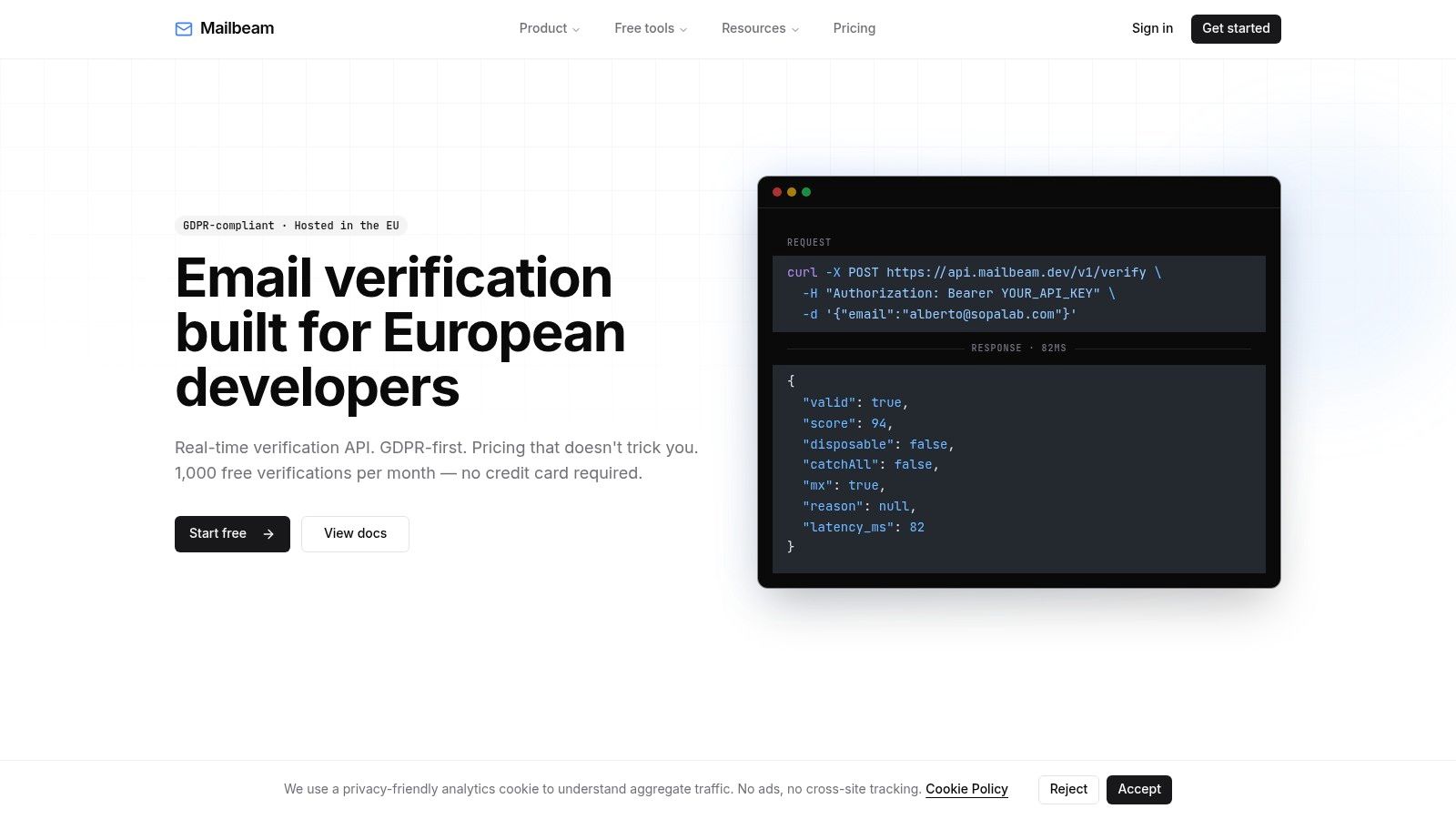
Mailbeam's stated API returns validity, a numeric score, and a machine-readable reason. Its checks cover syntax, MX records, SMTP existence, disposable domains, role addresses, free providers, and catch-all behavior. The published latency profile describes approximately 80 ms for cached or DNS-only paths and under one second for full SMTP probes, which is suited to synchronous signup flows when your timeout policy is designed carefully.
The platform also describes batch CSV processing, bulk endpoints, webhooks, API keys, monthly quotas, overage rates, optional SLA tiers, and an on-premise deployment option on upper plans. Free site utilities include an Email Verifier, Disposable Email Checker, and MX Record Checker. Planned official SDKs include Node.js, Python, PHP, Ruby, and Go.
Pricing is described as per-verification without credits or expiring bundles. That model is a distinct commercial choice, not automatically a lower-cost outcome for every workload. Teams should compare expected verification volume, batch needs, support requirements, retention terms, and deployment constraints before deciding.
The fair comparison is therefore conditional. Mailgun fits teams that want validation alongside an established email-delivery platform. An EU-first alternative fits teams for whom EU processing, retention defaults, and explicit reason codes carry more weight than keeping every email function under one provider.
Choosing the Right Verifier for Your Stack
A verifier sits on the boundary between your product and the mail system. That boundary is where many teams get tripped up. A service can tell you an address looks deliverable right now, but your application still has to decide what to do with a timeout, a catch-all domain, or a role inbox that is technically reachable but poor for account ownership.
Use four questions to turn the vendor shortlist into an engineering decision.
Where is address data processed? Ask for precise residency language, subprocessors, transfer mechanisms, and deletion terms. “Hosted in Europe” helps, but it is not the same as a contractual processing commitment.
Can the signup flow tolerate the check? Compare cached, DNS-only, and SMTP paths. Your application should treat a timeout differently from a confirmed invalid result, and it should have a fallback if the verifier is unavailable.
Can people understand the outcome? A score alone leaves support and risk teams guessing. Look for machine-readable categories that separate syntax failure, no route, temporary deferral, rejection, catch-all behavior, disposable domains, and role accounts.
Can finance predict the bill? Review per-verification pricing, quotas, overage rates, bundles, expiration rules, and optional support or SLA charges. A simple price model can still fit poorly if batch and real-time usage are billed differently.
Decision Axes for Picking an Email Validator
| Decision axis | Mailgun | EU-first alternative, Mailbeam |
|---|---|---|
| Data residency | Evaluate the processing terms, transfer language, and region settings that apply to your account | Confirm the DPA names the exact processing regions and subprocessors before you sign |
| Signup integration | Validation can sit alongside a broader email-sending and deliverability stack | Check whether the response model maps cleanly to your product rules for signup, login recovery, and account review |
| Explainability | Review which response fields and categories your implementation can rely on | Decide whether your support and fraud flows need deterministic reason codes, or whether a simpler pass/fail output is enough |
| Retention | Confirm service-specific retention, logging, and access terms | Ask for the deletion SLA in writing, including log retention, not just the default described on the site |
| Pricing model | Assess validation costs alongside the wider Mailgun account structure | Model your expected mix of live checks, batch jobs, and support needs before treating per-verification pricing as the cheaper option |
Before signing, ask the vendor to document four points in writing: the exact residency promise in the DPA, the default retention window for raw addresses and logs, the response fields returned for ambiguous outcomes, and the treatment of catch-all and role-based addresses.
Then test failure behavior in staging. Submit malformed input, a domain without a usable route, a temporary SMTP response, a catch-all domain, a disposable address, and a role account. Verify that your product shows safe user-facing messages, your backend receives stable reason codes, and retries do not create duplicate accounts.
Keep validation separate from consent and ownership. Validation filters obvious delivery problems. Double opt-in confirms control of the inbox. Bounce handling and suppressions keep teaching your system after signup.
Mailbeam provides an EU-hosted email verification API with syntax, DNS, SMTP, disposable-domain, role-account, free-provider, and catch-all checks, plus reason-coded results for signup decisions. If GDPR and EU residency are deciding factors in your email validation Mailgun evaluation, visit Mailbeam to review the API and verification tools.