
Does an EU server prove that every piece of personal data stays in Europe? Not necessarily. Data can leave through support access, monitoring tools, backups, or subprocessors even when a service's main database sits in an EU region.
Understanding EU residency requirements for personal data means tracing where information is stored, processed, and accessed, then identifying the legal basis for any transfers outside the European Economic Area (EEA). That's a different question from whether a person has the right to live in an EU country.
Table of Contents
- Data Residency Routes at a Glance
- Two Meanings of EU Residency You Might Mean
- Why EU Hosting Alone Does Not Settle Residency
- Map Every Data Flow in Email Verification
- When a Non-EEA Transfer Cannot Be Avoided
- Test Provider Claims and Choose With Confidence
Data Residency Routes at a Glance
EU hosting isn't automatically compliant. EU law doesn't require all personal data to remain physically inside the EU, but transfers outside the EEA must meet the requirements in Chapter V of the GDPR. The practical starting point is to match each data flow to its route, then check what documentation and controls that route requires.
| Route | Legal status | Extra work required | Fits when |
|---|---|---|---|
| Processing and storage inside the EEA | No transfer under Chapter V | Data-flow map, processor contracts, access controls | Default for EU-hosted verification |
| Adequacy decision under Article 45 | Transfer allowed without transfer-specific safeguards | Confirm the decision still covers the destination | The destination has an adequacy decision |
| Standard Contractual Clauses under Article 46 | Transfer allowed with contractual safeguards | Transfer impact assessment and supplementary measures where needed | A non-EEA dependency can't be avoided |
| Remote access from a third country | Counts as an international transfer | Restrict access and document safeguards | Support staff or subprocessors sit outside the EEA |
An adequacy decision is a European Commission finding that a destination provides a level of data protection equivalent to that in the EU. Where a decision covers the destination, it can allow transfers without additional transfer-specific safeguards. Ordinary GDPR duties still apply, and the decision must cover the destination you're using.
If there's no applicable adequacy decision, an organization may use Standard Contractual Clauses (SCCs), which are standard contract terms for protecting personal data transferred internationally. SCCs don't settle the question by themselves. The organization must assess the destination's laws and practices, document a transfer impact assessment, and add supplementary safeguards if the assessment shows they're needed. The European Commission adopted modernized SCCs on 4 June 2021, incorporating requirements associated with the Court of Justice's 16 July 2020 Schrems II judgment, as described in the European Commission's guidance on Standard Contractual Clauses.
How to use the table
Start with the vendor's actual processing, not its marketing description. Find out where it stores data, where people and systems can access it, and where it sends information next. Then identify the matching route and collect the relevant evidence.
For example, an EU-hosted service may still involve a transfer if a support team outside the EEA can open personal data in its logs. The table is a decision aid, not a certification: you still need to assess the full setup, including processor contracts, security, and people's rights. For a practical reference point when comparing infrastructure options, see this EU-hosted email verification service. Use the row that matches each destination and access path, then record the details in a data-flow map.
Two Meanings of EU Residency You Might Mean
Searches for EU residency requirements often mix a person's right to live in another Member State with the location and handling of personal data. The distinction matters: a relocation checklist answers questions about a person's legal status, while a data-residency review examines information held about people.
| Stay length or status | Requirement | Notes |
|---|---|---|
| Up to three months | Valid identity card or passport | The host country may require a presence report but generally can't require a residence permit |
| More than three months | Sufficient resources and comprehensive sickness insurance for economically inactive citizens | Registration may be required, and procedures differ by country |
| Five years of uninterrupted legal residence | Permanent right of residence | No longer conditional on employment, resources, or insurance |
These thresholds concern EU citizens exercising free-movement rights, not non-EU nationals seeking immigration permission. For an EU citizen visiting another Member State for up to three months, a valid identity document or passport is generally enough. A host country may ask the person to report their presence, but it generally can't require a residence permit for that initial period.
After three months, the conditions depend on the person's situation. Workers, self-employed people, and some students have rights under rules that relate to their status. An economically inactive citizen needs sufficient resources and full sickness insurance, so they won't become an unreasonable burden on the host country's social-assistance system. A third party may provide resources, and registration procedures differ between Member States.
When permanent residence applies
After five years of uninterrupted legal residence, an EU citizen obtains a permanent right of residence. That right is no longer conditional on employment, resources, or sickness insurance, and it can generally be lost only after more than two consecutive years outside the host country. These citizen-residence rules are summarized in the European Parliament's overview of EU citizens' rights.
The practical question isn't, “Do I need EU residency?” Ask instead: Is the issue a person's right to live in a country, or the handling of information about that person? If it's the second, focus on the data's storage, processing, access, and transfer arrangements.
Why EU Hosting Alone Does Not Settle Residency
A verification service can run its main server in Frankfurt and still send personal data outside the EEA. Support engineers in another country might open logs, a monitoring subprocessor might receive telemetry, or encryption keys might be administered from abroad. The server's location describes only part of the service.
Under European data-transfer guidance, storing personal data in a non-EEA cloud environment or allowing remote access from a third country can count as a transfer. A location label doesn't answer whether staff, systems, and vendors elsewhere can reach the information. The European Data Protection Board's recommendations on supplementary measures treat third-country access and non-EEA storage as transfer issues that require evaluation.
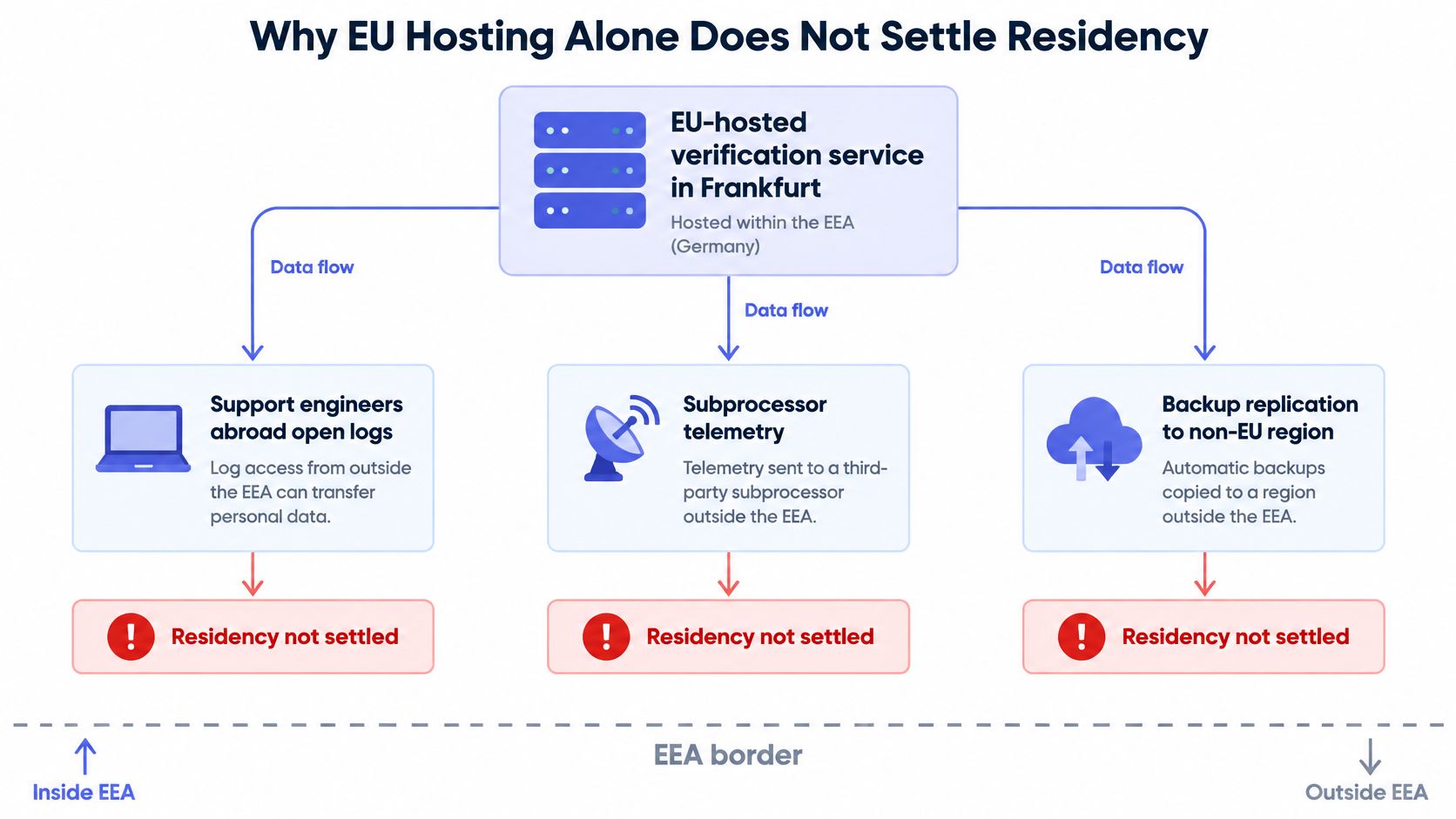
Email verification makes this easy to miss because the information may be transient. An email address can be personal data when it identifies or relates to a person. That means the assessment should include not only a primary database, but also SMTP probe traffic, API request payloads, uploaded CSV files, and logs created while a request is handled.
Apply one test at every touchpoint
For each system, person, or vendor that touches personal data, ask:
- Who can access it? Include support personnel, administrators, and service providers.
- From where can they access it? Record the location of both the system and the person or service connecting to it.
- Under what safeguard? Identify the applicable transfer mechanism and the controls that support it.
Then collect evidence that reflects the actual setup: region configurations, access logs, subprocessor commitments, deletion schedules, and data-processing terms. A data-flow map should include primary storage, backups, logging and monitoring, administrator access, and onward transfers. If you're evaluating who will coordinate those checks across multiple cloud vendors, this cloud services brokerage buyer guide offers useful context for structuring vendor review.
One EU region is weak evidence of residency on its own. The stronger test is whether every route for personal data is visible, controlled, and supported by the right documentation.
Map Every Data Flow in Email Verification
A useful data-flow map follows each kind of information through the service, rather than describing the service as one box. For every row below, ask where the data is stored or processed, who can reach it from outside the EEA, and how long it's kept.
| Data element | Residency question | Evidence to keep |
|---|---|---|
| Primary storage | Stored only in EEA regions? | Region configuration and storage location record |
| Backups and disaster recovery | Replicated outside the EEA? | Backup region settings and failover plan |
| Logs and monitoring | Shipped to a non-EEA observability tool? | Subprocessor list and data-flow diagram |
| SMTP probe traffic | Checks run from EEA infrastructure? | Network configuration and processing terms |
| Uploaded CSV batches | Stored and deleted within the EEA? | Retention schedule and deletion confirmation |
| Support and administrator access | Accessed from outside the EEA? | Access policy and access logs |
| Subprocessors | Each one located in the EEA or covered by a transfer mechanism? | Current subprocessor list with locations |
| Encryption keys | Administered from inside the EEA? | Key management description |
| Error and fallback paths | Retries sent to other regions? | Architecture documentation |
The residency question column is designed to expose gaps that a server-region statement won't answer. For example, a vendor may store uploaded CSV files in the EEA but route error reports to an observability platform elsewhere. Or a normal request may stay in Europe while a retry or disaster-recovery process sends data to another region.
The evidence column tells you what to request or retain to support your review. A region setting is more useful when you can file a configuration record. A statement about support access is more useful when it's backed by an access policy and logs. For subprocessors, keep a current list with locations, not just a list of company names.
Practical rule: If you can't answer one of the three questions for a row, record the gap as a finding and assign someone to resolve it. Don't treat missing information as proof that no transfer occurs.
Copy the table into a spreadsheet, complete it for each candidate provider, and file the evidence with your vendor review. Update the map when the service changes its architecture, subprocessors, or access arrangements.
When a Non-EEA Transfer Cannot Be Avoided
If personal data must leave the EEA, the organization needs a valid transfer mechanism and safeguards that maintain the level of protection required under EU law. Encryption helps protect data, but it does not, by itself, authorize an international transfer.
Start by checking whether an adequacy decision covers the destination. If so, it can permit the transfer without additional transfer-specific safeguards, while ordinary GDPR duties still apply. If there is no adequacy decision, Article 46 Standard Contractual Clauses (SCCs) may provide a contractual basis. The organization must still assess the destination's laws and whether the contractual commitments work in practice. If they do not, supplementary technical, contractual, or organizational measures are needed. The European Data Protection Board's guidance on international transfers explains how these measures work together.
Build a reviewable transfer file
For each unavoidable dependency, document the route and its safeguards:
- Document the transfer impact assessment. Explain why the transfer occurs and evaluate the destination's laws and practices.
- Name the data and access paths. List the exact fields involved, the systems that handle them, and the people or services that can access them.
- Reduce exposure. Send only the fields needed for the task and set a short retention period.
- Apply layered safeguards. Encrypt data in transit and at rest, and control encryption keys independently where feasible. Add contractual and organizational measures that address identified risks.
- Maintain a transfer register. Record which vendor relies on an adequacy decision or SCCs, along with the supporting assessment and safeguards.
Avoiding the transfer remains the simpler design when a practical EEA-only setup is available. A reviewable transfer file lets someone trace each transferred field to its legal basis and the safeguards that apply. For legal context on cross-border mechanisms, consult By Design Law Firm's privacy counsel. For email workflows, GDPR email compliance offers a relevant resource.
Test Provider Claims and Choose With Confidence
Treat a vendor's residency statement as a starting point to verify, not as the conclusion of your review. A region name in marketing material can't tell you where logs go, who can access them, or what happens when a request fails.
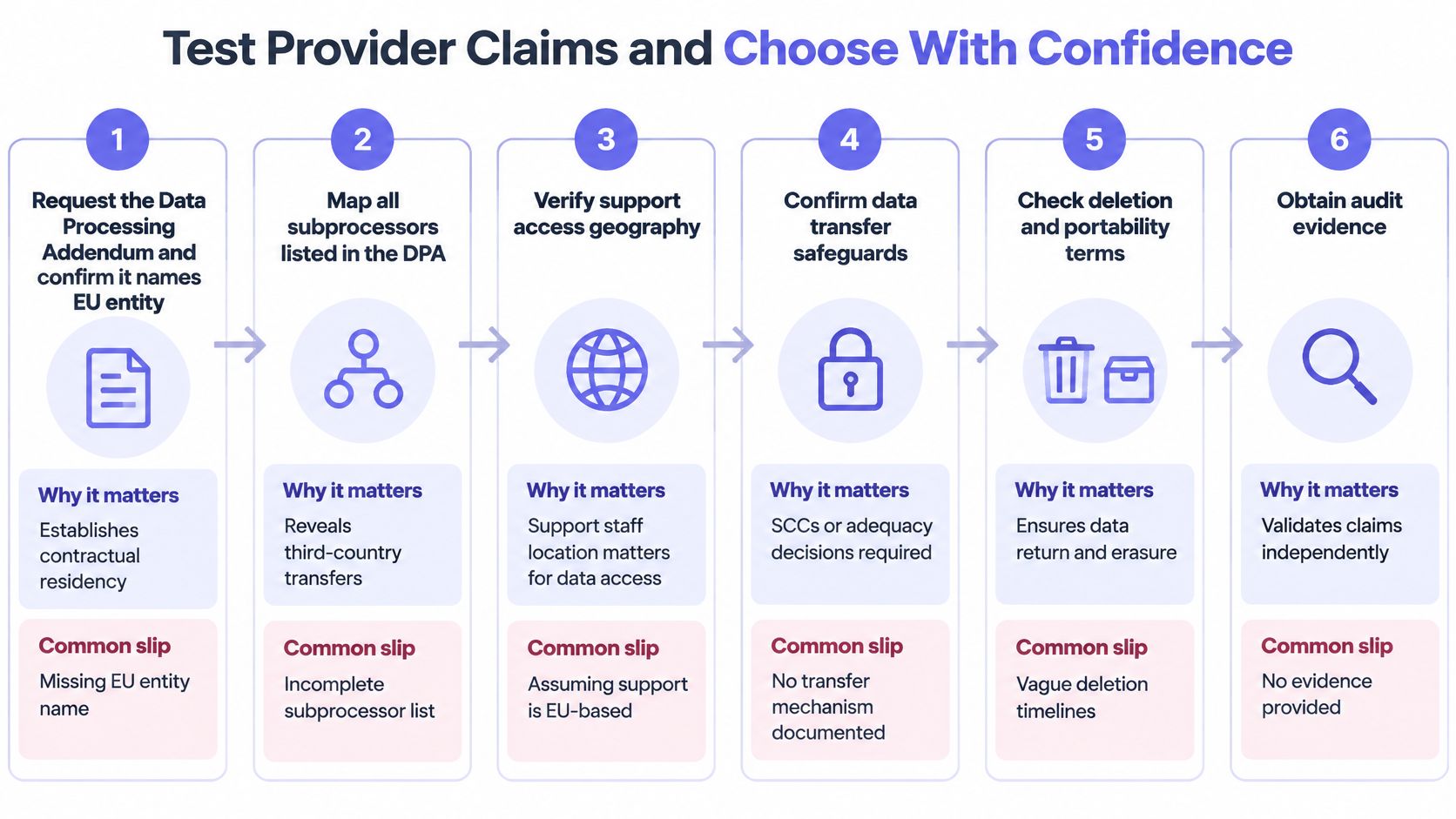
Use these six checks to turn broad claims into evidence:
- Request the Data Processing Addendum. Confirm that the agreement identifies the processing arrangement and names EU processing as the default. The common slip is accepting a region name from a sales page without checking what the contract commits the provider to do.
- Get the subprocessor list with locations. Ask where each entity operates and what transfer basis applies if an entity is outside the EEA. A list without locations leaves a key part of the processing chain unknown.
- Confirm the default processing region in writing. Check that requests are assigned to the stated region by default and can't be routed elsewhere through an ordinary configuration or fallback.
- Check support access and logs. Find out where support staff can connect from, what logs they can see, and where monitoring data is stored. Don't assume support access stays in the same region as the production service.
- Ask for the deletion timeline. Get separate answers for single requests and batch uploads, and check how the provider confirms deletion.
- Compare the answers with your map. Record inconsistencies as findings and seek evidence that closes each gap. A confident verbal answer isn't the same as a documented control.
Turn statements into evidence
Mailbeam states that no data crosses to the US, that email addresses aren't routed through US data centers during verification, and that addresses are discarded once verified, with no EU dataset kept in a third-party system. Treat those as claims to test through the same review: compare them with the processing terms, architecture, access policies, and deletion evidence. Mailbeam's real-time and batch verification run on infrastructure in Germany, and addresses don't leave the EU during processing.
A strong review connects each checklist row to a signed document or operational record. For an engineering team comparing implementation options, Mailbeam's email verification API overview describes an API and web tools designed for EU-hosted verification. Use your own completed map and contract review to decide whether a provider's setup fits your requirements.
Finish the review with a dated action list. Schedule the assessment, assign an owner to each checklist row, and set a recheck date whenever a provider changes its subprocessors. That gives the team a clear way to revisit the decision when the processing chain changes.
If your team needs email verification within an EU-first data-flow design, Mailbeam offers real-time and batch verification on infrastructure in Germany. Review your requirements, map the data each workflow handles, and visit Mailbeam to see whether its API fits your signup or list-maintenance process.